
Planning guides
Georgian Wedding Traditions in 2026: Crowning, Supra, Tamada and Dances (Georgia, the Country)
Updated 25 October 202623 min readPrices and facts checked: October 2026
A Georgian wedding is a church crowning (jvristsera), a supra led by a tamada with a fixed run of toasts, and the Kartuli dance, but only civil registration makes it legal. Here is what each tradition is, what it costs in 2026 and how to include it in your wedding.
On this page+
- Which venue fits a Georgian-style wedding?
- What happens at a Georgian wedding, from engagement to the last toast?
- Which Georgian traditions can you include, and what does each cost in 2026?
- Can a foreign couple have an Orthodox church wedding (jvristsera) in Georgia?
- How does civil registration work in Batumi?
- What is a tamada, and how do the wedding toasts go?
- What is served at a Georgian wedding supra, and what does it cost per guest?
- Which dances and songs belong at a Georgian wedding, and who performs them?
- What is special about a wedding in Adjara and the Adjara mountains?
- How do your guests get to a mountain wedding in Adjara?
- What if it rains at a mountain wedding, and what else should you plan for?
- What should guests wear and give at a Georgian wedding?
- How do you plan a Georgian-style wedding step by step?
- What do foreign couples get wrong about Georgian wedding traditions?
- Questions people ask
Map of the places in this guide
Zoom with + and - or by pinching. Click the map first to zoom with the mouse wheel.
- 1Glamping Tago
- 2Ajara Banquet Hall
- 3Teatri (Tsiskvili group), Tbilisi
- 4Holy Trinity Cathedral of Tbilisi (Sameba)
- 5Jvari Monastery
- 6Holy Mother Virgin Nativity Cathedral, Batumi
- 7St. Nicolas Church, Batumi
- 8Sameba Church, Batumi
- 9Batumi Central Mosque (Orta Jame)
- 10Batumi's Public Service Hall
- 11Batumi Summer Theater
- 12Skhalta Monastery
- Batumi airport to Glamping Tago by car · 87.4 km
- Glamping Tago to Skhalta Monastery by car · 9.5 km
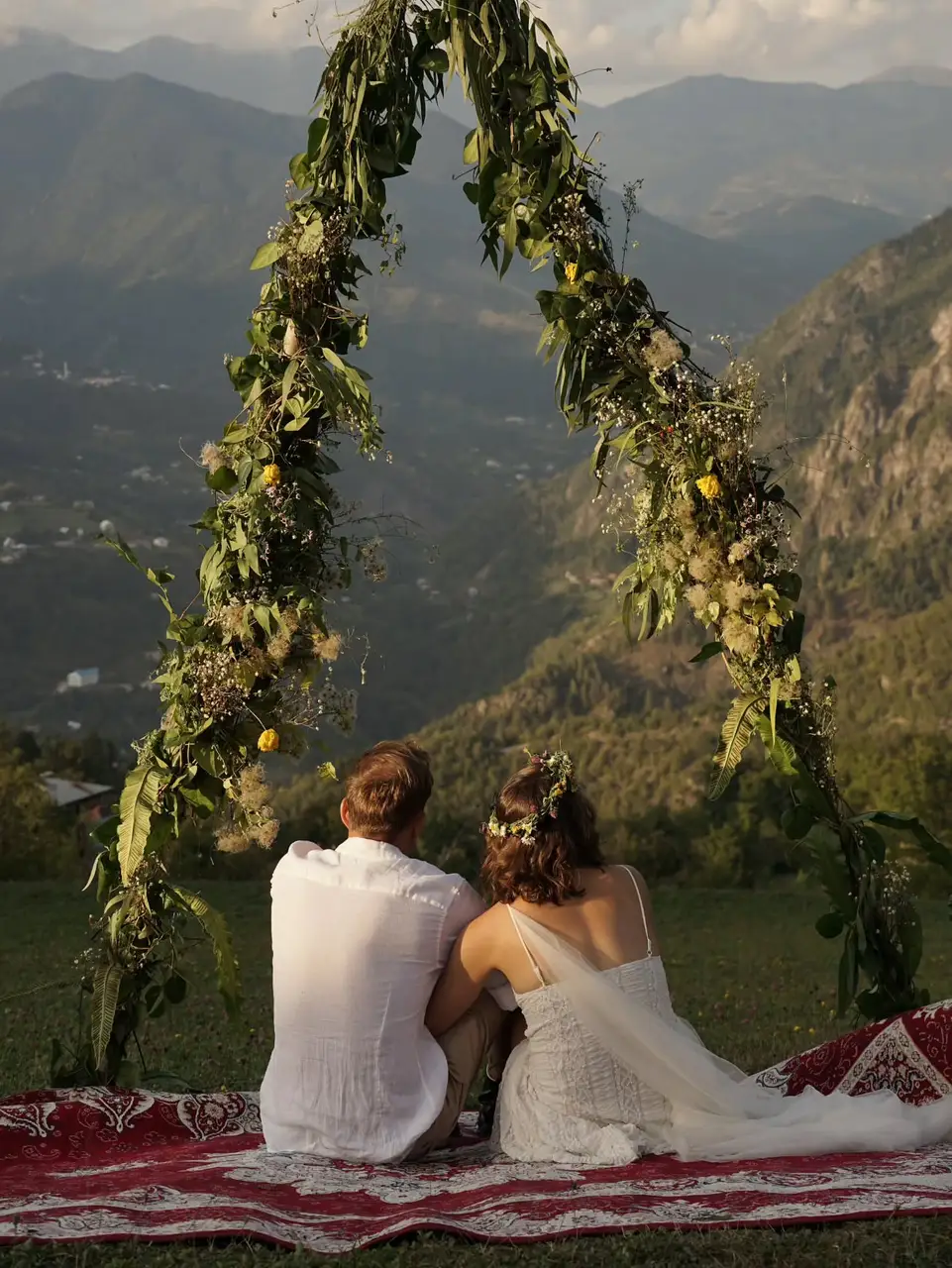
A Georgian wedding has three parts that matter: the legal registration, the church crowning (jvristsera) and the supra, a long feast run by a toastmaster called the tamada, with the couple's Kartuli dance somewhere in the middle. Only the first one makes you married in law. The other two are where the traditions live, and a foreign couple can include every one of them at a destination wedding in Georgia.
Which venue fits a Georgian-style wedding?
It depends on what kind of Georgian wedding you want. A traditional local wedding is one evening for a few hundred guests in a banquet hall; a destination wedding with Georgian traditions is usually around 30 guests who fly in and want to spend the whole weekend together. These are the facts that decide it:
| Venue | Just your wedding? | Guests sleep on site | Ceremony outdoors in nature | Private for 2-3 days | Nearest airport | Georgian music and dance |
|---|---|---|---|---|---|---|
| Glamping Tago (ours), Adjara mountains | Yes, the whole camp, one wedding at a time | Everyone sleeps on site, 33 beds on the ridge | Mountain meadow at 1,200 m | Yes, two nights minimum | Batumi, 87 km, about 2 h | Adjaran folk trio 900 GEL, or bring your own dancers |
| Ajara Banquet Hall, Batumi | A city banquet hall | No, guests stay in Batumi hotels | No, indoor hall | No, one evening | Batumi, 8 km, 15 min | Bring your own band and dancers |
| Teatri, Tbilisi | A theatre-restaurant that takes wedding bookings | No | No, indoor theatre hall | No, one evening | Tbilisi, 27 km, 35 min | Its own stage and the Georgian Show with Sukhishvili dancers |
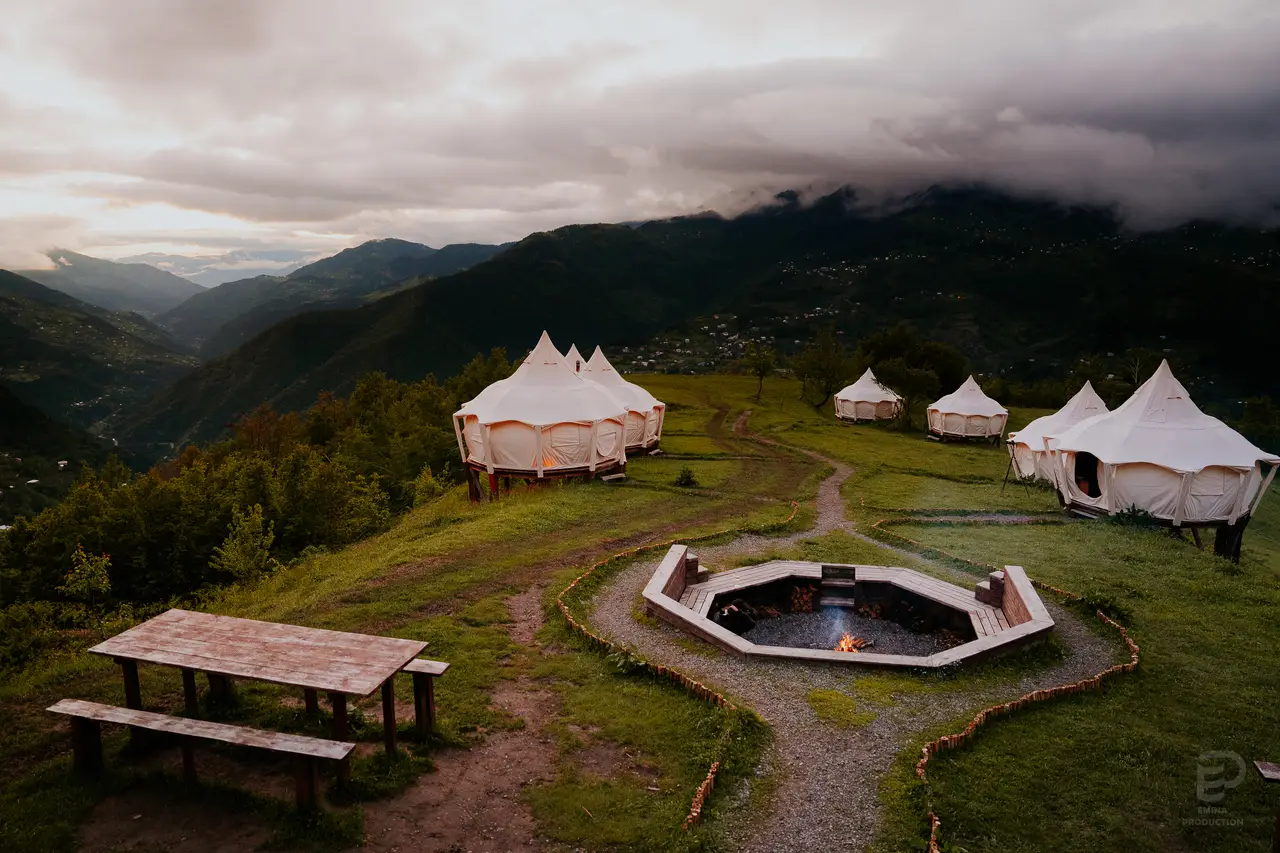
Glamping Tago (our venue), Adjara
- Where: the ridge above Village Tago, Khulo municipality, mountainous Adjara, 1,200 m
- From the airport: 87.4 km from Batumi airport, about 2 hours; the last stretch from Khulo is a 4x4 road
- Guests: weddings of about 30 guests and retreats of up to 30 people; the whole place belongs to one group and everyone sleeps on site, in 12 Lotus Belle tents and a nine-bed dome
- Price from (2026): 3,258 GEL a night for the whole camp in April, 6,035 GEL in July and August
- Season: open April to the end of October; weddings May to mid-October
A wedding here books the whole camp, so the ceremony meadow, the 150 m² sailcloth event tent on its deck, the yurt and the fire circle are yours for the weekend. The traditions fit the place: a Mountain Supra dinner at 85 GEL a guest, an Adjaran folk ensemble of three singers with a panduri for 900 GEL plus 50 GEL transfer, and a civil registrar who comes up to marry you on site for 255 GEL. Meals are in Yurtalicious, the yurt restaurant on site, and the kitchen is vegetarian, with a BBQ live station at 45 GEL a guest and meat khinkali on the supra at 15 GEL for groups who want meat. Everything with prices is on our practical guide for organizers.
In our Google reviews guests talk about the view first, then the staff, the food and how romantic the ridge is, and for a supra that runs late into the night that mix is the point.
Ajara Banquet Hall, Batumi
- Where: 7a Sulkhan-Saba Orbeliani St, central Batumi
- From the airport: 8.2 km, about 15 minutes
- Hours: open daily from 10:00 to 01:00 (to midnight on Sundays)
- Season: all year
This is the format most local Adjaran weddings use: one long evening in a city hall, with the tamada, the band and the dancing under one roof. It works on any date of the year, including winter. It does not give you nature or a weekend together, and in Batumi the wedding costs run higher than elsewhere in Georgia, because hosts and show teams often travel from Tbilisi.
Teatri, Tbilisi
- Where: 99 Akaki Beliashvili St, Tbilisi
- From the airport: 26.6 km from Tbilisi airport, about 35 minutes
- Bookings: weddings, corporate and private events by phone
- Season: all year
Teatri is a theatre-restaurant of the Tsiskvili group with its own stage. Its Georgian Show brings polyphonic songs such as Chakrulo and Mravalzhamieri and the dancers of the Sukhishvili national ballet together over a Georgian dinner, so it is the Tbilisi answer for a couple who want a staged folk performance at the wedding dinner.
What happens at a Georgian wedding, from engagement to the last toast?
A traditional Georgian wedding runs in three stages: machankloba (the matchmaking), nishnoba (the engagement) and kortsili (the wedding itself), as Advantour sets out. On the day itself there is a church crowning, a car procession and a supra that goes on for hours, and it is big: guest lists of 300 to 500 people are standard, not exceptional, according to TripRoadwayPlanner, and in rural areas whole villages come.
The old wedding language has a role for everyone. The bride is dedopali (queen) and the groom mepe (king); the mejvare is the best man, who later becomes godparent to the first child; the makari are the groom's party, and a makharobeli carries the good news ahead, as the ethnographic notes on Dzeglebi.ge list them.
A typical wedding day today goes like this:
- The church crowning. Relatives and friends gather at the church for the jvristsera, which takes 1 to 1.5 hours.
- The car procession. A convoy of cars follows the couple through town with horns going.
- Arrival at the groom's house or the hall. The bride breaks a plate at the threshold, tastes honey and walnuts and touches the hearth; in some families the groom releases a white bird.
- The ring in the wine. The groom drops the ring into a glass of wine, both drink, and he gives it to her.
- The supra. The tamada opens the feast with the first toast and leads it for the rest of the night.
- The dancing. Young relatives of the couple dance Kartuli and other ceremonial dances; by late evening everyone is on the floor.
There are small superstitions too. The groom should not see the bride before the wedding, and the bride should not cry on the day, which the old beliefs hold to be a bad omen, as Daily Trust notes.
Which Georgian traditions can you include, and what does each cost in 2026?
Every tradition below works at a destination wedding with about 30 guests. The table gives the price and how far ahead to arrange it; the sections after it explain each one.
2026 prices
| Tradition | What it is | How to include it | 2026 cost | Arrange |
|---|---|---|---|---|
| Civil registration | The legal marriage | At a Public Service Hall, or a registrar at your venue | Free without a ceremony; 75 GEL with a ceremony at a Public Service Hall; 135-225 GEL at a Wedding House; 255 GEL for a registrar at your own venue | The day you apply, or any date within 2 months |
| Church crowning (jvristsera) | The Orthodox rite with crowns, about 1-1.5 h | Through the parish priest, or an agency | Agency organisation from US$250 (Lotus Wedding); church package US$1,190 (WedInGeorgia) | Agree the date with the priest before you book anything else |
| Tamada | The toastmaster who leads the supra | A family friend, or a professional | 300-600 GEL for the evening (Georgia Journeys); US$400-800 for a tamada or bilingual host (Eventive) | Weeks ahead |
| Bilingual or Russian-speaking host (MC) | A host who runs the toasts in two languages | Through our vendor guide | 2026 prices from 7 hosts working in Batumi and Adjara: entry packages mostly 1,000-1,900 GEL, top packages about 3,000 GEL, travel to Tago about 150 GEL | With your other vendors |
| Supra dinner | The shared feast | At your venue | 40-70 GEL a guest for a simple supra, 90-140 mid-range, 180-280 at wedding scale with an experienced tamada; Mountain Supra at Glamping Tago 85 GEL | Final food count 7 days before at Glamping Tago |
| Georgian folk music | Polyphonic singers, panduri, a band | Hire a trio or a band | Adjaran folk trio 900 GEL plus 50 GEL transfer; two Georgian musicians 800 GEL; a full band up to 2,500 GEL | With your other vendors |
| Kartuli lesson for the couple | A private Georgian dance class | 90-minute masterclass in Batumi or Tbilisi | 270 GEL for one person, 290 GEL for two, 145 GEL for each extra person, with transport to the studio and a buffet (Yolo) | At least 3 days ahead |
| Folk dance show for your guests | A public show by the Batumi state ensemble | Take your guests the night before | Tickets 20-60 GEL, under-6s free (InfoBatumi) | June to late July only |
Planning this yourself? See how Glamping Tago can host it
Can a foreign couple have an Orthodox church wedding (jvristsera) in Georgia?
Usually yes, when both of you are baptised Orthodox Christians and the two witnesses who hold the crowns are Orthodox too. A Catholic or Protestant partner is sometimes accepted with a special blessing, which is the church hierarchy's decision and takes months to arrange, as Tourism Center explains; some foreigners are baptised before the wedding instead. Tbilisi also has Catholic and Armenian churches.
The crowning has no legal force on its own. Since civil registration became the law in 1920, only a registered marriage counts in Georgia, so you register first and bring the civil marriage certificate to the church. The Public Service Development Agency registers marriages at a Wedding House, at its own offices or at a Public Service Hall, in front of two adult witnesses. A foreign citizen brings a document proving legal stay in Georgia, and every foreign document except the passport needs an apostille and a notarised Georgian translation.
The rite itself has no spoken Western-style vows. After prayers and Gospel readings the priest places crowns on the couple's heads, the rings are exchanged, the couple share a cup of wine and are led three times around the lectern. For the church you need:
- passports for both of you;
- baptism certificates;
- the civil marriage certificate;
- your rings;
- two witnesses of the same faith.
Most services are in Georgian, and many priests turn down couples who do not understand it. Tbilisi has Russian Orthodox churches, and some parishes serve in Church Slavonic.
Dress for church is strict. Women cover hair, shoulders and knees, men wear long trousers and sleeves and take their hats off. Sameba, Svetitskhoveli, Jvari and Bodbe keep scarves to borrow at the door; small monasteries may not, as The Georgian Guide notes.
Which churches do couples choose?
In Tbilisi and Mtskheta the churches most couples choose are Sameba (Holy Trinity), Metekhi, Anchiskhati, Sioni, Jvari and Svetitskhoveli; in Kakheti it is Bodbe near Sighnaghi. In Batumi the cathedral of the Batumi and Lazeti eparchy holds weddings, and in the Adjara mountains the oldest church is Skhalta, 9.5 km from our camp.
The Holy Trinity Cathedral (Sameba) is the classic choice for foreign couples in Tbilisi: a large complex with a bell tower, a monastery and a seminary. It is open daily from 7:00, to 22:00 on weekdays and 21:00 at weekends, and its interior is plain stone without frescoes. Sunday from 10:00 to 14:00 is its busiest time, so a weekday crowning is calmer.
Jvari stands on the hill above Mtskheta, the old capital, and is a classic wedding church. It is open daily from 9:30 to 17:30, busiest on Sundays and late on Saturday mornings and quietest on Mondays, so a weekday crowning keeps the tour groups out of your photos. Agree the date with the priest before you book anything else.
In Batumi the Cathedral of the Holy Mother of God, built from 1898 to 1903 as a Catholic church, is now the seat of the bishop of Batumi and Lazeti and holds weddings. It has no public phone: ask the priests at the cathedral in person, or let an agency such as Lotus Wedding, which works in Batumi, arrange it.
Two smaller Batumi churches are often suggested. St Nicholas was built by the city's Greek community in 1865-1871 and is small inside; ask the priest before you plan a wedding video there. Sameba on the hill above the city has the view over Batumi and the mountains, a strict dress code and a rough road up. Neither has a public phone, so you arrange a crowning in person with the priest.
Can you have a nikah in Georgia?
Yes. An imam performs the nikah with Quran recitation, mutual consent and witnesses, and like a church crowning it has no legal force, so couples combine it with civil registration, as Wedding in Georgia does for its clients. Orta Jame, Batumi's 19th-century central mosque, is full for Friday prayers; the contact is the Administration of All Muslims of Georgia.
How does civil registration work in Batumi?
In Batumi you register at the Public Service Hall, open Monday to Friday, 9:00 to 18:00; Batumi's No. 1 Public Service Hall also holds ceremonies on Saturday and Sunday, 10:00 to 17:00. Registration is free without a ceremony and 75 GEL with one, and a registrar who comes to your own venue costs 255 GEL, according to the Tbilisi Expat guide. You need no residency and there is no waiting period: you both sign the application, bring passports, proof of legal stay and two adult witnesses with ID, and register the same day or on any date within the 2 months the application stays valid.
What is a tamada, and how do the wedding toasts go?
The tamada is the toastmaster of the supra. He proposes every toast, sets the order and the pace, and passes the word to a guest who wants to speak, which is called alaverdi. At a wedding the family chooses him weeks ahead: someone eloquent and sociable, who can sing and dance a little and drinks moderately. At a large wedding he names vice-tamadas to lead the other tables, and a merikipe sits next to him and pours his wine, because the tamada never pours his own. In Georgian practice the tamada is a man, and nobody interrupts him.
The toasts follow a loose order:
- To peace and to God.
- To Georgia.
- To the couple.
- To the parents.
- To the departed.
- To the children and the new life ahead.
- To friendship.
- Kvelatsminda (to all saints), and a last toast to the tamada.
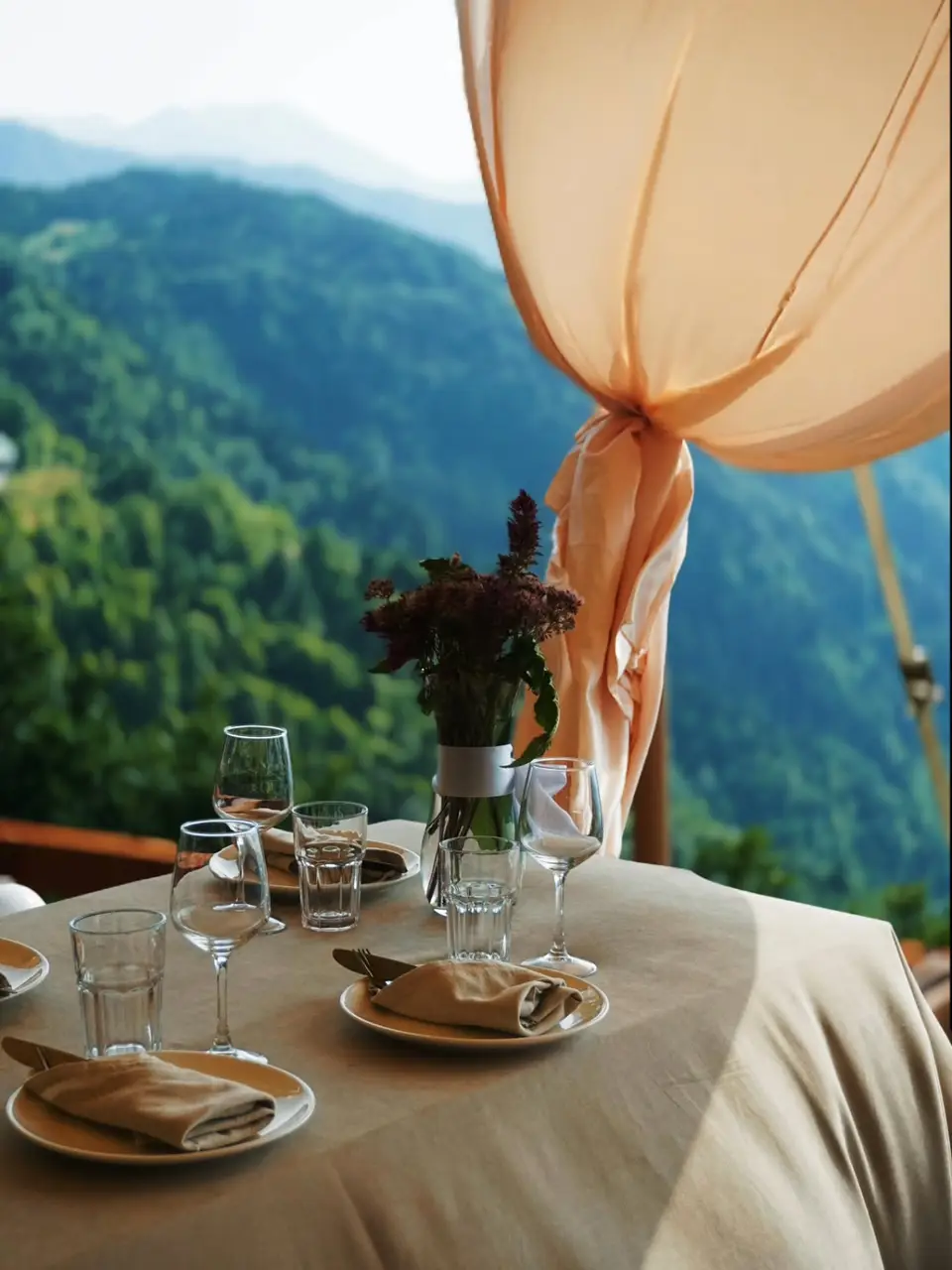
Every place at the table has a small wine glass and a bigger glass for soft drinks. Guests raise their glasses while the tamada speaks and drink when the toast ends; gaumarjos ("to victory") is the word, and "bolomde" means to the bottom of the glass. A sip is enough, and a guest who does not drink toasts with water or lemonade. A kantsi, the drinking horn, cannot be put down until it is empty, so it comes out for one toast, not all of them, as The Georgian Guide explains. Mravalzhamieri ("many years"), sung in three voices, is the classic toasting song.
What is served at a Georgian wedding supra, and what does it cost per guest?
A supra is shared food on the table, not plated courses, which makes it much cheaper than a European wedding dinner. A wedding supra lasts four to six hours, and often runs into the early morning. The Georgian supra has been on Georgia's national list of intangible cultural heritage since 2017, by Order No. 2/20; it is Georgian polyphony and qvevri wine, not the supra, that are on the UNESCO list.
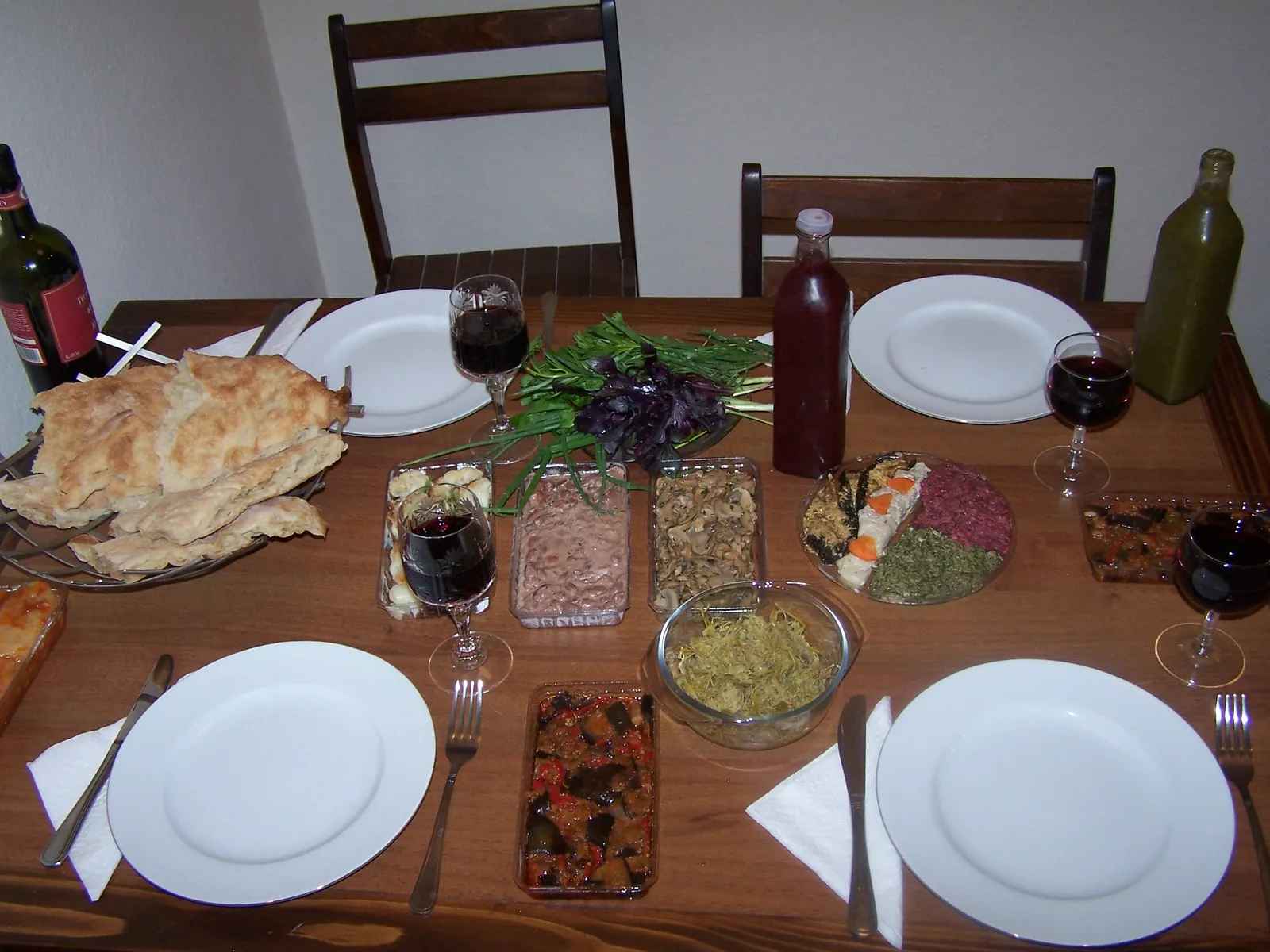
The dishes change by region. In western Georgia the wedding table has pork, kupati and chicken, Guria adds ghomi and satsivi, Samegrelo gebzhalia and elarji, and Kakheti khashlama and guda cheese; everywhere there is a cheese board of Imeretian cheese and sulguni, according to the Georgian National Tourism Administration. Eastern Georgia bakes a wedding bread called jvari, of milk and sugar with dough birds on top, days before. In Adjara the wedding dessert is majuni, and the local table has borano (cheese in browned butter), chirbuli and sinori.
For an international guest list, planners such as Miel Wedding keep the dishes Georgian and change the format instead: everything on the table at once in the traditional way, or plated service, a buffet or food stations. Fresh herbs (tarragon, coriander, basil and spring onions) are always on the table, and pkhali, lobio, ajapsandali and the cheeses give a vegetarian guest more than enough for a whole feast.
At Glamping Tago the Mountain Supra is three generous vegetarian courses at 85 GEL a guest, for a wedding of about 30 guests, or up to about 100 when the village guesthouses are used, with homemade lemonade, compote and water included. Meat khinkali on the supra adds 15 GEL a guest and the BBQ live station 45 GEL, cooked for the whole group. You can bring your own wine or chacha for 15 GEL corkage a bottle, and our own drinks are 10% off for weddings.
Which dances and songs belong at a Georgian wedding, and who performs them?
Kartuli is the couple's wedding dance. The man never touches the woman and keeps his upper body still while she glides with her eyes down, and newlyweds are expected to dance it whether they know the steps or not, as Wikipedia describes it. Couples who cannot dance take a few private lessons before the wedding.
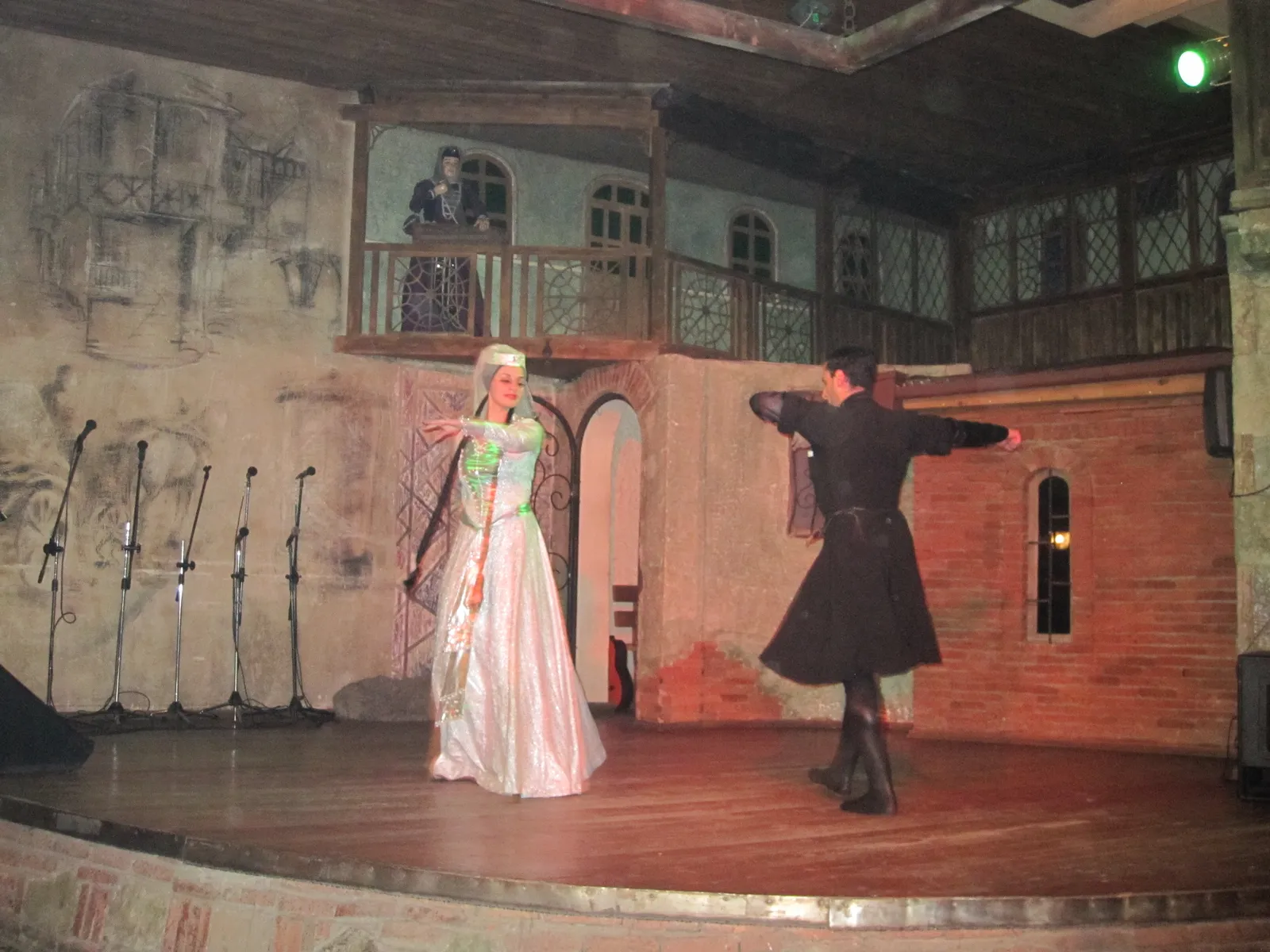
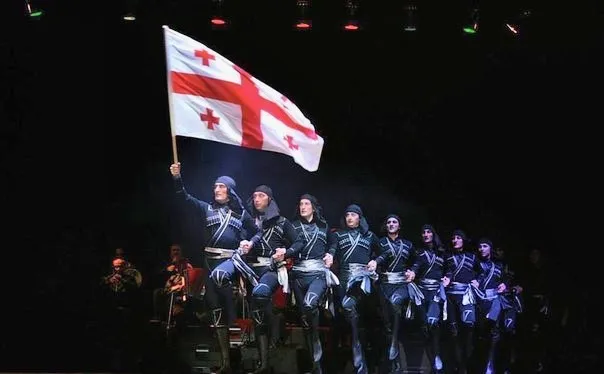
Two dances come from Adjara. Acharuli is a playful flirtation between men and women in red costumes, much less formal than Kartuli. Khorumi is a war dance in four episodes (scouting, the enemy approaches, battle and victory) for 30 to 40 men, on Georgia's national heritage list since 2013. Gandagana is an Adjaran folk song and dance.
The music is Georgian polyphony, singing in three voices, which UNESCO inscribed on its intangible heritage list in 2008. Couples often ask for particular songs, Suliko among them, so send your list with the programme.
How to book them:
- At Glamping Tago: an Adjaran folk ensemble of three singers with a panduri is 900 GEL plus 50 GEL transfer, two Georgian musicians 800 GEL for the evening, and a full party band with its own sound up to 2,500 GEL.
- In Batumi: the Batumi state dance ensemble plays public shows at the Summer Theater on the Old Boulevard in summer (in 2026 from 4 June to 23 July), with tickets from 20 to 60 GEL. It is a show to take your guests to the evening before, not a band for hire.
- In Tbilisi: the Sukhishvili national ballet dances in Teatri's Georgian Show, and Teatri takes wedding bookings.
What is special about a wedding in Adjara and the Adjara mountains?
Adjara had its own customs. The matchmaker left a ring, a necklace or a gold coin (altun) with the bride's family, the engagement was held on a Friday or Saturday at full moon, and the groom's family sent the bokhcha, the bride's whole wedding outfit, as the Adjara museums record. In mountainous Adjara the marriage was often made official at the engagement itself, the agdis gachra, with a contract that fixed a payment to the wife in case of divorce.
Some of it is still alive. The bride's side still blocks the road of the groom's party and asks for a small payment to let it pass, a custom of Adjara and historic Tao-Klarjeti that Ambebi.ge describes, and autumn, after the harvest, was the old wedding season. Village weddings in highland Adjara are simple: neighbours cook, and the music and dancing go late, as The Dial describes them.
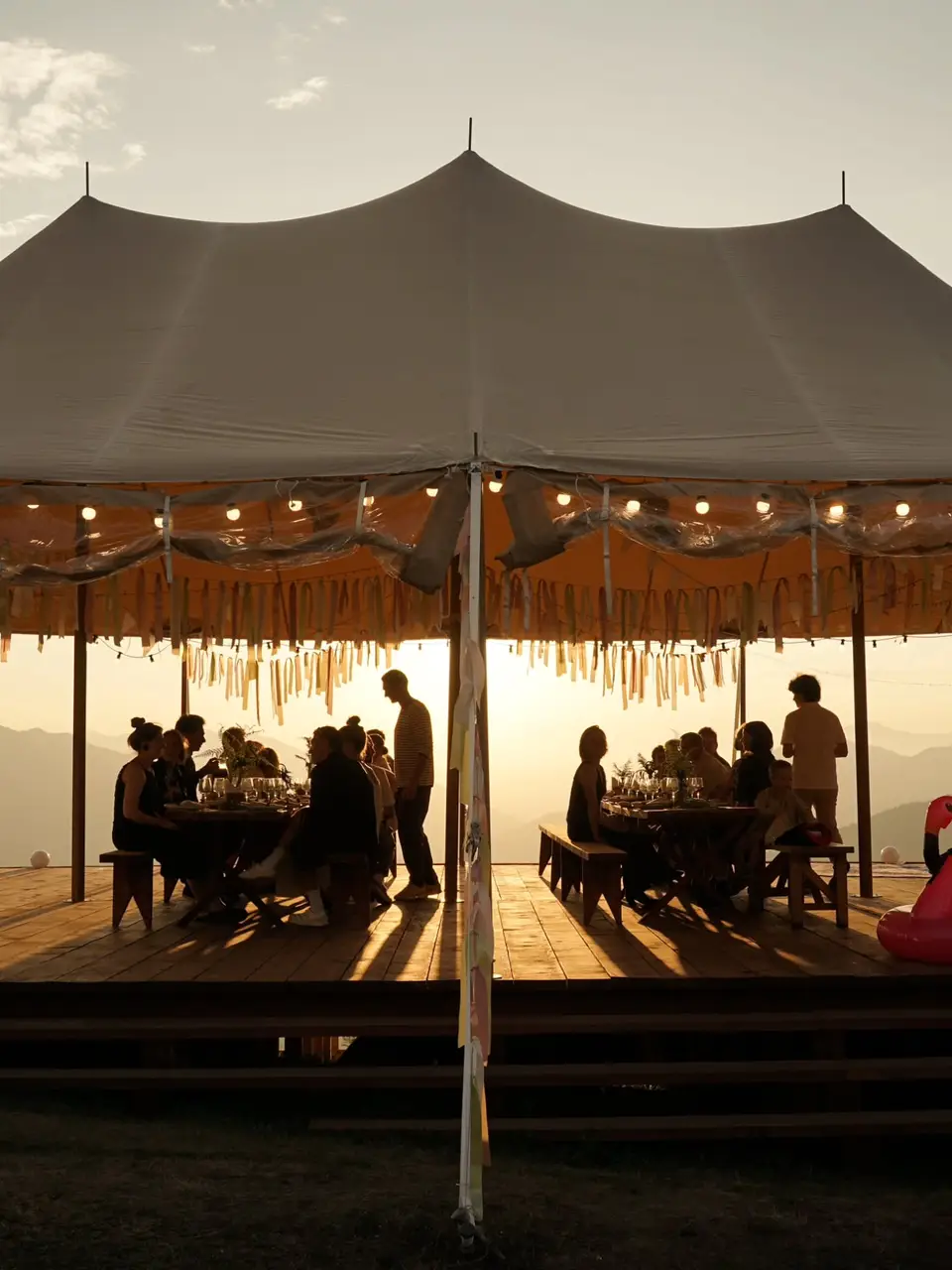
Upper Adjara is also where Georgia's Orthodox and Muslim traditions meet. In the 2002 census 30% of Adjarans were Muslim and 64% Orthodox, as openDemocracy reports. Tago has a village mosque; the call to prayer is mostly on Fridays, and we time the ceremony around it. Men in Adjara wear their own version of the chokha, the long Georgian coat that many grooms put on for the wedding.
For a church crowning in the mountains, Skhalta Monastery is the one. It is a 13th-century hall church at Kinchauri, the only medieval church in Adjara that survived the Ottoman and Soviet periods, in use again since 1990 and the seat of the bishop of Skhalta, as Wikipedia records. It is 9.5 km by road from Tago, or 8.4 km on our marked trail. It is a side valley, not a stop on the Batumi road: a detour that way adds 13.5 km and about half an hour.
How do your guests get to a mountain wedding in Adjara?
By car or minibus from Batumi, about 2 hours for 92 km, with the last stretch from Khulo on a mountain road for 4x4 cars and minibuses only. Big coaches cannot reach the camp, so we move groups in waves in our 15-seat minibuses and 4x4 cars, from Batumi, the airport or the train station.
| Transfer | Vehicle | Price, one way |
|---|---|---|
| Batumi to Glamping Tago | 4x4 car, 4 seats | 265 GEL per car |
| Batumi to Glamping Tago | Minibus, 15 seats | 410 GEL per car |
| Khulo to Glamping Tago | 4x4 car, 4 seats | 75 GEL per car |
| Khulo to Glamping Tago | Minibus, 15 seats | 135 GEL per car |
| Kutaisi to Glamping Tago | 4x4 car | 465 GEL per car |
| Tbilisi to Glamping Tago | 4x4 car | 925 GEL per car |
The public marshrutka runs from Batumi to Khulo every 30 minutes from 08:00 to 20:00, takes about 2 hours 30 minutes and costs about 10 GEL; from Khulo a 4x4 brings guests up in 30 to 35 minutes. The Khulo cable car is closed, so we send a car to meet guests in Khulo. From Tbilisi the train to Batumi takes about 6 hours and costs 35 GEL. Guests who drive can take a normal car as far as Khulo, 85 km of asphalt from Batumi, park in the centre and ride our 4x4 taxi up; a 4x4 parks at the top of the camp by the sign. The whole route, with maps, is on how to get to Glamping Tago.
What if it rains at a mountain wedding, and what else should you plan for?
Every wedding at Glamping Tago has a rain plan: the walls of the sailcloth event tent close, and the ceremony moves under the tent or into the yurt restaurant, which has a wood stove and 36 seats inside. Mountain weather changes fast and forecasts for Khulo are not reliable for Tago, so bring umbrellas whatever the forecast says. Even in the wedding season it rains at Tago on 11 to 16 days a month, most in May, and the nights cool quickly after summer: September nights usually fall to 10-13°C and October nights to 5-8°C, so tell guests to pack a warm layer for the evening ceremony and the bonfire.
- Cold nights: the Lotus Belle tents are heated, the fire circle is lit every evening, and the sauna is free for everyone staying.
- Internet: Starlink Wi-Fi at about 300 Mbps covers vendors and a live stream for family who cannot travel.
- Paying: you pay in lari by bank transfer or a payment link (company invoices in GEL or EUR), the balance before arrival, and food and extras at the end of the stay against an itemised invoice.
- Getting ready: the heated yoga dome is the getting-ready room and the base for your planner's team, at no charge.
All of it is on our practical guide for organizers.
What should guests wear and give at a Georgian wedding?
Cash in an envelope is the standard gift, handed to the couple or to a family member. For a foreign guest US$100 to 300 is what TripRoadwayPlanner suggests.
Dress is elegant and modest. Anyone going to the church needs covered shoulders and knees, and women bring a scarf for their hair. At a mountain wedding add a warm layer: nights are cold even in summer.
There is no custom of calling on the couple to kiss in public, as Russian weddings do with "gorko". A Georgian wedding is a stately event, which Novaya Gazeta Europe points out to Russian-speaking guests.

How do you plan a Georgian-style wedding step by step?
- Fix the date with the church first. If you want a crowning, check the fasts and ask the priest, then book the venue. At Glamping Tago June to September books 6 to 12 months ahead.
- Book the venue. At Glamping Tago a 30% prepayment of the total confirms the date; it is non-refundable and it is your minimum.
- Prepare the civil paperwork. Apostille and translate any foreign document other than your passports, bring proof of legal stay and find two witnesses. You can register the day you apply or book a date up to 2 months ahead.
- Prepare the church paperwork. Baptism certificates for both of you (for a Catholic wedding, also your home priest's permission), and the civil certificate on the day.
- Choose the tamada or bilingual host. Weeks ahead, with the list of toasts you want.
- Book the music and the dance. The folk trio or band with your other vendors, and the Kartuli lesson three days ahead.
- Send the timeline. At Glamping Tago the full programme, vendor list and mood board are due 30 days before, and the final food count 7 days before.
- Plan the transfers. Send every guest's flight or train time, and we build the transfer plan a few days before.
What do foreign couples get wrong about Georgian wedding traditions?
For the venue side, read our guides to mountain wedding venues in Georgia, a glamping wedding weekend and a wedding in Adjara, coast or mountains, or see our weddings page.
Glamping Tago for this
A Georgian-style wedding weekend at Glamping Tago
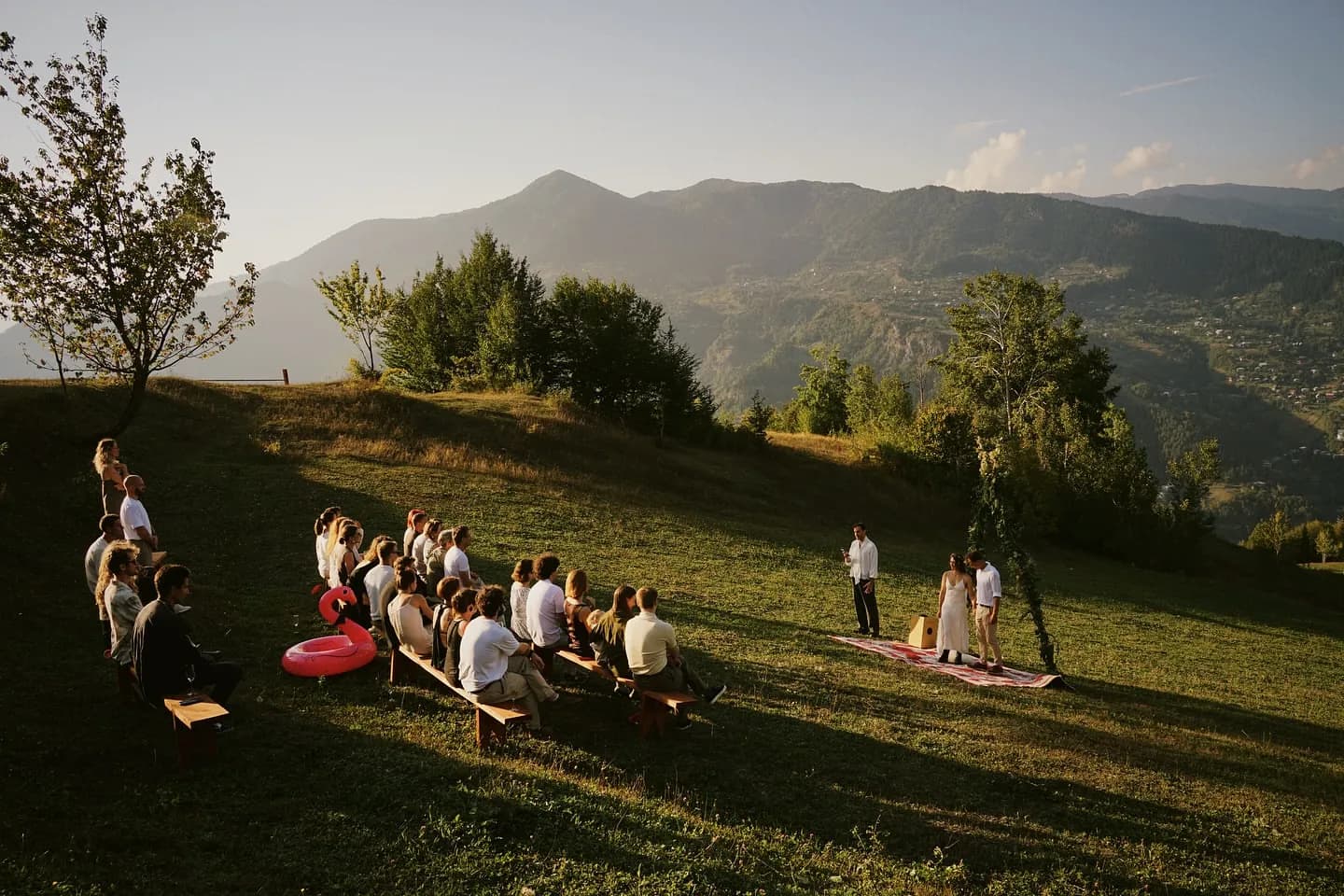
We are Jonas and Lisa, a Belgian couple who fell in love with Georgia and opened Glamping Tago in 2021. We are on the ridge above Village Tago in Khulo municipality, 1,200 m up in mountainous Adjara and about two hours from Batumi. A wedding books the whole camp: one wedding at a time, no other guests, two nights at least, so the toasts can run late and everyone sleeps on site, with 33 beds on the ridge.
The Georgian part is built in. The Mountain Supra is served in the 150 m² sailcloth tent, an Adjaran folk trio with a panduri sings through dinner, and a civil registrar comes up to marry you on the meadow. Meals come from Yurtalicious, our yurt restaurant; the kitchen is vegetarian, with a BBQ live station or meat khinkali for groups who want meat.
Every price, space and the day's timeline are on our practical guide for organizers. Write to us with your date.
- Guests
- Weddings of about 30, retreats up to 30; one group at a time
- Beds on site
- 33 on the ridge; everyone sleeps on site
- Whole camp, per night
- 3,258 GEL in April, 5,041 in June and September, 6,035 in July and August
- Wedding supra
- Mountain Supra 85 GEL a guest; BBQ live station 45 GEL
- Georgian music
- Adjaran folk trio with a panduri, 900 GEL plus 50 GEL transfer
- Registrar on site
- 255 GEL per wedding
- From Batumi
- About 2 hours, 92 km; 4x4 car 265 GEL, 15-seat minibus 410 GEL one way
- Season
- Weddings May to mid-October
Questions people ask
What are the main traditions of a Georgian wedding?
The church crowning (jvristsera), a car procession, the bride breaking a plate and tasting honey at the threshold, the ring dropped into a glass of wine, and a supra led by a tamada with a fixed run of toasts. The couple dances Kartuli and, by late evening, everyone dances. Only the civil registration makes the marriage legal.
Can foreigners have an Orthodox church wedding in Georgia?
Usually, when both partners and both witnesses are baptised Orthodox; a Catholic or Protestant partner needs a special blessing from the church hierarchy, which takes months, or is baptised first. You need passports, baptism certificates, rings and the civil marriage certificate, because the crowning has no legal force on its own. Most services are in Georgian, so agree the date and the language with the priest first.
How much does a tamada cost in Georgia?
A professional tamada costs 300 to 600 GEL for the evening, and a tamada or bilingual host US$400 to 800 through an agency. A Russian-speaking host for 6 hours costs 3,000 GEL through the Glamping Tago vendor guide. Book him weeks ahead and give him your list of toasts.
When can you not have a church wedding in Georgia?
Orthodox churches do not crown couples during the four fasts, including the Mariamoba fast from 14 to 27 August, or in Easter week. Georgian parishes generally do not crown on Tuesdays, Thursdays or Saturdays either, so ask the priest before you book the venue.
How do you register a marriage in Georgia, and how long does it take?
You both sign an application at a Public Service Hall with your passports, proof of legal stay and two adult witnesses. There is no waiting period: you can register the same day, or on any date within 2 months. It is free without a ceremony, 75 GEL with one, and 255 GEL for a registrar who comes to your venue.
How long does a Georgian wedding supra last?
Four to six hours, and a wedding supra often runs into the early morning. The tamada sets the pace, and leaving the table without his leave is frowned on. Plan your photos before the dinner starts.
What do you give as a gift at a Georgian wedding?
Cash in an envelope, handed to the couple or a family member. US$100 to 300 is the suggested amount for a foreign guest. Dress elegantly, with shoulders and knees covered if you go to the church.
Do we have to drink at every toast?
No. Guests raise their glass at each toast, and a sip is enough. Anyone who does not drink toasts with water, lemonade or compote, and an alcohol-free wedding follows exactly the same toasts.
Can we have a Georgian-style wedding in the mountains near Batumi?
Yes. Glamping Tago in Village Tago, about 2 hours and 92 km from Batumi, is made for weddings of about 30 guests, with the whole camp for one group and everyone sleeping on site, with a Mountain Supra at 85 GEL a guest, an Adjaran folk trio at 900 GEL and a registrar on site at 255 GEL. Skhalta Monastery, the oldest church in Adjara, is 9.5 km away by road.
What happens if it rains on a mountain wedding day?
At Glamping Tago the walls of the 150 m² event tent close and the ceremony moves under the tent or into the yurt restaurant with its wood stove. Even in the wedding season it rains on 11 to 16 days a month, so bring umbrellas. The tents are heated for the cold mountain nights.
Glamping Tago
Planning something in the mountains?
Tell us the dates and the number of people. We answer within a day, with a real price, not a brochure.