
Planning guides
Why a Belgian couple built a glamping in a Georgian mountain village: the Glamping Tago story
Published 7 November 202612 min readPrices and facts checked: November 2026
Jonas and Lisa, a Belgian couple, opened Glamping Tago in 2021 on a ridge above Tago village in mountainous Adjara, Georgia, after a chance visit. It is a family-run camp for small groups, with a team and a kitchen from the village.
On this page+
- Who runs Glamping Tago?
- How did we end up in Tago, a village above Khulo?
- Why a glamping and not a hotel?
- What did we build it around?
- Why does the village matter to us?
- How has the camp grown since 2021?
- Who is Glamping Tago for, and who is it not for?
- How do you visit us or bring your group?
- Questions people ask
Map of the places in this guide
Zoom with + and - or by pinching. Click the map first to zoom with the mouse wheel.
- Batumi to Glamping Tago through Khulo by car · 94.2 km
Glamping Tago is a family-run camp on a ridge above Village Tago, in Khulo municipality in the mountains of Adjara, two to three hours' drive from Batumi. It is not a hotel chain or an investor project. Below is how it started, why it looks the way it does, and what that means for you when you come to stay or bring your group.
Who runs Glamping Tago?
We do. We are Jonas and Lisa, a Belgian couple who fell in love with Georgia and opened Glamping Tago in 2021. On our team page Jonas is listed as the "Captain"; day to day, the camp runs with Neli Chavchanidze as general manager, Maria Tsetskhladze as chef and Anastasia as the coordinator for retreats and events, and most of the team comes from Tago and the villages around it.
Since 2021 we have welcomed 12,531 guests and more than 75 retreat groups, and guests rate us 4.9 on Google Maps from 648 reviews. When they write about us, most mention the view first, then the friendly staff, the food and the host.
How did we end up in Tago, a village above Khulo?
By chance. Jonas wanted to see Georgia on its less-travelled routes, and one of them led to Tago. He stayed a few more days than planned for the landscapes, and the idea for a tourism project followed, as we wrote in our first post about the camp.
Tago sits at about 1,000 m on the left bank of the Adjaristsqali river, 7 km from Khulo, and the 2014 census counted 294 people living there (Georgian Wikipedia). It is an old place: iron ingots found here point to an early iron-working centre, and a 16th-century Ottoman register lists five households in Tago. Upper Adjara was under Ottoman rule from 1614 to 1878 and most families are Muslim today, and the call to prayer from the Khulo mosque carries across the valley (FinnsAway).
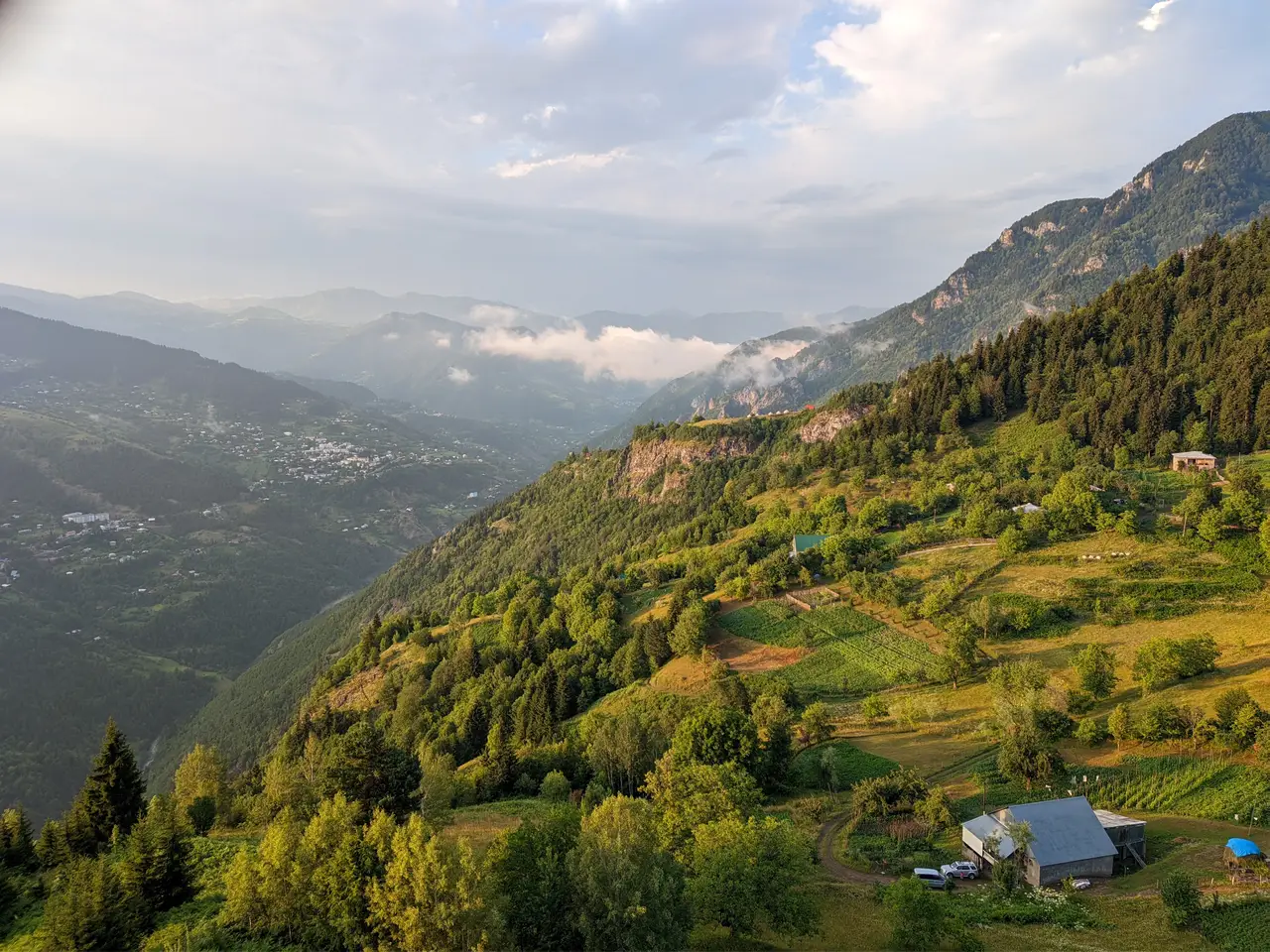
The plot itself is on the ridge above the village, at about 1,200 m. We chose it for the view over the valley and because the open space has room for events, workshops and groups (why we chose Adjara).
Why a glamping and not a hotel?
Because a hotel was beyond what we could build well, and tents fit the land and the kind of travel we wanted to offer. The first plan was a hotel with climbing walls between the floors, a trampoline and a rooftop pool. It needed time, money and experience we did not have yet.
The second plan was a two-storey hostel of wood and straw bales, with a pool and a drinking-water filter underneath. That was too expensive as well. Glamping won on three counts: low start-up costs, a fit with travellers who want an experience rather than a room, and our belief that it is the future of mountain tourism.
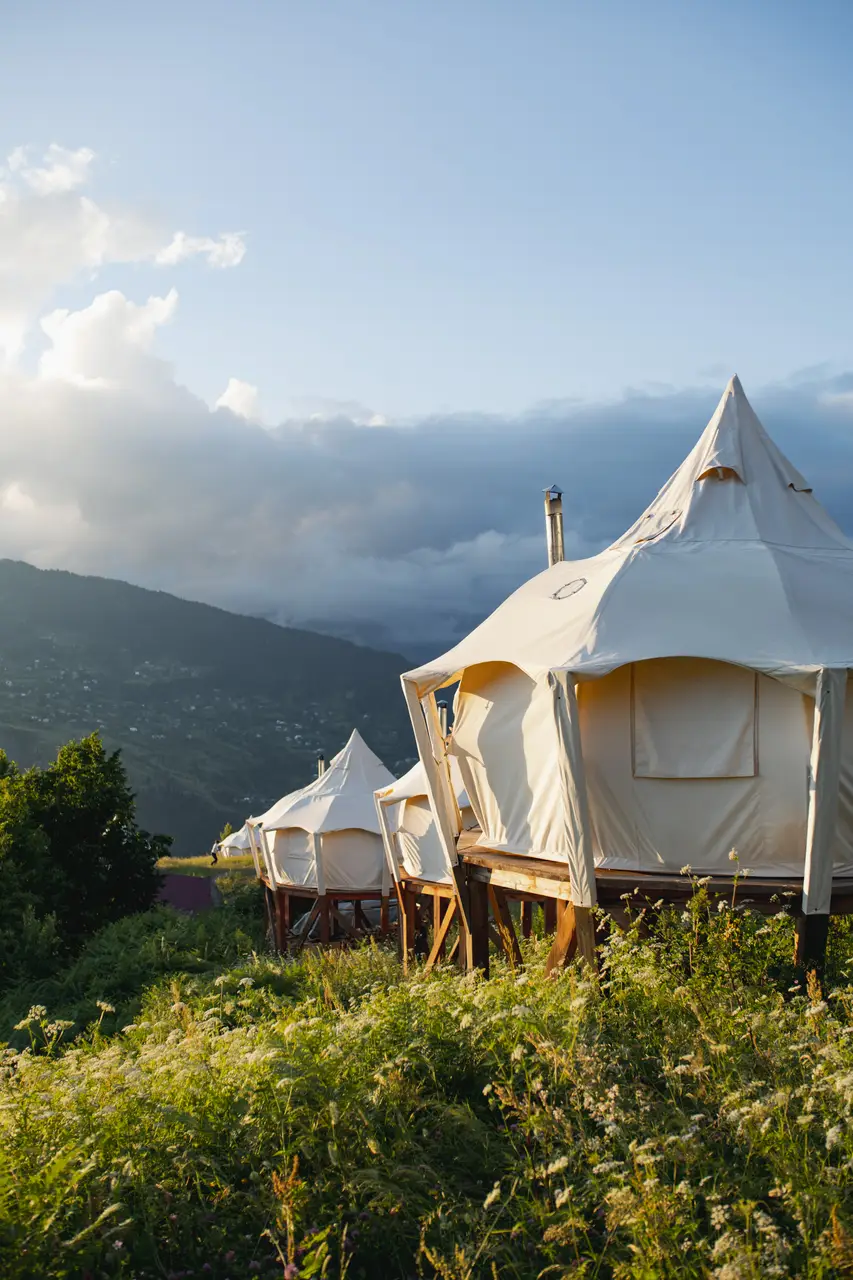
Staying in the Adjara mountains? See the glamping in Tago village
What did we build it around?
Connection: with the mountains, with each other and with the village. From the first drawing the camp had one goal, many shared spaces, because, as we wrote in our first post, "most people are more used to solitude than to unity. We vote for option number two."
Everyone eats together in Yurtalicious, the round yurt restaurant on site, at a breakfast buffet from 9:00 to 11:00 (32 GEL) and a dinner buffet from 19:00 to 21:00 (37 GEL). The kitchen is fully vegetarian: milk, eggs and honey, but no meat or fish (restaurant).
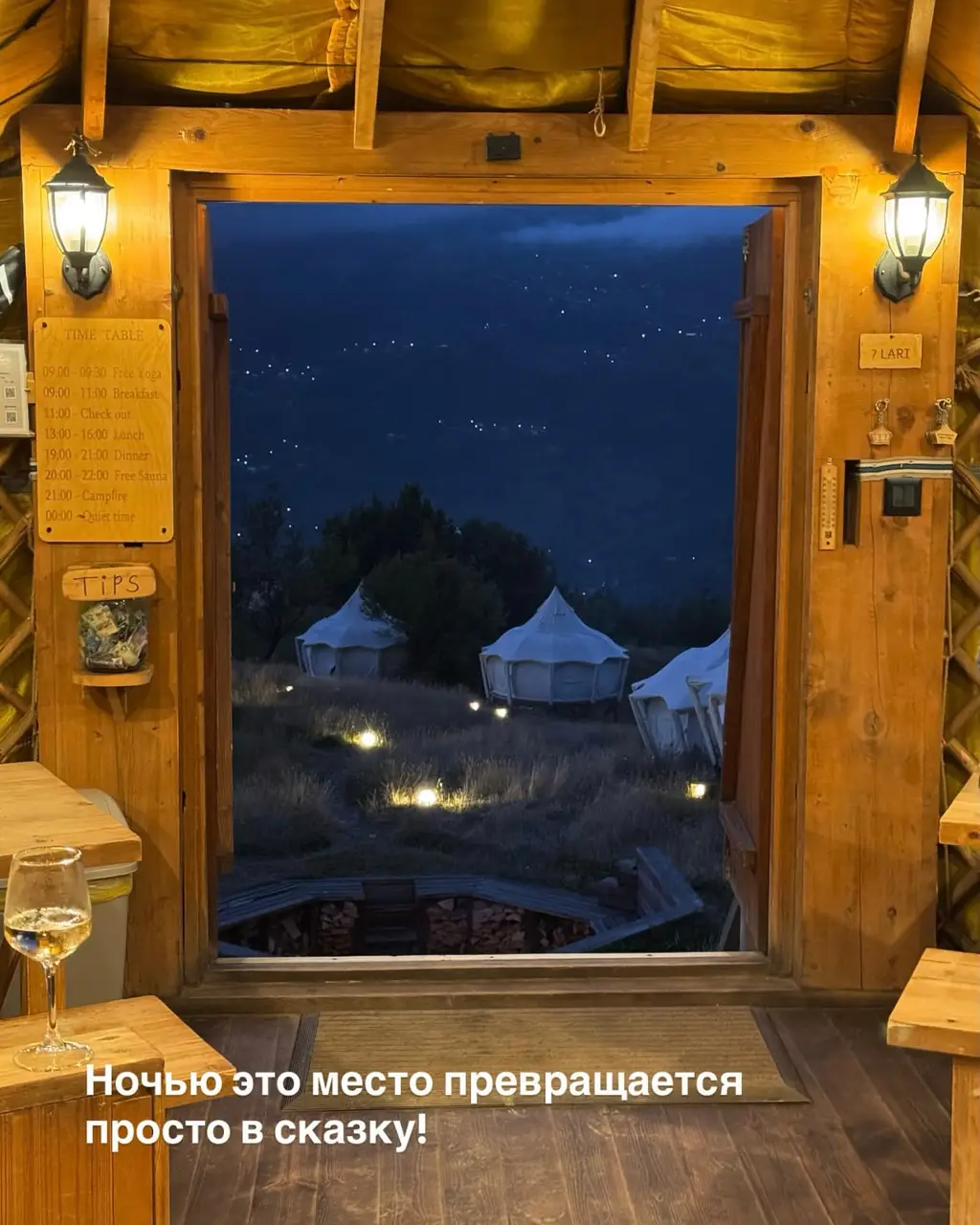
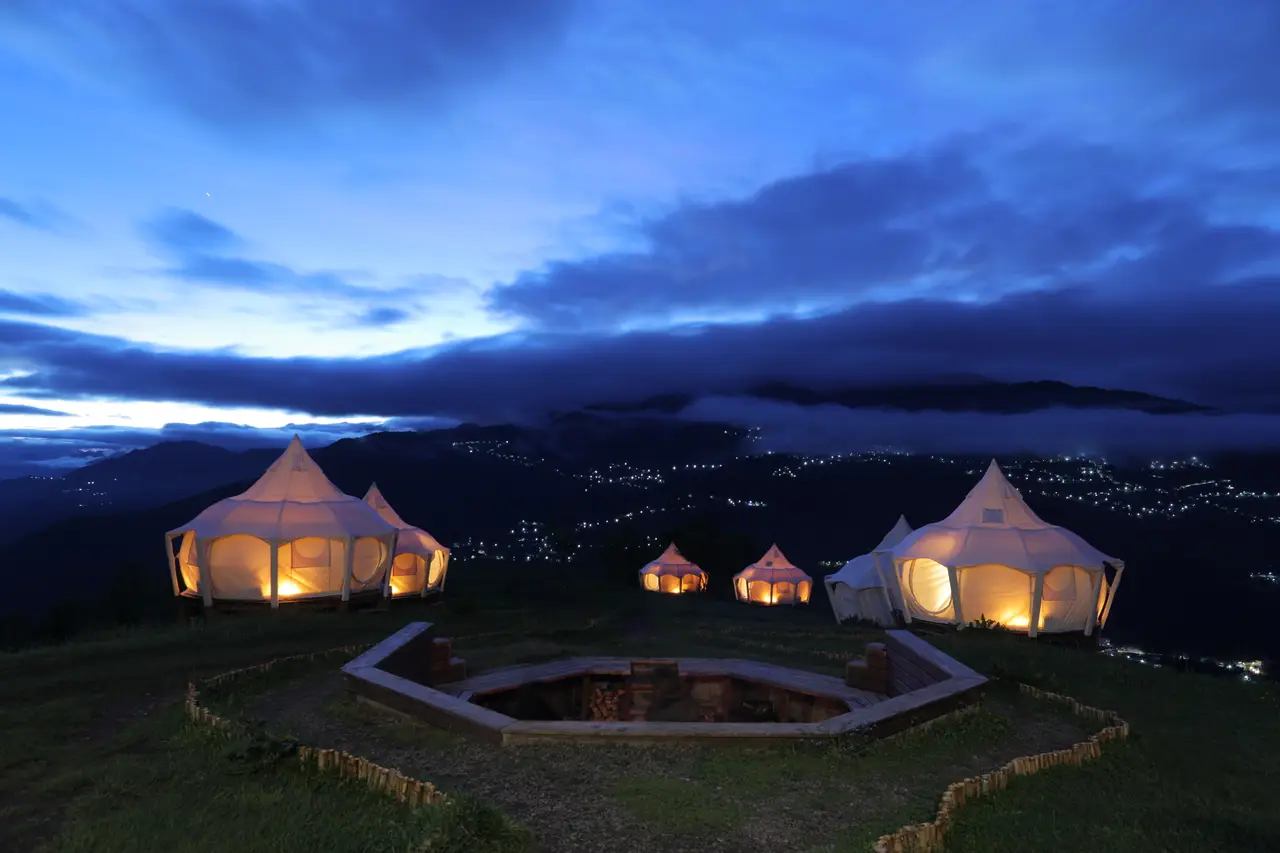
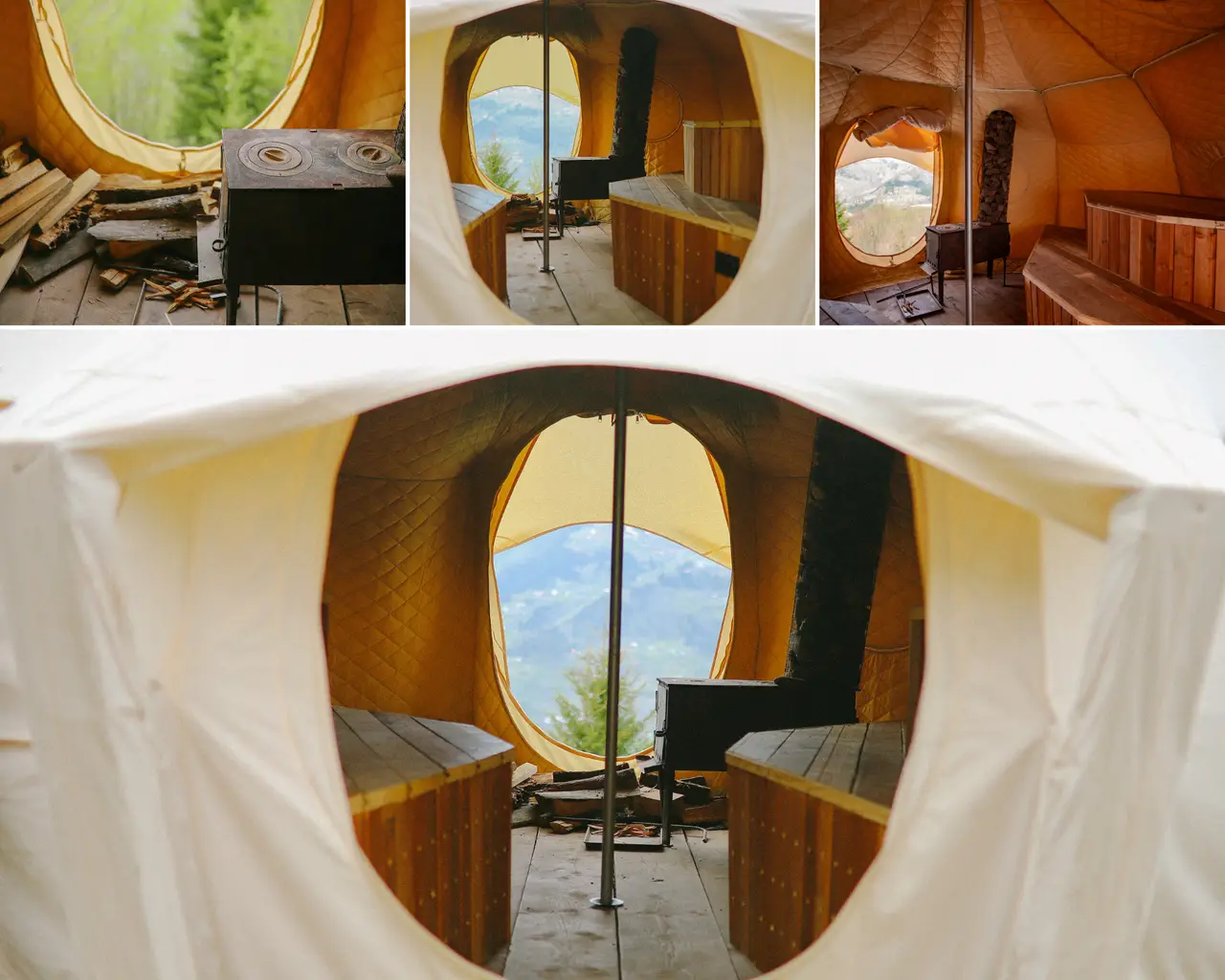
The rest of the day follows the same idea. The campfire is lit most evenings when the weather allows, morning yoga is included in your stay, and the wood-fired sauna in a converted Lotus Belle tent, with a cold plunge next to it, is lit every evening from 20:00 to 22:00, free for everyone staying (stays). Our Instagram bio sums it up in four words: "We bring people together".
There is Starlink Wi-Fi at about 300 Mbps for guests who have to work. For those who want the opposite, we run a phone-free Digital Detox week where phones are handed in for the whole stay: the first one ran from 26 October to 1 November 2026, the next is 5-11 April 2027, with a dorm bed at EUR 420 until 31 January 2027 and EUR 540 after.
Why does the village matter to us?
Because mountain villages in Adjara are emptying, and a camp that works with the village gives Tago a reason to keep living. Khulo municipality had 23,327 residents in 2014 and 16,342 in the 2024 census, almost a third fewer in ten years (City Population). Keda, Shuakhevi and Khulo together lost 23.6% of their people while Batumi grew by more than half (AVI Estates).
Floods and landslides drove many families out, and with few jobs beyond farming, young people leave for the cities or abroad (Caritas Czech Republic). Tourism is one of the few things that can keep people here, as long as the money stays in the village.
So this is what we do:
- The team comes from Tago. After six seasons, the kitchen, housekeeping, handymen and drivers are still mostly from Tago and the villages next to it, many of them from the Tsetskhladze family.
- Women of the village cook. Breakfast and dinner are cooked fresh every morning by local mothers, with products we buy from village families. Please do not bring your own food: the restaurant is one of the main ways the camp supports the village.
- Activities go to local families. Jara honey tasting with Mindia, a beekeeper whose family has kept bees for generations, followed by a Georgian feast at his home, a forest and herb walk with a local herbalist, and horse rides with a village family (activities).
- Groups sleep in village houses too. Seven families in Tago keep rooms for guests: 27 rooms with 64 beds, 3 to 10 minutes on foot from the camp. Groups who stay there still eat together with everyone at the camp (local guesthouses).

Until 2024 many of our guests came up the way the villagers did, on the Khulo-Tago cable car. Built in 1985, it crosses the gorge in a single 1,720 m span without towers, up to 280 m above the ground. It closed for restoration in 2024 and has no reopening date, so today everyone comes up by road.
How has the camp grown since 2021?
Slowly, one season at a time. In short: from a handful of Lotus tents and a yurt to a camp that sleeps 33 and hosts weddings and retreats.
| Year | What changed |
|---|---|
| 2021 | Opened with the Lotus Belle tents and the round yurt where everyone eats together |
| 2023 | 8 Lotus Belle tents and a geodesic dome dorm for groups, the Half Dome (our January 2023 post) |
| 2024 | 3 more Lotus tents, bringing us to 12; staff quarters and a panorama room for group leaders; honey and horse tours with village families; our first wedding (April 2025 newsletter) |
| 2025 | Sauna rebuilt for 15 people with a cold plunge; bathroom building rebuilt on a stronger foundation; a platform with a sailcloth event tent; our first co-working week; weddings of 24, 17 and 35 guests |
| 2026 | Weddings of 27 and 38 guests (wedding site), retreat groups through the season, the first Digital Detox week |
2024 was the hardest year. It started with the news that the cable car would close, a tent shipment held up by the war in Gaza and a slow spring, and then July and August were almost fully booked (August 2024 newsletter). That summer a Stockholm film NGO moved its film lab to Tago: 28 filmmakers spent 4 days at the camp and 4 in the village guesthouses, and on some days the kitchen cooked for more than 60 people.
In September a storm, which locals called a tornado, hit the camp in 15 minutes, and the bathroom building took the hardest blow. Nobody was hurt. Jonas was at home in Belgium when the call came. We closed for 20 days while the team cleared the rubble and built new showers and toilets, and reopened the day before a wedding the couple had been planning for months (September 2024 newsletter). In 2025 we rebuilt it again, properly, on a stronger foundation (July 2025 newsletter).
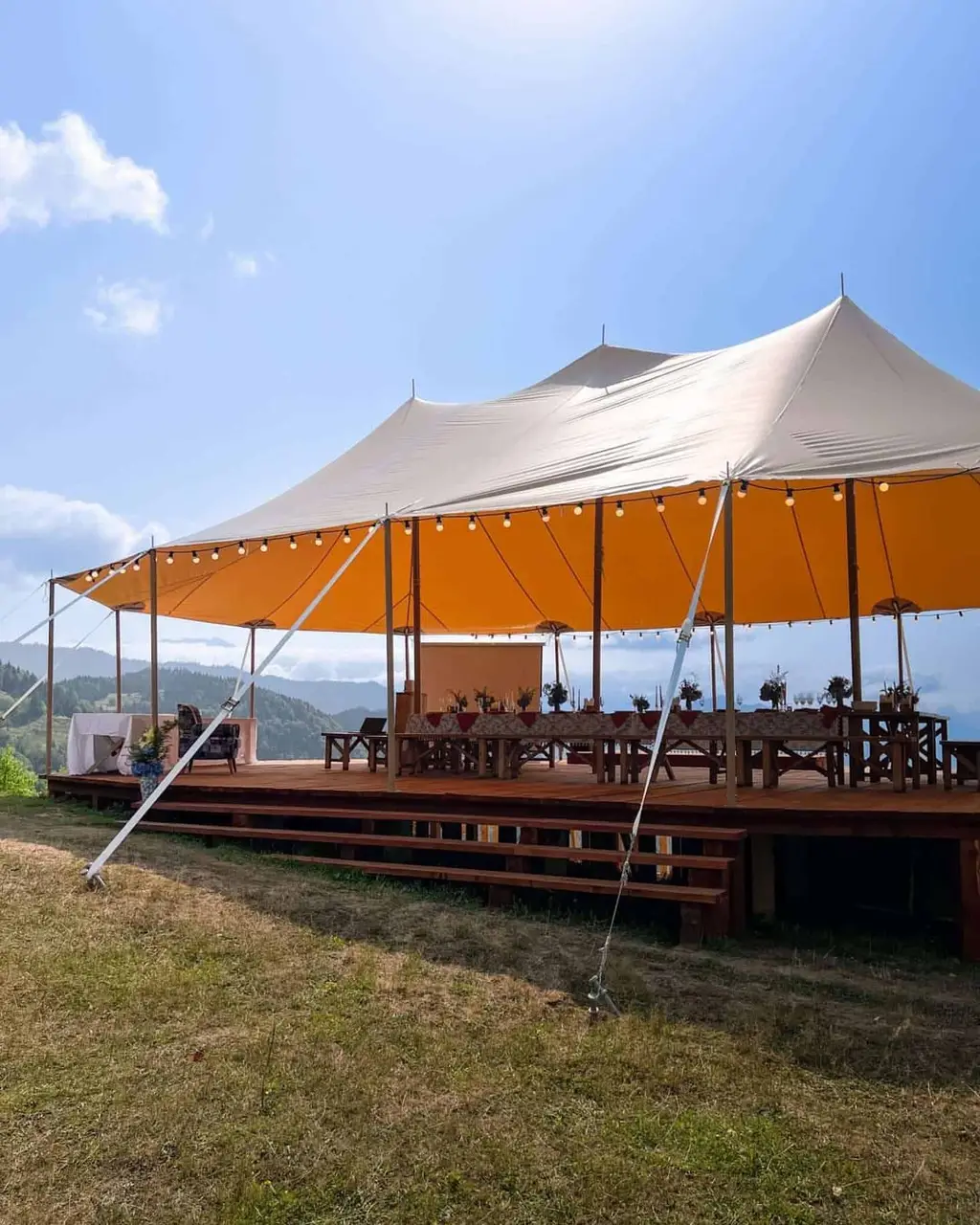
Today the camp has 12 Lotus Belle tents for two and the 9-bed Half Dome, so 33 people sleep on site. Groups practise on the 138 m2 outdoor platform under the sailcloth tent, with room for more than 50 on mats, or in the 38 m2 yoga dome with a wood stove for 10-12 (retreat venue).
Who is Glamping Tago for, and who is it not for?
It is for small groups who want a whole place to themselves, and for couples and travellers who like to share a table. Weddings of about 30 guests and retreats of up to 30 people take the whole camp, one group at a time, and everyone sleeps on site: a two- or three-day weekend instead of one evening in a banquet hall (weddings, retreats).
It is not for you if you want complete privacy or hotel luxury, need meat at dinner, travel between November and March, or do not want a mountain road on the last stretch. Our tents are comfortable, but they are tents, and the bathhouse is shared.
Other people have built places in Georgia from a first visit, and a few hotel groups have built from scratch. If you are weighing us against them, here is how they differ:
| Place | Who built it, or what it is | Where | What it is | Google rating |
|---|---|---|---|---|
| Glamping Tago | Jonas and Lisa, a Belgian couple, 2021 | Khulo, Adjara | 12 tents and a dorm dome, one group at a time | 4.9 (648) |
| Eco House Merisi | Boutique mountain hotel | Silibauri, Adjara | Glass cottages, restaurant hall for 50 | 4.9 (1,651) |
| Lost Ridge Inn | John Wurdeman (USA) and Ia Tabagari | Near Sighnaghi, Kakheti | Inn, brewery and horse ranch | 4.8 (207) |
| Rooms Kazbegi | Adjara Group, 2012 | Stepantsminda, Kazbegi | Hotel in a former Soviet sanatorium | 4.5 (5,586) |
Eco House Merisi, Keda (Adjara)
The other mountain stay in Adjara small groups look at: glass cottages and jacuzzis about 50 km from Batumi, a restaurant hall for up to 50 guests and a group transfer from Batumi at 20 GEL per person (Eco House Merisi). The difference is that it is a hotel: its cottages and restaurant are open to other guests at the same time.
Lost Ridge Inn, Kakheti
The closest story to ours in the east of the country. American John Wurdeman first came to Kakheti in 1996 and, with Ia Tabagari, grew a horse ranch and a tour business into an inn and brewery near Sighnaghi (Georgia Today). It is a good stay for wine country, at the other end of Georgia from Batumi.
Rooms Kazbegi
The opposite model. The Adjara Group opened it in 2012 in a Soviet-era building in Stepantsminda, as part of the Rooms Hotels brand (Investor.ge). It has a pool, spa and restaurant; recent reviews are mixed, with several saying the prices are high for the quality.
How do you visit us or bring your group?
Take the marshrutka from Batumi to Khulo and our 4x4 taxi up, or book our private 4x4 from Batumi. It is about 94 km by road from central Batumi through Khulo: 85 km of asphalt on the Batumi-Akhaltsikhe road, then 8.6 km from Khulo up to the camp, where the last stretch needs a 4x4. All the details are on how to get to Glamping Tago.
| Option (2026 prices) | Price | Time |
|---|---|---|
| Marshrutka, Batumi old bus station to Khulo | About 10 GEL per person, cash | About 2 h 30 |
| Our 4x4 taxi, Khulo to the camp | 75 GEL per car, up to 4 people | 30-35 min |
| Our private 4x4, Batumi to the camp | 265 GEL per car, up to 4 people | About 2 h 30 |
| Our private 4x4, Kutaisi to the camp | 465 GEL per car, up to 4 people | About 5 h 30 |
| Marshrutka, Kutaisi bus station to Batumi | About 20 GEL per person | About 3 h |
| Train, Kutaisi airport to Batumi | About 31 GEL per person | About 2 h |
Marshrutkas leave Batumi bus station every 30 minutes from 08:00 to 20:00; the sign in the window says ბათუმი - ხულო, and the van stops halfway for food and a toilet. From Kutaisi, the marshrutka to Batumi runs every hour from 08:00 to 18:00 and the train from the airport 4 times a day; then you continue as above. Group minibuses and normal cars come up the easier Skhalta valley road, turning off at Zamleti, 4.7 km before Khulo.
If you drive yourself, use Maps.me (other map apps take you the wrong way here). With a 4x4 you can park at the camp; without one, park anywhere in Khulo centre and take our taxi. We accept cards, bank transfers and cash, and Geocell and Magticom both have good mobile signal at the camp (FAQ).
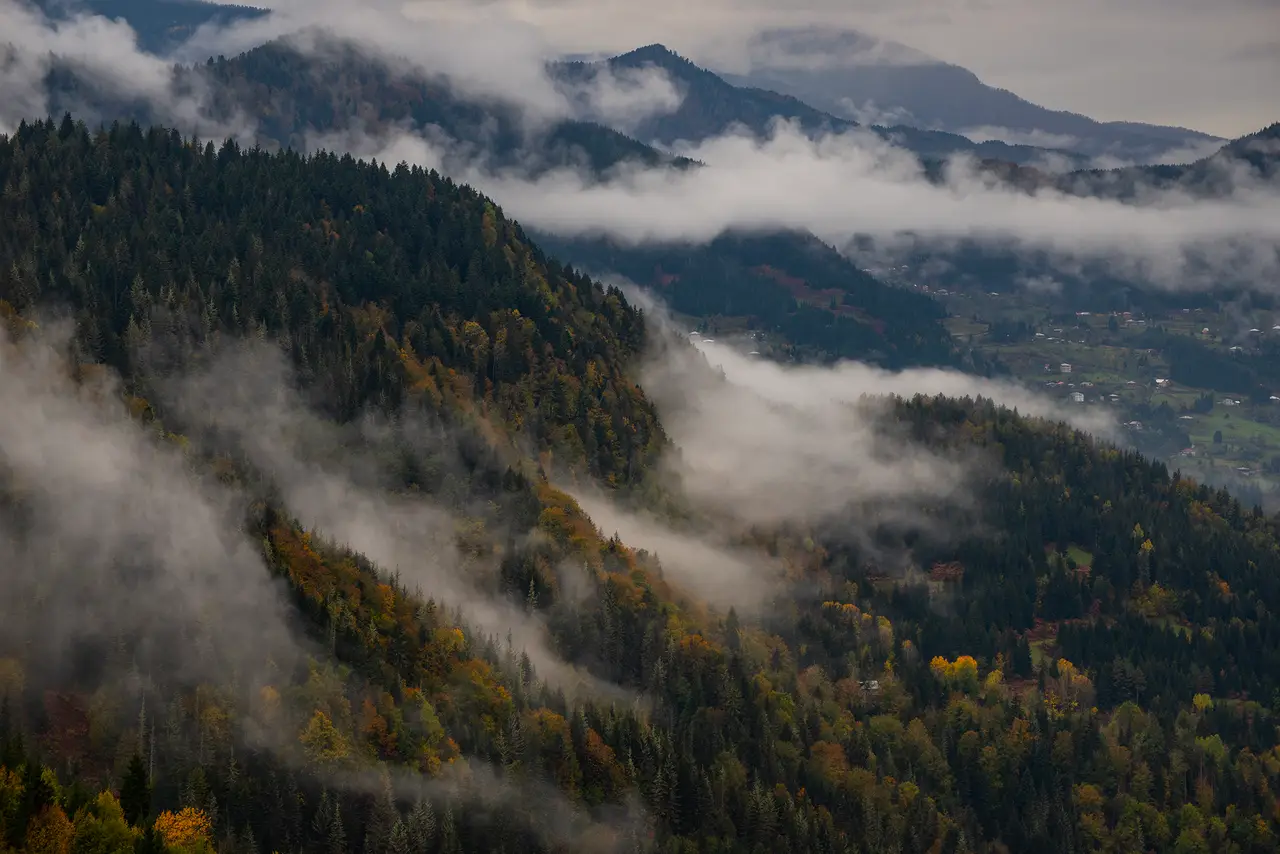
We are open from 1 April to the end of October. Days usually reach about 19°C in May, 24°C in June and 18°C in October, and October nights drop to 5-8°C, so pack a warm layer even in summer. In winter snow lies on the ground most days, which is why we close.
Most travellers book one to two weeks ahead and stay one night; in June to August, book earlier, and stay two nights if you can, because the camp only makes sense once you have had one evening at the fire. Weddings and retreats book months ahead: write to Anastasia, who coordinates groups and events, on +995 599 29 97 57 or anastasia@glampingtago.ge. Groups pay a 30% prepayment, which is not refundable, and confirm final numbers in writing 14 days before arrival (groups). For everyone else, today's prices are on the booking page, and the front desk answers on WhatsApp at +995 555 56 24 83.
If you are in the area for the day trips, our guide to Green Lake and the story of Tago, the cable car village are good next reads.
Glamping Tago for this
Stay with us on the ridge above Tago
Come for a night at the fire, or bring your group and take the whole camp. For weddings of about 30 guests and retreats of up to 30, the camp belongs to one group and everyone sleeps on site, with meals in Yurtalicious, our yurt restaurant, cooked by women from the village.
Individual stays are on the booking page; weddings on wedding.glampingtago.ge and retreats on retreat.glampingtago.ge.
- Run by
- Jonas and Lisa, a Belgian couple, with a team from Tago
- Open since
- 2021
- Beds on site
- 33: 12 Lotus Belle tents for two and a 9-bed dorm dome
- Groups
- One group at a time: weddings of about 30, retreats up to 30
- Season
- 1 April to the end of October
- From Batumi
- About 94 km by road, 2 to 3 hours
- Altitude
- About 1,200 m, above Village Tago
- Prices
- They change with the date: see today's prices on the booking page
Questions people ask
Who owns Glamping Tago?
Glamping Tago is owned and run by Jonas and Lisa, a Belgian couple who fell in love with Georgia. It is a family business, not part of a hotel group. Jonas is the camp's "Captain", and the day-to-day team, from the general manager to the chef, mostly comes from Tago and the neighbouring villages.
When did Glamping Tago open?
Glamping Tago opened in 2021 with Lotus Belle tents and the round yurt restaurant. It has grown every season since: today it has 12 Lotus Belle tents and a 9-bed dorm dome for 33 people, a wood-fired sauna, a yoga dome and a platform with a sailcloth event tent.
Why did a Belgian couple open a glamping in the mountains of Adjara?
Jonas came to Tago by chance while travelling Georgia's less-travelled routes and stayed for the landscapes. A hotel and then a straw-bale hostel turned out too expensive, so the plan became a glamping with many shared spaces, built to bring people together and to give the village work.
Does Glamping Tago work with the local village?
Yes. Most of the team is from Tago, women of the village cook breakfast and dinner, and the kitchen buys products from village families. Honey tastings, herb walks and horse rides are run by local families, and seven family guesthouses in Tago host the guests that do not fit in the camp.
Can I take the cable car from Khulo to Tago?
No. The Khulo-Tago cable car closed for restoration in 2024 and has no reopening date. Come up by road instead: our 4x4 taxi from Khulo takes 30-35 minutes and costs 75 GEL per car for up to 4 people.
Is Tago the same village as Chao?
No. Chao is the next village to the west, 1.6 km away in a straight line but 13 km and about 20 minutes by road. Map apps sometimes send guests there, so use Maps.me with our Tago pin and follow the wooden "Glamping Tago" signs.
Can I speak English with the hosts?
Yes. Jonas is from Belgium, and our website and teams work in English, Georgian and Russian. The front desk replies fastest on WhatsApp at +995 555 56 24 83, and group and event questions go to Anastasia, our Events & Groups manager, at +995 599 29 97 57 or anastasia@glampingtago.ge.
How big a group can Glamping Tago host?
The camp is made for weddings of about 30 guests and retreats of up to 30 people: the whole place belongs to one group and 33 people sleep on site. Bigger weddings of up to about 100 guests work with the family guesthouses in the village, a few minutes' walk below the camp, and everyone eats together at the camp.
Glamping Tago
Stay in the mountains of Adjara
Glamping Tago is in Tago village, Khulo: tents with real beds, a yurt restaurant and a sauna. A good base for exploring mountainous Adjara.