

Planning guides
Remote Team Workation in Georgia (the Country): the 2026 Guide to a Working Week in the Mountains
Updated 11 October 202638 min readPrices and facts checked: September 2026
A workation only works if the work works. Here is how a remote team runs a real working week in the mountains of Georgia (the country) in 2026: the permit and insurance rules at the border, whether the internet holds, the five venues that can take a team of 10 to 30, what a week costs per person, and how the whole team gets there.
On this page+
- Why a workation instead of an offsite?
- Why Georgia (the country) for a remote team workation?
- Does a remote team need a work permit in Georgia in 2026?
- What does every person have to show at the border in 2026?
- Is the internet in the Georgian mountains good enough for a full week of video calls?
- Where can a remote team base a workation week in Georgia?
- What does a city week in Tbilisi or Batumi cost instead?
- What workspace does a team get at Glamping Tago?
- How does the daily rhythm run in the mountains?
- Sleeping and eating: where does the team sleep, and what does the kitchen cook?
- Does Georgia's time zone work for a distributed team?
- What does a workation week in the Georgian mountains cost in 2026?
- How do you get a whole team to Village Tago?
- Which month should you pick for a mountain work week?
- How do you book a team week, and in what order?
- Can a few people join an open week instead of booking the whole camp?
- What do teams get wrong about a mountain workation?
- Questions people ask
Map of the places in this guide
Zoom with + and - or by pinching. Click the map first to zoom with the mouse wheel.
- 1Glamping Tago
- 2Hotel Ambassadori Goderdzi
- 3Rooms Kazbegi
- 4Emerald Borjomi Hotel
- 5Gistola Hotel
- 6Hotel Monte
- 7Ambassadori Kachreti
- 8Coliving & Coworking Gumbrini
- 9The Hub Co Working Space
- 10Hubitat Coworking
- 11Fabrika Tbilisi
- 12Terminal Vake
- 13LendSpace
- 14Coworking Batumi Locus
- 15Terminal Batumi
- 16Batumi old bus station
- 17Alexander Kartveli Batumi International Airport
- 18Kutaisi International Airport
- Batumi to Village Tago by car · 91.8 km
- Khulo to Village Tago, the 4x4 leg · 8.9 km
- The Skhalta valley road: from the Sh 1 at Zamleti up through Cheri to Village Tago · 25.4 km
Why a workation instead of an offsite?
An offsite is three days of workshops with the laptops shut. A workation is an ordinary working week somewhere better than the usual flat, with the sprint board untouched and the team in one place for the evenings. Distributed teams use it for the things a video call cannot do: a planning week, a hackathon, onboarding a new cohort, or simply sitting next to each other for once.
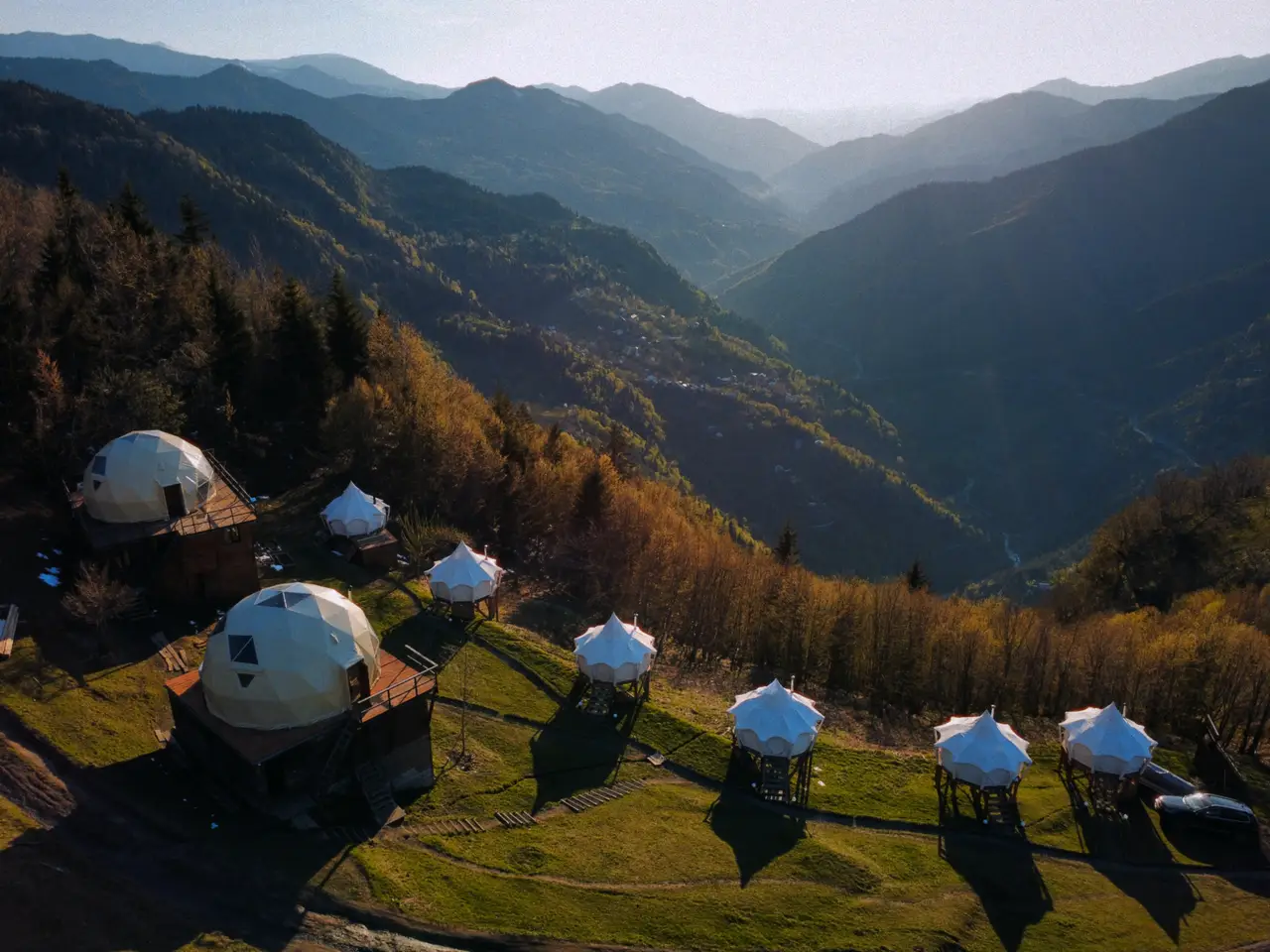
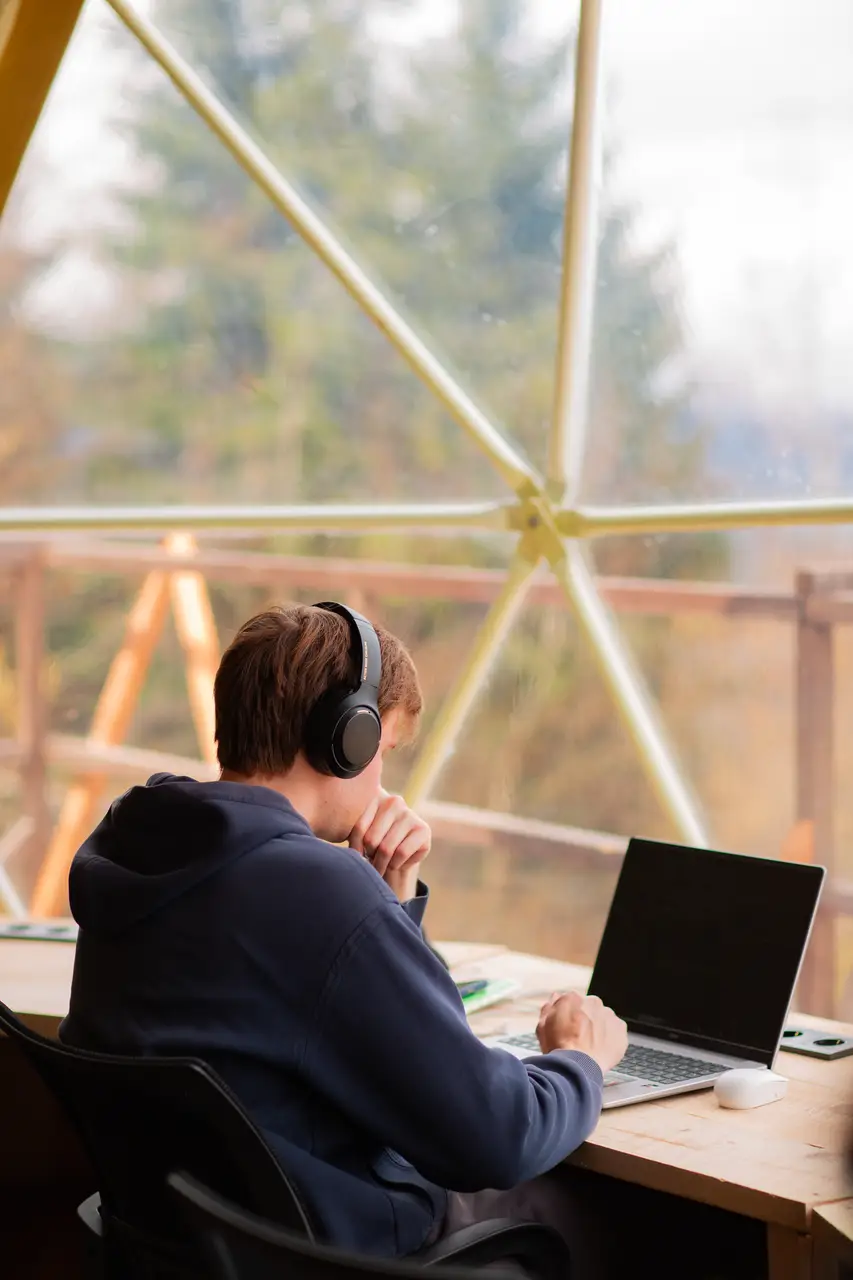
It only works if the work part is boring in the best sense. Fast internet, a desk, coffee at 10:00, and a room where a call happens behind a closed door. Most of this guide is about making that part reliable in a country where the fixed line stops well below the treeline.
The rest of the week is why you came: ridges running to 2,000 m, a sauna lit every evening, and dinner at one long table.
Why Georgia (the country) for a remote team workation?
Because the paperwork is short, the clock lines up with Europe and the Gulf, and a week in the mountains costs less than three nights of a coworking hotel in Lisbon. Citizens of 94 countries and territories enter and stay for a full year without a visa under Government Ordinance No 255, as amended on 24 February 2026, and EU citizens may enter on a national identity card instead of a passport.
Georgia sits on UTC+4 all year and abolished seasonal clock changes in 2005, so the overlap with head office never moves. Flights land at Batumi airport, 87.1 km from our valley, and at Kutaisi, the only airport in the region with low-cost service: 50 destinations, an open skies agreement with the EU and no restriction on night flights.
Two rules changed in 2026: mandatory entry insurance from 1 January, and a work-activity permit regime from 1 March. The short answers for a visiting team are in the next two sections.
Does a remote team need a work permit in Georgia in 2026?
No, not if every person keeps working for their own employer abroad. The regime that took effect on 1 March 2026 applies to foreigners without permanent residence in Georgia who work for a local employer registered in Georgia, including remotely, or who are self-employed or run a business here. The wording of the Law on Labour Migration is precise about it: a labour immigrant is someone who enters to be employed by a local employer, or who has a remote labour relationship with a local employer, or who is self-employed in Georgia. A German payroll and a German client list are outside all three.
Legal.ge lists who else falls outside it: recognised refugees, asylum seekers, employees of accredited diplomatic missions and international organisations, accredited foreign journalists, and holders of a valid investment or permanent residence permit. An ordinary temporary residence permit is not enough on its own.
The regime bites when someone in the group has a Georgian tie. Legal.ge and Relocation.ge list them: individual entrepreneurs and the self-employed, foreign employees of a Georgian company, partners and contractors of one, and people working remotely on a Georgian registration. The colleague who set up a Georgian IE for the 1% small business tax is in scope. The colleague on a German payroll flying in for six nights is not.
For the person who does need one, the numbers are fixed. The state fee is 200 GEL for a decision in 30 calendar days or 400 GEL for 10 working days, and the employer pays for an employee while a self-employed foreigner pays their own. A first permit runs six months to a year, and up to three years for IT specialists. It names one employer and one post, or one field of activity for the self-employed, so a change needs a new permit. Applications go through the state labour-migration system at labourmigration.moh.gov.ge, and a self-employed applicant also sits a video interview with the agency. A Georgian employer has to advertise the job on the state job board first and may only apply for a foreign hire if no suitable local candidate comes forward, then applies for the follow-on D1 immigration visa at a Georgian consulate. Annual quotas cap four occupations: courier services, passenger transport, tourist guides and mountain or ski guides.
A second law, No 1509 of 15 April 2026, added a list of exemptions on top. Two of them matter to remote workers, and both are narrower than they first look. One covers work done entirely remotely for a Georgian employer where the job does not require entering Georgia at all, which is not the case for a team sitting in a tent in Adjara. The other covers services for a non-resident client connected to that client's activities outside Georgia, and it stops applying the moment the person holds a Georgian individual-entrepreneur registration and needs a residence permit to stay. The same law created a short-term professional activity route capped at four months per calendar year, which the local employer or the organiser of the services has to register in the labour-migration system before the work starts.
One more number worth holding: a person becomes a Georgian tax resident for the whole year once they spend 183 days or more in Georgia in any rolling 12 months, under Article 34 of the Tax Code. A workation week is nowhere near it. Three people repeating the trip all year is worth a look.
Planning this yourself? See how Glamping Tago can host it
What does every person have to show at the border in 2026?
Health and accident insurance of at least 30,000 GEL, covering every day from entry until departure. Decree No 602 was issued on 26 December 2025 and took effect on 1 January 2026, and it applies at every land and air crossing to almost every foreign visitor, long-stay visitors and remote workers included.
Three minimums have to be met at once: at least 30,000 GEL of cover, medical plus accident cover, and validity for the whole period from entry to departure, up to a maximum of one year. The sum is in lari, not dollars. The policy may be on paper or on a phone, in Georgian or English, from a Georgian or a foreign insurer, and the border police may ask for it. The only exemptions are diplomatic and special passport or visa holders, accredited mission and international organisation staff and their accredited families, people entering under an international agreement, and drivers on international road transport.
Is the internet in the Georgian mountains good enough for a full week of video calls?
Not by default, and any venue that answers this with the word "yes" and nothing else is worth a second question. Georgia's national numbers are lopsided: in August 2026 the Ookla Speedtest Global Index put the country 19th in the world on mobile at a median 229.03 Mbps down and 24.79 Mbps up with 25 ms latency, and 132nd on fixed broadband at 55.07 Mbps down, 53.06 Mbps up and 14 ms.
The regional picture is what decides a workation. Tbilisi runs 100 to 140 Mbps on 4G, Batumi 80 to 120, Kutaisi 60 to 100, Kazbegi 30 to 60, Mestia 20 to 50, and remote mountains 0 to 10 Mbps where there is a signal at all. It is not an abstract problem in our own region: residents of Ghorjomi and Didachara, two side valleys off the same road, told Georgia's public defender that weak communications are a live complaint, and a project to bring coverage up to the Didachara summer pastures was started and never finished.
Satellite is what closes that gap. The Communications Commission of Georgia authorised Starlink Georgia in July 2022, service started in the second half of 2023, and by June 2026 there were 5,435 subscribers growing by about 200 a month, at 100 to 150 Mbps for individual customers and up to 220 Mbps for business accounts. At Glamping Tago the line is Starlink, measured at about 300 Mbps, with Magti mobile as the fallback. Remote teams from Berlin, Lisbon and Amsterdam have run full working weeks of video calls from the ridge.
Build the backup anyway, because a mountain valley is a mountain valley. MagtiCom has the widest network in the country at 98% of the territory and is the one that actually reaches rural Adjara, so put Magti SIMs in the phones even if Silknet is quicker in the cities. A 50 GB monthly 4G plan costs 25 to 40 GEL and turns any phone into a hotspot. The village power goes off from time to time, as it does across upland Adjara, so anyone presenting to a board that week should have a charged laptop and a phone tether ready rather than a plan.
Where can a remote team base a workation week in Georgia?
Five places in the country can hold a team of 10 to 30 for a working week with a real meeting room. Here is what each one is for.
| Base | Drive from | Altitude | Workspace | Whole place for your team | Pick it when | |
|---|---|---|---|---|---|---|
| Glamping Tago, Village Tago | Batumi, 91.8 km, about 2h30 | about 1,200 m | 38 m2 dome, 138 m2 covered platform, yurt long table | Yes, with the whole-property buyout | 4.9 (642) | You want the whole place to yourselves and a satellite line you can test |
| Hotel Ambassadori Goderdzi | Batumi, 111 km, 34 km past us on the same road | about 1,700 m | Two conference rooms with projectors | No, a resort hotel shared with ski and spa guests | 4.7 (336) | You need the same mountains in winter, when we are closed |
| Rooms Kazbegi, Stepantsminda | Tbilisi, 155 km, about 2h30 | 1,837 m | 300 m2 hall plus three 60 m2 rooms | No, a large hotel shared with other guests | 4.5 (5,528) | The team flies into Tbilisi and wants a hotel, not a camp |
| Emerald Borjomi | Tbilisi, 162.6 km, about 2h20 | spa town | 20 to 25 at tables, 30 theatre style | No, a town hotel shared with other guests | 4.9 (35) | You want a short transfer and a conference room with a spec |
| Gistola Hotel, Mestia | Tbilisi, 454 km, over 8 hours | Svaneti | about 60 m2 of conference space | No, a 44-room hotel shared with other guests | 4.8 (291) | The scenery is the point and the internet is not |
Glamping Tago, Village Tago (Adjara)
Where: on the hill above Village Tago in Khulo municipality, mountainous Adjara, at about 1,200 m. Drive time: about 2h30 from Batumi, the last 8.9 km by 4x4. Capacity: 10 to 28 for a team week, 33 beds at the absolute maximum. Season: 1 April to the end of October. Good for: a company that wants the entire property, three vegetarian meals a day and a programme built around its own agenda. Watch out for: the mountain road, the winter closure, and no bathroom inside the tents.
We have hosted groups here since 2018, and a tech week already runs every summer: it has come back each year since 2023 and grew from 8 people to the whole glamping for 34 guests in June 2026. Two groups can share the site at once, with the shared spaces scheduled between them.
Hotel Ambassadori Goderdzi
Where: on the Goderdzi pass road, 34 km past our valley. Drive time: 111 km from Batumi on the same Sh 1 road as ours, so allow longer than the 2 to 2.5 hours Batumi to Khulo takes. Altitude: about 1,700 m. Workspace: two conference rooms, one on the second floor with panoramic views and one on the ground floor, both with projectors, screens and reconfigurable layouts, sold with coffee breaks and buffets. Good for: the same mountains in the months we are shut, with an indoor pool, garden spa, hot tubs, sauna and gym. Watch out for: a large ski and spa resort, so the team shares the restaurant, the pool and the evenings with other hotel guests.
Rooms Kazbegi, Stepantsminda
Where: 1 V. Gorgasali St, Stepantsminda, under Mount Kazbek. Drive time: 155 km and about two and a half hours from Tbilisi, with Gudauri on the way. Altitude: 1,837 m. Workspace: a 300 m2 Grand Conference Hall plus three 60 m2 meeting halls, which are the right size for 10 to 30, with free Wi-Fi throughout, complimentary parking and a shuttle service. Good for: a team flying into Tbilisi that wants hotel service and a famous view. Watch out for: recent reviews criticising restaurant and bar service and calling the rooms dated for the price, and Kazbegi internet at 30 to 60 Mbps.
Emerald Borjomi
Where: 49 Meskheti St in the spa town of Borjomi. Drive time: 162.6 km and about 2h20 from Tbilisi. Workspace: a conference room seating 20 to 25 at tables or 30 theatre style, with a projector, flexible layouts and natural light, sold with coffee breaks, meals, rooms and transfers. Good for: the shortest transfer of any mountain-town option with a published meeting spec. Watch out for: a small review base of 35, and a town hotel the team shares with other guests.
Gistola Hotel, Mestia
Where: 39 Boris Kakhiani St, Mestia, in Svaneti. Drive time: 454 km and over eight hours from Tbilisi. Capacity: 44 rooms. Workspace: about 60 m2 of conference space, with banquet halls, AV equipment and setup support, and discounted rates from five rooms up; plus a heated indoor pool, a sauna, secured parking and a free airport shuttle. Good for: a team that wants the towers of Svaneti and is genuinely async. Watch out for: 20 to 50 Mbps with dead zones between villages, and a full travel day at each end.
Two mountain hotels we do not recommend
Hotel Monte in Upper Gudauri has the right shape on paper: a conference room, sauna, indoor pool and game room at about 1,700 m, two hours from Tbilisi. Several September 2026 reviews describe unfriendly staff at reception and long waits at the bar, which is not what a team wants from the place it lives in for a week. Quadrum up at 2,200 m sits at 4.1 from 366 reviews, below the bar we recommend at.
Ambassadori Kachreti in Kakheti is the resort Superteam Georgia took over for its Solana Startup Village, 20 founders, developers and creatives for nine nights from 22 to 31 August 2026, which is the clearest whole-venue model anyone has run in the country: rooms, workspaces, gardens, a pool and long dinners, an hour east of Tbilisi. The resort itself has had a weaker autumn: several September 2026 reviews complain about reception service and unanswered booking messages, and outside a takeover like that one it is a large resort shared with other guests.
The ready-made alternative: a coliving that sells the week for you
Colive & Cowork Gumbrini at Gumbrini village near Tskaltubo is the closest thing in Georgia to a workation off the shelf: fixed 14-day sessions with the programme, accommodation, coworking room with panoramic windows, Wi-Fi and food included, at 249 USD for a comfort single tent, 219 USD per person in a double or twin, 259 USD for a bed in the four-person dorm and 295 USD per person in a shared room. It is about 10 km from central Kutaisi and 25.1 km from Kutaisi airport. The camping tents run to the end of September, and the indoor sessions continue through the winter: 27 October to 10 November, 13 to 27 November, 3 to 24 December and 26 December to 9 January. Booking two sessions in a series takes 15% off and the nights between them are free.
Read the meal line carefully: breakfast and a late lunch on weekdays, breakfast only at the weekend, because the weekends are for outings. Dinner is a barbecue, a campfire or a drive into Kutaisi.
The catch for a company is structural. It sells individual places in a mixed community, so there is no whole-venue hire, no company invoice for the group, and the call room is shared with everyone else. DreamLanka runs the same model in the mountains, a Stepantsminda work camp with two one-week sessions in July and August 2027 at 420 to 520 USD per person in a triple, 650 to 750 in a double and 850 to 950 single, the lower figure if you pay at least two weeks before the start. The transfer from Tbilisi is included, the recommended working window is 10:00 to 16:00, and the camp uses the Rooms Kazbegi lounge as its coworking.
What does a city week in Tbilisi or Batumi cost instead?
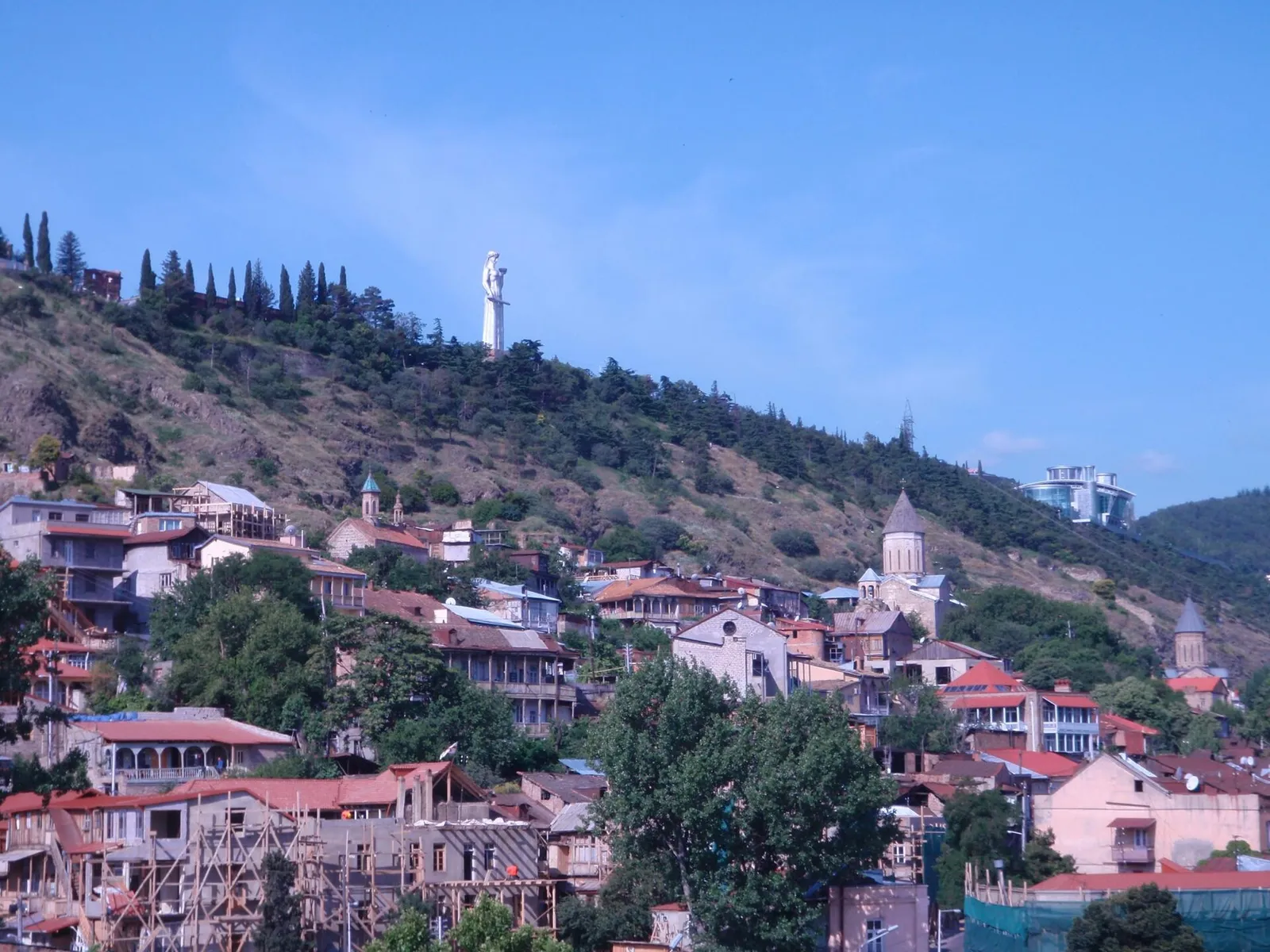
Less than you think for desks, more than you think for everything else, and the team goes home without having spent an evening together. Desks are the cheap part: the rooms, the meals and the logistics are what a mountain venue bundles and a city does not.
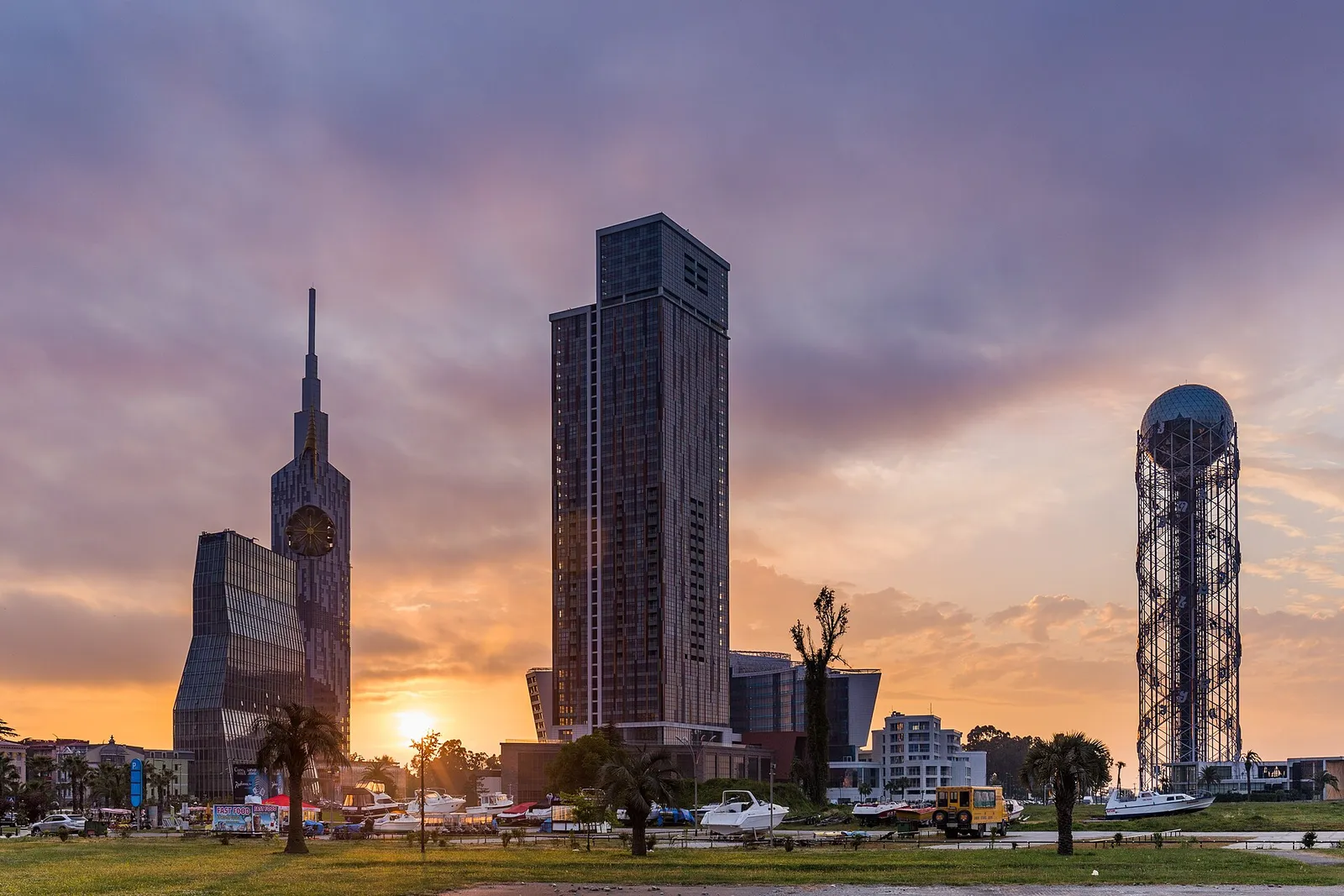
| Space | City | Day | Week | Team option | |
|---|---|---|---|---|---|
| The Hub | Tbilisi | by arrangement | by arrangement | Flex desk 425 GEL a month, fixed 525, private office from 1,400; conference room up to 35 | 4.9 (507) |
| Hubitat | Tbilisi | 35 GEL | 150 GEL | Five private desks with 20 hours of meeting room 1,750 GEL a month, plus 300 per extra person; training room for 8 at 220 GEL a half day or 380 a full day | 4.9 (53) |
| Impact Hub Tbilisi | Tbilisi | 40 GEL | 140 GEL | Meeting room for 8 to 10 with projector, 40 GEL an hour or 340 GEL a day | 4.6 (164) |
| Terminal (Vake) | Tbilisi | 40 GEL | by arrangement | Meeting rooms from 40 GEL an hour, private offices by branch | 4.6 (433) |
| LendSpace | Batumi | 30 GEL | 150 GEL | Week includes a dedicated desk, locker and 60 minutes of meeting room; month 490 GEL with 240 minutes | 4.8 (82) |
| Locus | Batumi | by arrangement | by arrangement | Several meeting rooms, weekdays only | 4.7 (99) |
| Terminal Batumi | Batumi | 40 GEL | by arrangement | Dedicated desks and a private office for up to 20 | 4.3 (46) |
Hubitat is the one Tbilisi space that prices a whole team rather than selling you eight hot desks: five private desks with 20 hours of meeting room at 1,750 GEL a month, 300 GEL for each extra person and four more meeting-room hours, and training rooms by the day at 380 GEL for 8 people or 650 GEL for 24. Hot desks are 35 GEL a day, 150 GEL a week, 195 for two weeks and 250 for three, and there is an off-peak rate of 20 GEL a day for a fixed four-hour window. The catch is the address: it is out in Didi Dighomi, not in the centre.
Impact Hub Tbilisi publishes the clearest small-team numbers in the country: 40 GEL a day for a pass valid 10:00 to 18:00, 140 GEL a week, and Meet #1, a room for 8 to 10 with projector and screen, at 40 GEL an hour or 340 GEL a day. A movable wall joins it to a second room that seats 16 boardroom style or 20 theatre style. It sits inside Fabrika, the converted sewing factory, and it ran a three-day regional camp there for 42 participants from four countries in July 2026. Google Maps marks the Fabrika location permanently closed while the membership page still sells these passes, so message them to confirm a desk before you build a week around it.
Terminal is the chain with the most branches, and the Vake one is the branch to book: 40 GEL a day, meeting rooms from 40 GEL an hour, 24-hour access for members, and private offices priced per branch rather than off a list. The open space is shared with other members, so take calls in a meeting room. Makers publishes the other team numbers worth knowing, a 6-person private room at 2,000 GEL a month and a 12-person room at 4,000 GEL with VAT and utilities included, but its space is temporarily closed.
On the coast, LendSpace is the best arrival-day or wet-day desk for a team: 150 m from the sea, open 10:00 to 22:00 every day, 30 GEL a day or 150 GEL a week with a dedicated desk, a locker and an hour of meeting room, booked over WhatsApp or Telegram and paid online in lari. The open room is shared with other members, so book the meeting room for anything that matters.
What workspace does a team get at Glamping Tago?
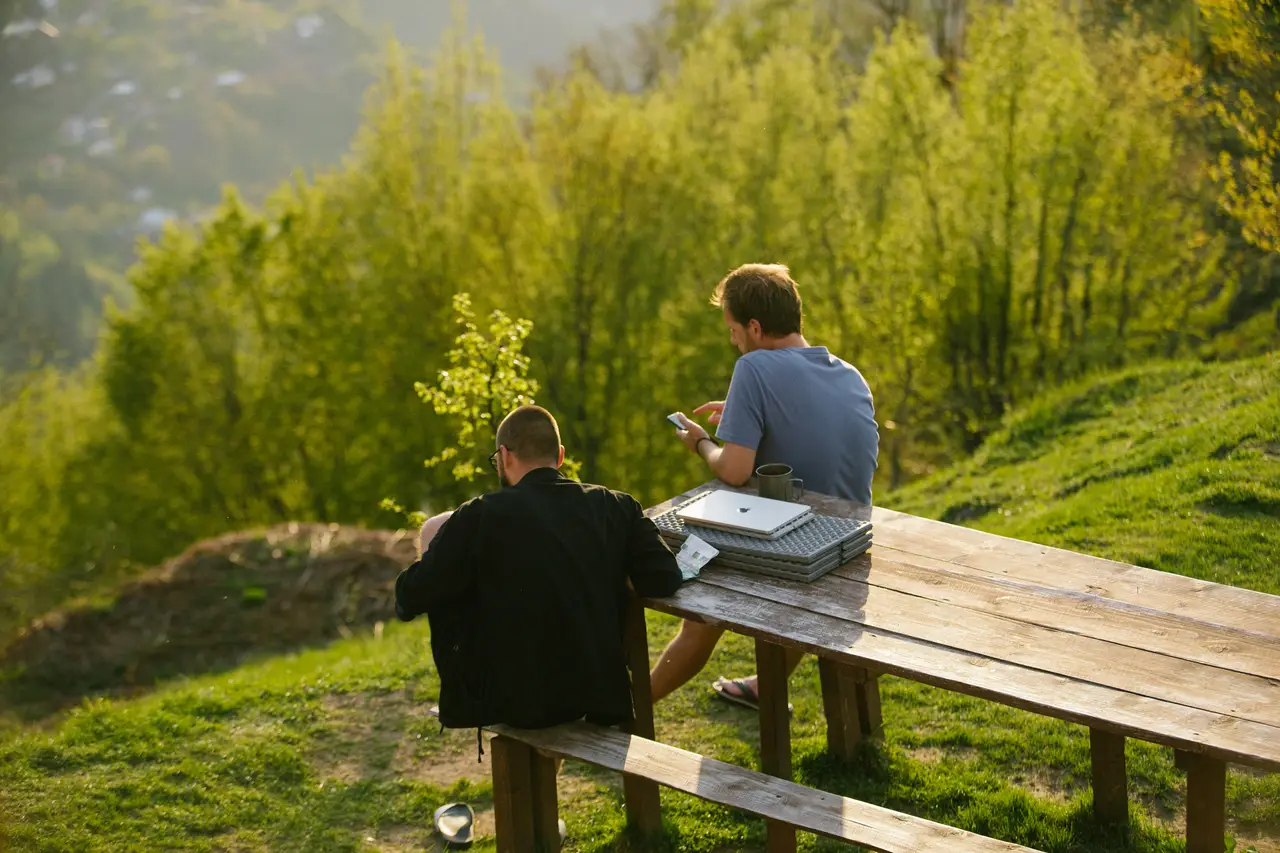
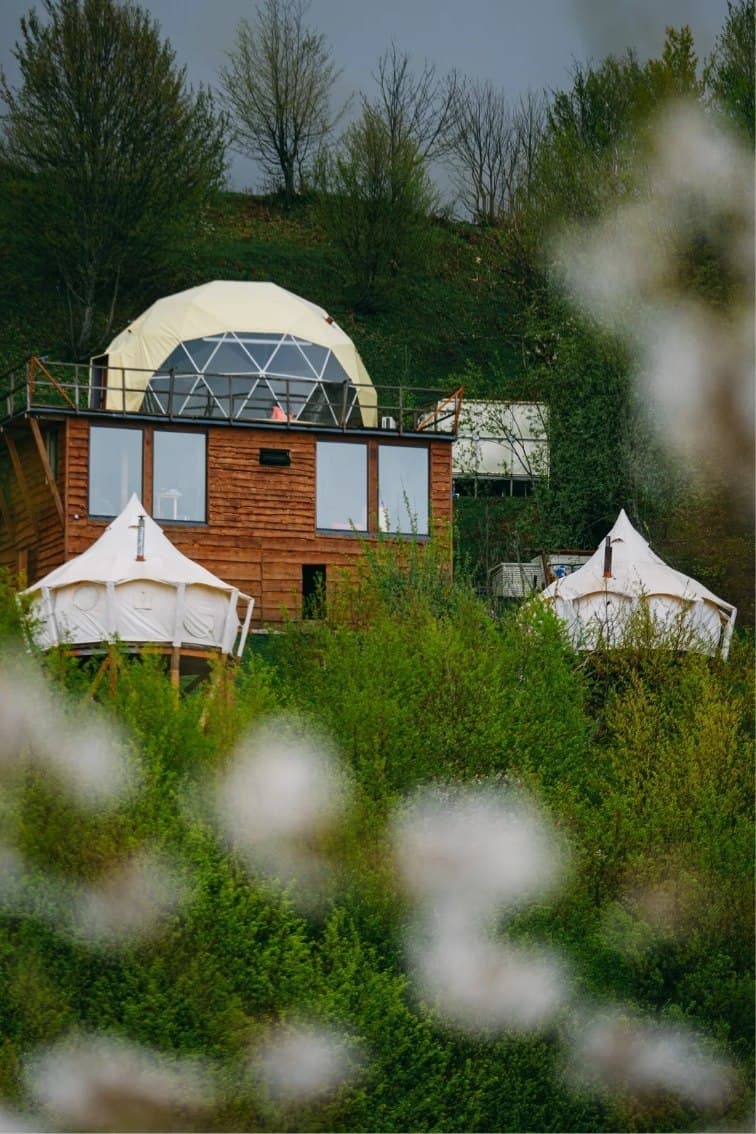
A quiet 38 m2 dome for calls, a 138 m2 covered platform for the whole group, the long table in the yurt and two breakout tents, all on our own Starlink line. None of it is a hotel ballroom, and on a buyout all of it belongs to the team for the week.
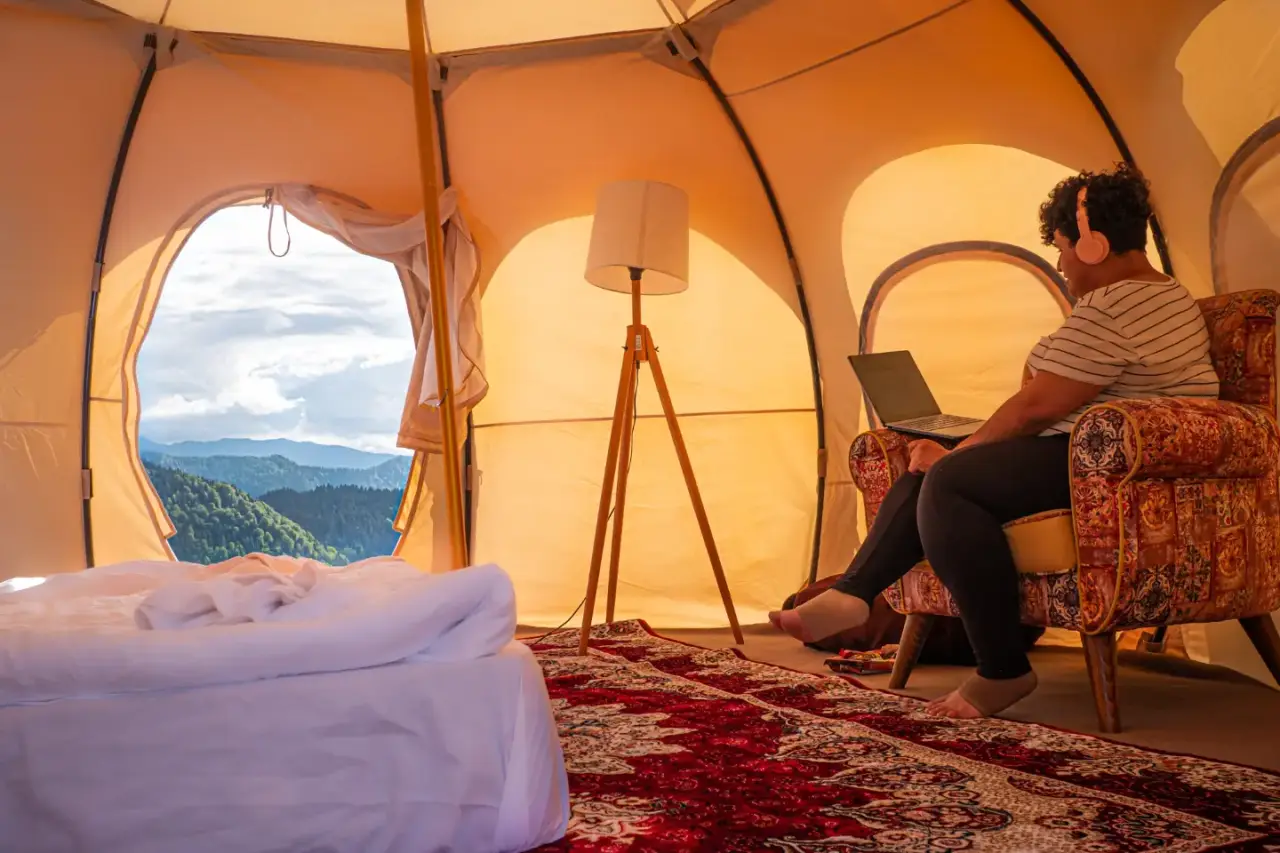
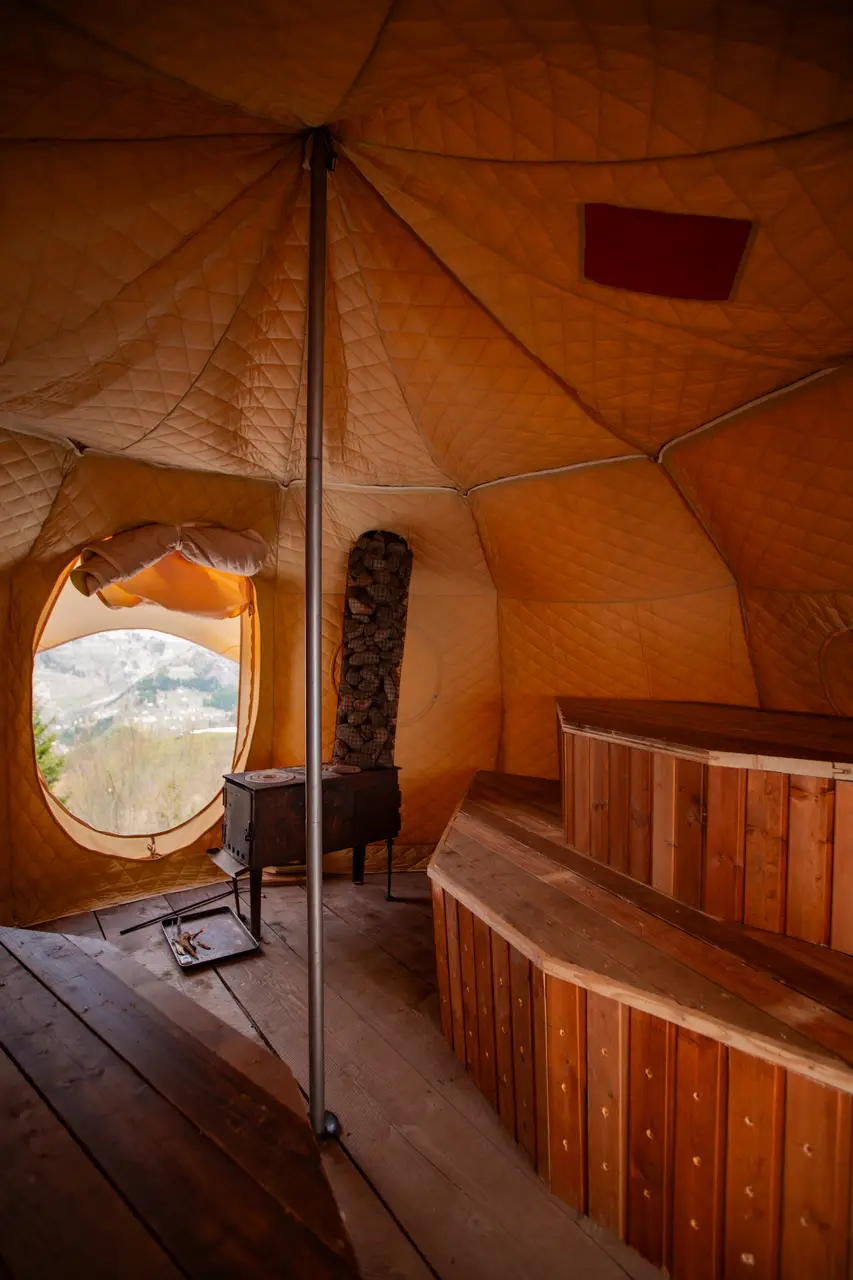
- A 38 m2 indoor geodesic dome, the quiet room: desks, chairs, and the door closed during calls. It doubles as the yoga shala, so it is booked out for an hour in the morning.
- A 138 m2 platform under a sailcloth tent for the whole group: standups, workshops, the projector and screen, whiteboards and post-its, with coffee and snacks refreshed every two hours.
- The long table in our restaurant yurt, which the group works from during co-working weeks once breakfast is cleared.
- Two breakout tents for parallel sessions and one-to-ones.
Projector, screen, speaker and microphone are on site. Power and Wi-Fi reach every tent, so the early risers and the night owls work from their own porch instead of waiting for the dome to open. There is no air conditioning anywhere on the hill, which at 1,200 m is a thing you notice for about two afternoons in August and never again.
How does the daily rhythm run in the mountains?
A workation without a structure turns into a holiday with laptops open on it. Ours has a rhythm the team opts into, built around the kitchen hours rather than against them.
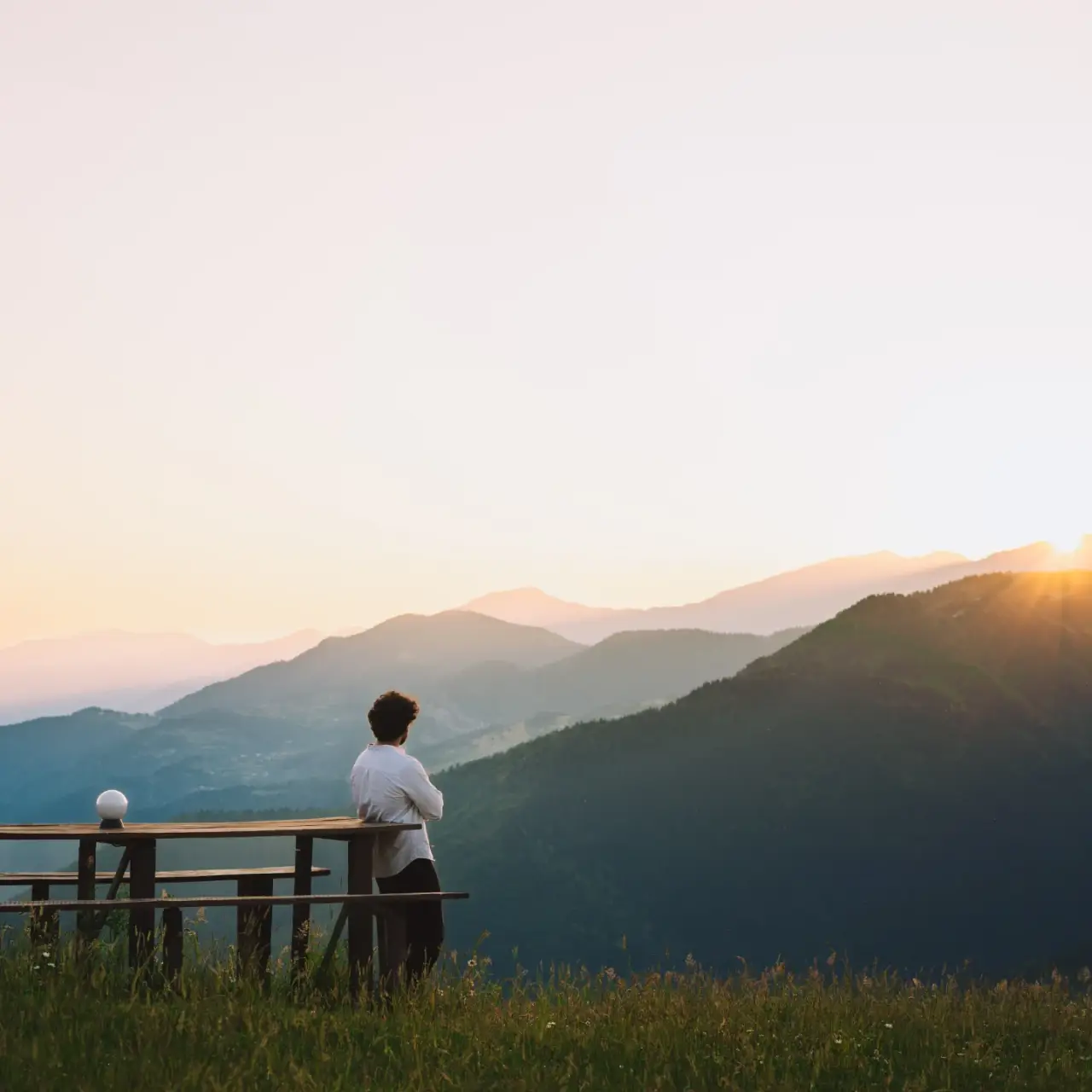
- 09:00 to 11:00: breakfast buffet, after sunrise yoga for whoever wants it. Yoga is included every day, indoors in the dome or out on the platform.
- Morning block: the dome and the platform are work-only. This is the European team's quiet time, because Berlin has not started yet.
- 13:00 to 16:00: lunch a la carte, which is deliberately not a buffet, so people eat in shifts around their calls.
- Afternoon block: the calls land here. Central Europe is awake from about 11:00 local and the overlap runs to the end of the Georgian working day.
- 19:00 to 21:00: dinner buffet at the long table, everybody at once.
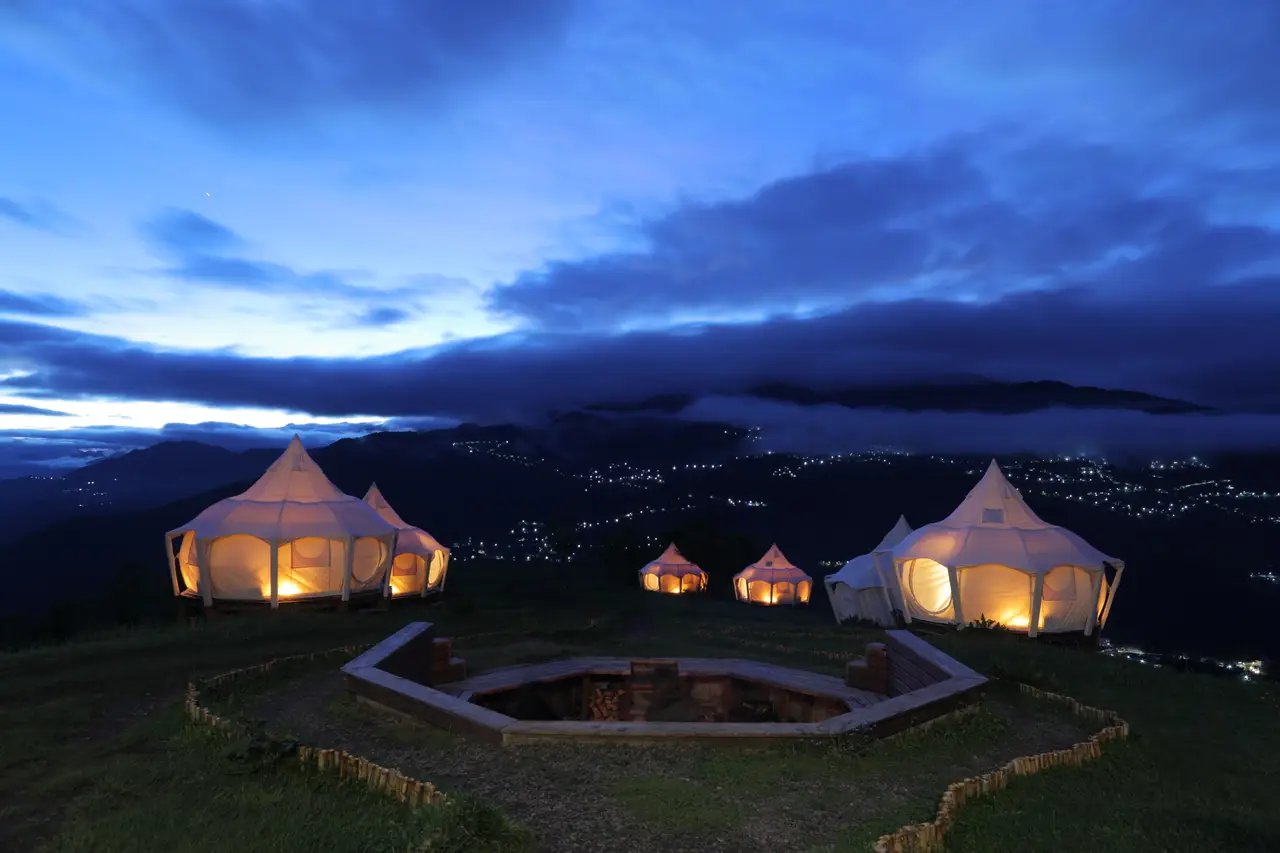
- 20:00 to 22:00: the wood-fired sauna with the cold plunge is lit every evening and is included for staying guests, then the campfire when the sky is clear.
- 23:00: quiet hours start, which is also why people are functional at nine.
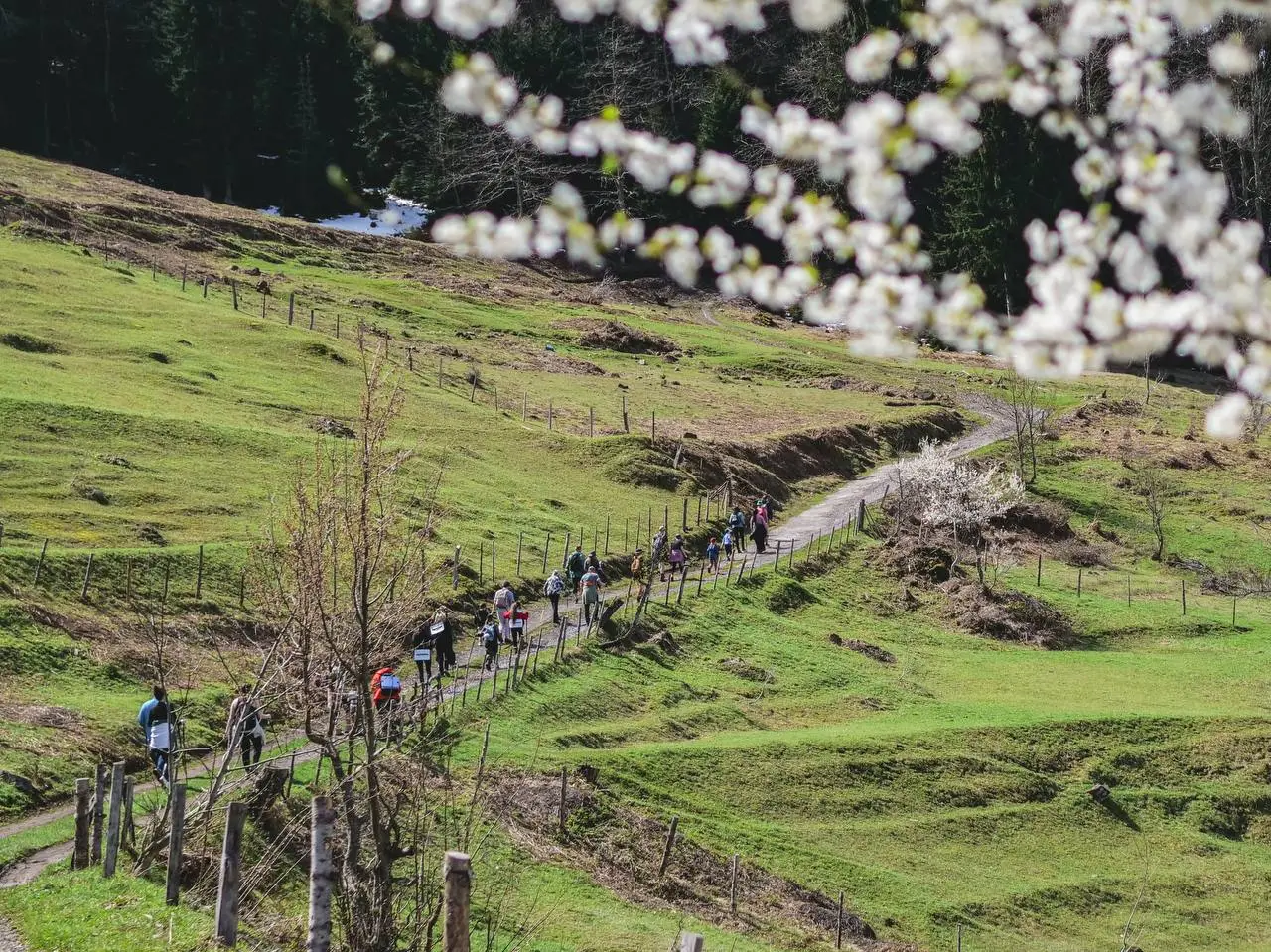
Hikes and activities run midweek, not only at the weekend. Five marked routes leave the gate, two to six hours each, free to walk or 150 GEL with a guide: a two-hour village loop, a hilltop built for a picnic, a monastery in the next valley. A half day out is a better afternoon for a team than a half day of workshops, and the jeep days to Green Lake, Khikhani fortress, the Shuamta lakes or Goderdzi work in either slot. For a team that wants one hard shared day, the Uchkho canyon runs six hours with certified guides and all the equipment, for 4 to 15 people.
Sleeping and eating: where does the team sleep, and what does the kitchen cook?
Twelve Lotus Belle tents sleeping two each, with a wood stove, a gas heater, electricity and Wi-Fi, plus a nine-bed Half Dome dormitory: 33 beds on the ridge. That is the ceiling for a self-contained week, and it is why groups here stay small enough that everyone knows everyone by Wednesday.
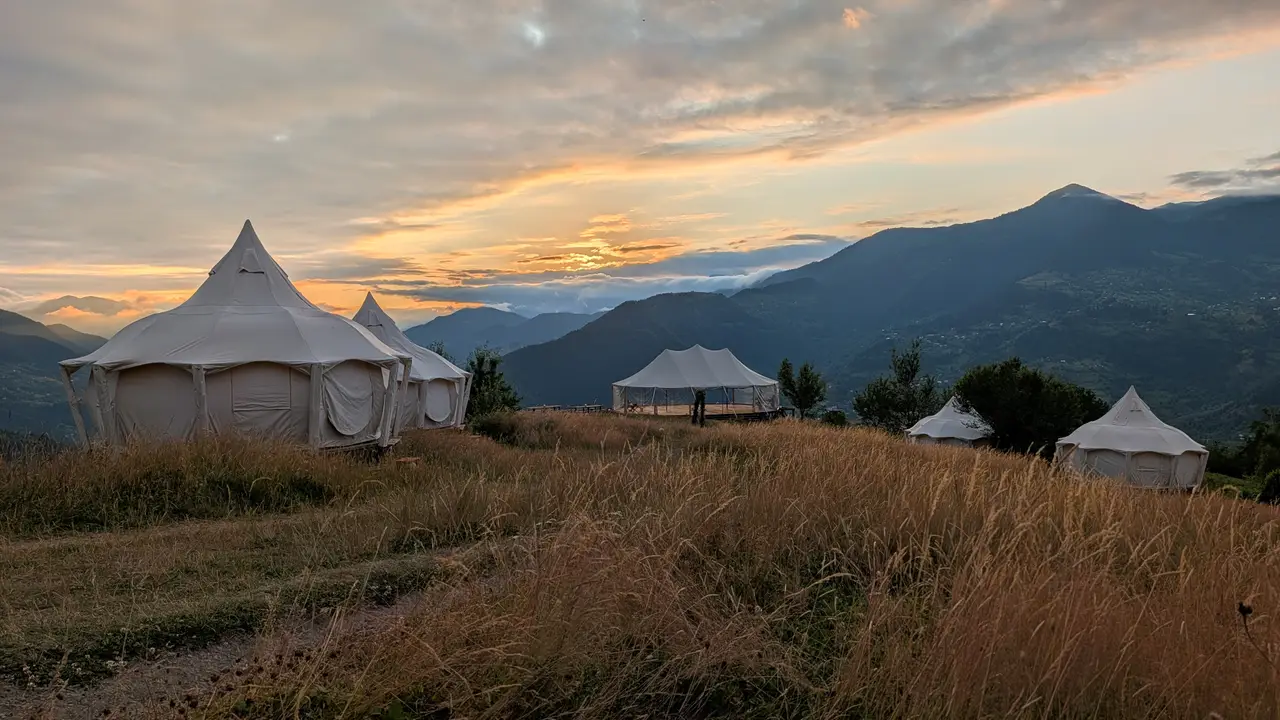
Above 33 the village takes the overflow. Seven families in Village Tago run guesthouses with 27 rooms and 64 beds, three to ten minutes on foot, at 150 GEL a room per night, booked through us, and there are about 60 camping spots between the house gardens and the camp on top of that. The combination is proven at scale: a group of more than 100 people spent six nights here in August 2026 across the camp and the village with one kitchen feeding everybody, and a 100-person team building ran over 10 to 13 June 2026.
Two bathhouse blocks hold two showers and two toilets each with hot water. There is no bathroom inside the tents. Towels and bedding are provided, laundry is 15 GEL, and the tap water comes straight off the mountain and is drinkable, so bottles and thermoses refill for free instead of buying the 3 GEL half litres.
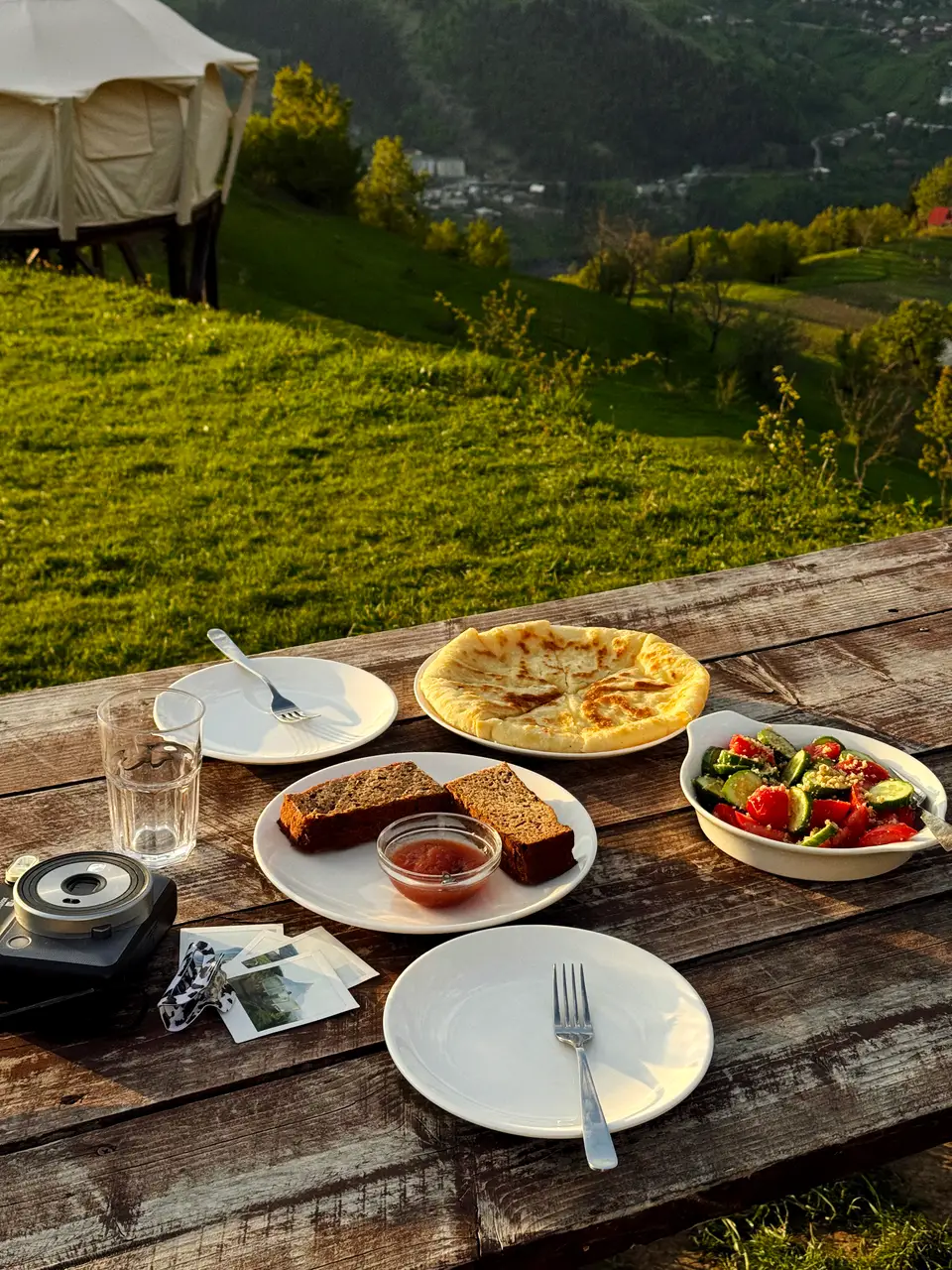
The kitchen is fully vegetarian, with no meat and no fish. Say that out loud to the team before anyone books flights, because it is the single thing people are surprised by on arrival. Vegan and gluten-free are straightforward with notice. For a group that wants meat at one meal, a BBQ live station is 45 GEL per person for the whole group and meat khinkali on a supra is 15 GEL per person. Group catering runs 85 GEL a head for a Georgian supra, 125 for a Euro-Georgian buffet and 215 for the five-course signature menu from 30 guests. Own wine is welcome for a corkage fee of about 15 to 20 GEL a bottle.
The kitchen at Glamping Tago, Village Tago
The yurt restaurant is where all three meals happen and where half the working day ends up. It seats 24 at the long table and up to 32 with extra tables, and the buffets are cooked fresh each morning by local cooks. Breakfast runs 09:00 to 11:00 at 32 GEL, lunch is a la carte 13:00 to 16:00, and the dinner buffet is 19:00 to 21:00 at 37 GEL, which is 100 GEL per person per day on full board. Outside food and drink are not brought in.
Does Georgia's time zone work for a distributed team?
Yes for Europe, the Gulf and India, and with one late window for the US East Coast. Georgia is UTC+4 all year on the IANA zone Asia/Tbilisi, with no daylight saving, so the offsets only move when the other side changes its clocks.
- Berlin, Amsterdam, Paris: two hours behind in summer, three in winter. The mountain morning is yours, European meetings land after lunch, and the local day ends at 18:00 while head office is mid-afternoon. This is the pairing the week is built for.
- London: three hours behind in summer, four in winter.
- Dubai, Abu Dhabi: the same hour. No maths at all.
- India: an hour and a half ahead, so a Bangalore team is winding down as the mountain afternoon starts.
- US East Coast: eight hours behind in summer, nine in winter. Keep one late overlap window and make the rest async, or accept that someone is taking a 19:00 call in the sauna queue.
What does a workation week in the Georgian mountains cost in 2026?
Accommodation is priced per tent per night, food per person per day, and the workspace comes with the booking. A person sharing a tent for seven nights in September with three meals a day comes to 1,638 GEL. Here are the 2026 rates a group is quoted.
2026 prices
| What | 2026 price | Notes |
|---|---|---|
| Lotus Belle tent, per tent per night | April 147, May 200, June 268, July 336, August 336, September 268, October 173 GEL | Sleeps two, wood stove and Wi-Fi |
| Whole nine-bed dorm, per night | April 294, May 400, June 536, July 672, August 672, September 536, October 346 GEL | The Half Dome, taken as a block |
| Whole-property buyout, per night | April 1,962, May 2,520, June 3,584, July 4,488, August 4,488, September 3,584, October 2,316 GEL | Every bed and every space |
| Event privatisation fee | 2,000 GEL | On top of a buyout, for events |
| Full board | 100 GEL per person per day | Breakfast 32, lunch 25 to 31, dinner 37 |
| Group catering, per person | Georgian supra 85, Euro-Georgian buffet 125, five-course signature 215 GEL | Signature menu from 30 guests |
| Village guesthouse room, per night | 150 GEL | 27 rooms and 64 beds, 3 to 10 minutes on foot |
| Extra mattress in a Lotus | Child 30, adult 50 GEL a night | Children 0 to 6 eat free, 6 to 12 pay half |
| Private 4x4 transfer, per car up to 4, one way | Khulo 75, Batumi 265, Akhaltsikhe 360, Kutaisi 465, Tbilisi about 925 GEL | Plus 20 GEL for multiple pickups, plus 50 GEL for a waterfall picnic stop |
| Marshrutka Batumi to Khulo | about 10 GEL per person | Old bus station, every 30 minutes 08:00 to 20:00 |
| Taxi app Batumi to Khulo | up to 175 GEL | Bolt, Yango or Maxim |
| Kutaisi airport to Batumi | Train 31 GEL, Georgian Bus minivan 25 GEL | Just under 2 hours either way |
| Tbilisi to Batumi by train | 36 GEL second class, 76 GEL first | 4h01, four departures a day |
| Jeep day from the camp, per group | Single destination 400, combined day 600, Ghorjomi 250 GEL | 1 to 14 people; about 85 to 100 GEL a head from six people |
| Uchkho canyoning day | 415 to 1,125 GEL by group size | Six hours, certified guides, equipment included |
| Hiking guide | from 150 GEL | Five marked routes, free to walk unguided |
| Sauna and cold plunge | Included every evening; guided ritual from 40 GEL per person | Private session outside the evening hours 150 GEL |
| Georgian cooking workshop | from 50 GEL per person | Adjaruli khachapuri, hands on |
| Painting workshop | from 100 GEL per person | |
| Guided forest and herb walk | from 300 GEL per group | With a local herbalist |
| Jara honey tour with a Georgian feast | from 200 GEL per person | Half day, at the beekeeper's table |
| Movie night on the platform | from 5 GEL per person | |
| Laundry | 15 GEL | Bottled water 3 GEL per half litre, tap water free |
| Mandatory entry insurance | from 1.7 GEL per person per day | 30,000 GEL cover, bought online |
What a real week adds up to
| Team | What they book | 2026 total | Per person |
|---|---|---|---|
| One person, 7 nights in September | Half a Lotus tent plus full board | 1,638 GEL | 1,638 GEL |
| Team of 8, 7 nights in September | 4 tents plus full board | 13,104 GEL | 1,638 GEL |
| Team of 12, 5 nights in June | 6 tents plus full board | 14,040 GEL | 1,170 GEL |
| Team of 20, 5 nights in June | 10 tents plus full board | 23,400 GEL | 1,170 GEL |
| Team of 28, 5 nights in June | Whole-property buyout plus full board | 31,920 GEL | 1,140 GEL |
Transfers sit on top: two 4x4 cars bring eight people up from Batumi for 530 GEL each way, and we pool a team's arrivals into shared cars so nobody waits three hours at the airport for the last flight.
The organiser eats free for the whole stay, and an agency or organiser booking on a client's behalf earns the standard 10% commission against a commission invoice.
How do you get a whole team to Village Tago?
Fly to Batumi. It is 91.8 km from the city over the Sh 1 Batumi to Akhaltsikhe road, or 87.1 km from the airport, and the real drive is about 2h30 because the last stretch out of Khulo is a mountain road. Batumi sits at sea level, Khulo at 942 m and the camp at about 1,200 m.
| Leg | Distance | Time | How |
|---|---|---|---|
| Batumi to Khulo | 85.9 km | 2 to 2.5 hours | Asphalt the whole way |
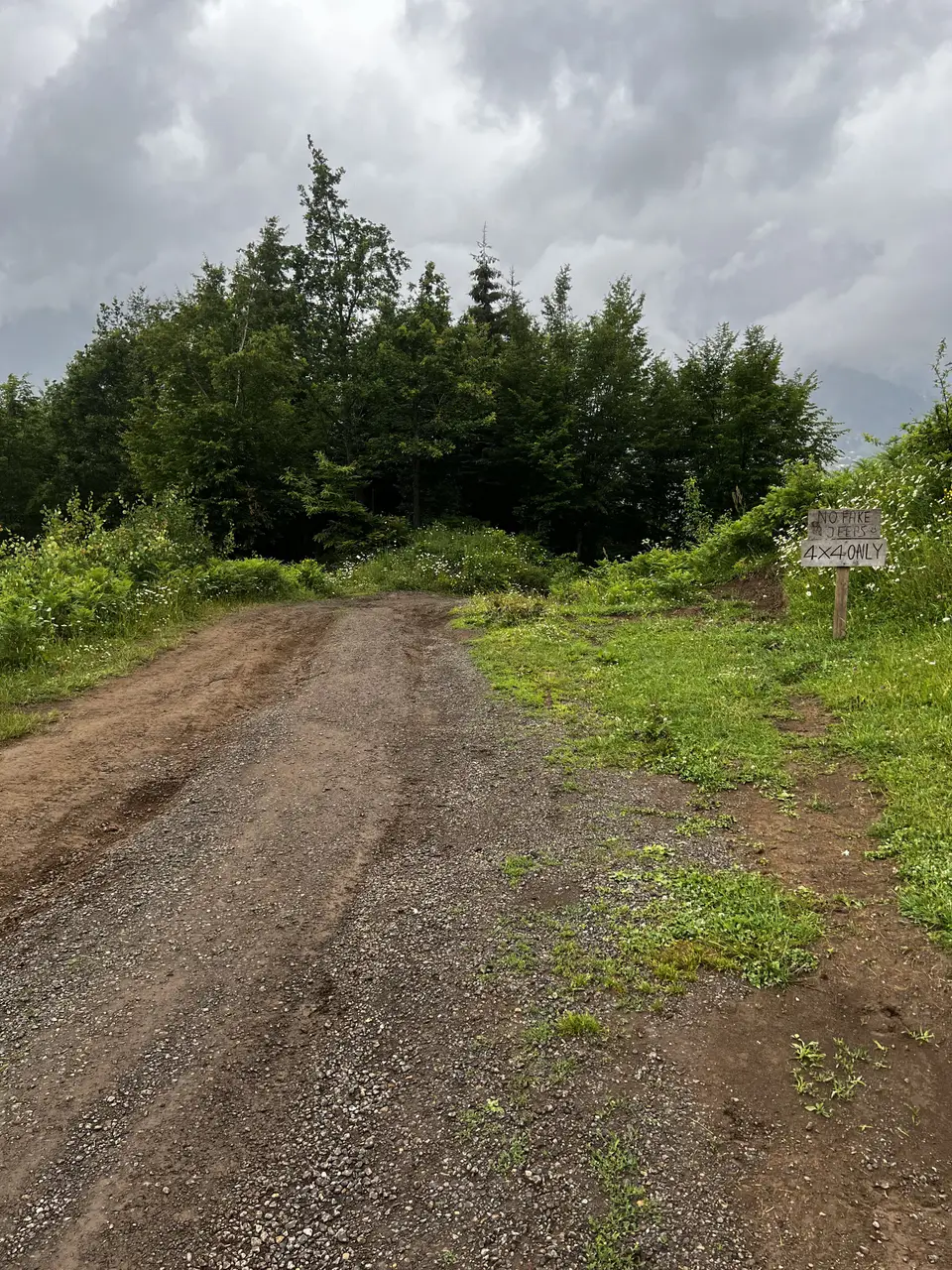
| Khulo to Village Tago | 8.9 km | 30 to 35 minutes | 4x4 only, up from Khulo at 942 m |
| Batumi airport to Village Tago | 87.1 km | about 2.5 hours | Private 4x4, 265 GEL per car |
| Kutaisi airport to Village Tago | 213.8 km via Batumi | our transfer sheet allows 5h30 | The shorter line on the map is the Bakhmaro to Khulo mountain track, not a road for a minibus |
| Tbilisi to Village Tago | 449.4 km via Batumi on asphalt, or 296.5 km over the Goderdzi pass in summer | our transfer sheet allows 8h30 | The pass route is shorter and rougher |
By marshrutka, the cheap way: minibuses leave Batumi's old bus station every 30 minutes from 08:00 to 20:00 for about 10 GEL, and the window sign reads ბათუმი - ხულო. Allow 2h30, up to three hours with traffic, and the last kilometres into Khulo are under repair and slow. At 2.9 stars from 93 reviews it is not a pleasant bus station and nobody pretends otherwise, but it works. The minibus stops halfway for food and a toilet.
By private transfer, the way a team actually travels: a 4x4 takes four people from Batumi for 265 GEL one way, or 75 GEL from Khulo, and we run multi-wave pickups from Batumi, Kutaisi and Tbilisi pooled into shared cars. For a Tbilisi minibus transfer we collect the group at any address in the city the organiser picks. Transfers are paid in cash to the receptionist at the camp, never to the driver, and the 4x4 has no fixed hours, so a 23:00 arrival in Khulo is fine as long as somebody messages us about 30 minutes out.
Flying in: Istanbul is the year-round link to Batumi, with Turkish Airlines and Pegasus; Air Baltic to Riga is the only direct EU route, and the rest of Batumi's route map is seasonal, from Tel Aviv, Dubai, Riyadh and Amman to Central Asia and many Russian cities, plus Georgian Wings to Tbilisi and Tehran. Kutaisi is the cheap way in from Europe. From Kutaisi airport a Stadler train reaches Batumi Central in just under two hours for 31 GEL in second class, with a free shuttle bus between the terminal and the station, and Georgian Bus runs a direct minivan timed to arrivals for 25 GEL in about two hours. The hourly marshrutka from Kutaisi bus station takes three hours for 20 GEL and stops at the Batumi bus station where the Khulo minibus leaves.
From Tbilisi, take the train rather than the road: four double-decker departures a day at 06:30, 08:05, 10:15 and 17:10, four hours and one minute to Batumi, 36 GEL in second class and 76 GEL in first, power sockets in every row, and the same trains stop at the Kutaisi airport station. Seats go on sale on tkt.ge and Georgian Railway's own site 20 days ahead and the summer Batumi trains sell out, so book the team's seats the day sales open. The Didube marshrutka is seven hours for 35 GEL and the Ortachala bus six and a half for 40 GEL.
There is a second road, and it is the one to put a minibus on. The Skhalta valley route leaves the Sh 1 at the Zamleti turn-off 4.7 km before Khulo, 94 km and about two hours from Batumi, then runs 15 km and 35 minutes up through Cheri, where you take the road uphill before you reach Skhalta monastery, and a last 3.6 km and 9 minutes through Dzmagula and Samtsukhi to us. It is a little longer than going through Khulo and the gradient is gentler, which is why normal cars and minibuses manage it.
Which month should you pick for a mountain work week?
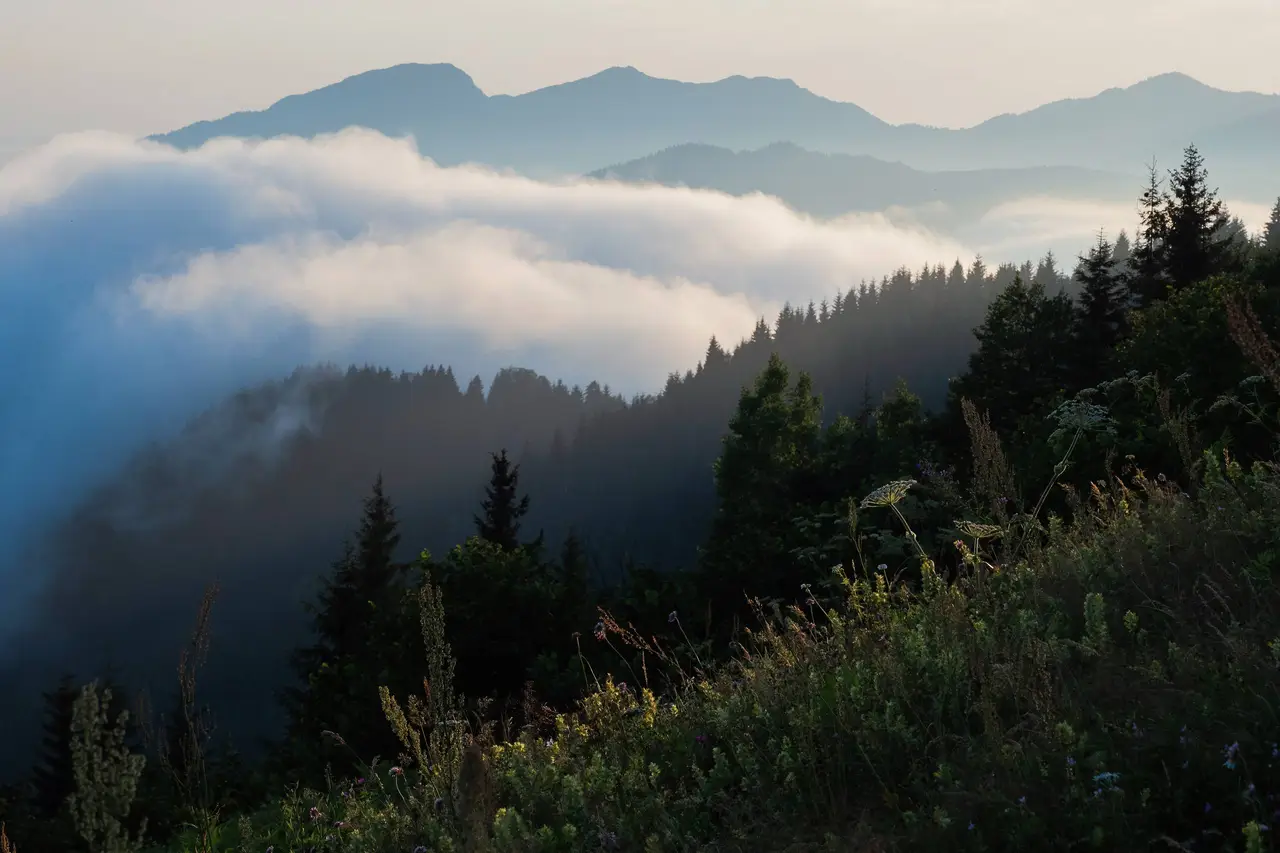
May to July, if the work matters more than the foliage. The Khulo climate series puts July at the driest month of the year and October at the wettest, and sunshine holds above 12 hours a day from April to September.
| Month | Mean temperature | Rainfall | What it means for a working week |
|---|---|---|---|
| April | 14.2 C | 64.7 mm | We open on the 1st, rates are at their lowest, nights are properly cold |
| May | 19.7 C | 50.7 mm | Green, quiet, dry, and the cheapest good month |
| June | 23.9 C | 55.7 mm | The most sunshine of the year at 14.3 hours a day |
| July | 25.5 C | 48.2 mm | Driest month of the year, peak rates |
| August | 26.1 C | 61.2 mm | Warmest, busiest, book six to twelve months out |
| September | 22.9 C | 95.0 mm | Still warm, but rainfall nearly doubles |
| October | 17.9 C | 110.7 mm | Autumn colour, the wettest month, we close at the end of it |
We close from November to March, and the reason is the road rather than the cold: heavy snowfall closes mountain roads in upper Adjara and cuts the power, and there is no mains gas in the region, so heating runs on wood stoves. A team that needs winter dates should look at Ambassadori Goderdzi, which stays open, or at Gumbrini's indoor winter sessions near Kutaisi.
How do you book a team week, and in what order?
June to September dates go six to twelve months ahead, so the order matters more than the speed.
- Send the brief. Team size, dates, and what the week has to produce. Anastasia, our retreats coordinator, replies within 24 hours on teambuilding.glampingtago.ge with availability, a draft programme and a quote: +995 599 29 97 57, anastasia@glampingtago.ge.
- Hold the dates. We pencil dates for a maximum of one week without money. After that they go back on the calendar.
- Confirm with 30%. A 30% prepayment of the total fixes the dates. It is non-refundable and it is your minimum bill, whatever happens to the numbers later. Inside about 60 days for a June to August week, the minimum rises to 50% upfront with the rest due within a week.
- Book flights around the transfer, not the other way round. Tell us the arrival waves and we pool the cars.
- Adjust the tents. More than 60 days out, add or remove freely. Between 60 and 30 days, two tents come off free; between 30 and 14 days, one more.
- Send the programme 30 days out. The daily schedule does not depend on the exact number of tents, so it can be settled early.
- Buy the insurance. One policy per person, 30,000 GEL minimum, covering every day including arrival and departure.
- Confirm final numbers 14 days out, in writing. The accommodation balance is invoiced at that point, paid before arrival, and the booking is fixed from then on.
- Send the tent allocation list 7 days out. Who sleeps where, and which beds are doubles and which are twins.
- Settle food and extras at the end of the stay.
Companies pay by GEL bank transfer or a 24-hour payment link in GEL with no commission, and we invoice in GEL or EUR. Russian-issued Visa, Mastercard and Mir cards do not work in Georgia, so those colleagues use KoronaPay, cash or a transfer from a Georgian account. We do not take crypto.
Can a few people join an open week instead of booking the whole camp?
Yes. Besides a private week for one company, two open formats sell single places, so three formats run here in all.
Altitude AI Weeks are our own themed co-working weeks at co-working.glampingtago.ge: 33 spots, a minimum of three nights and a maximum of seven, with a bed, three meals a day, the workspace, yoga and the sauna included. Founders, engineers and builders work on their own things by day and join hands-on sessions together.
Digital Detox and Mental Health Week runs from 26 October to 1 November 2026, six nights for 33 people with the phones in a box: daily psychological talks and group sessions, yoga and sport, sauna and ice baths. Full price is EUR 600 in the Half Dome dorm, EUR 810 for a bed in a shared Lotus and EUR 1,190 for a private tent, everything included; until 12 October it is 10% less, at EUR 540, 730 and 1,070. A 30% prepayment reserves a spot and the rest is paid on arrival. Shorter stays are sold from 4 nights at EUR 100 a night, and a cancellation at least two weeks before the start is refunded in full. The longer version of that idea is in our digital detox guide.
A private week is the whole property for your dates, with the programme built around your agenda. That is what most companies book, and it is the format the offsite venues guide compares against the rest of the country.
What do teams get wrong about a mountain workation?
Glamping Tago for this
A workation week for your team at Glamping Tago
We are on the hill above Village Tago in Khulo municipality, mountainous Adjara, at about 1,200 m and about two and a half hours from Batumi. A team takes the whole property: 12 Lotus Belle tents, a nine-bed dorm, the dome, the platform and the yurt restaurant, for its own dates and its own agenda.
The work part is the part we build for. A 38 m2 indoor geodesic dome as the quiet call room, a 138 m2 covered platform for standups and workshops with projector, screen, speaker and microphone, two breakout tents for parallel sessions, and Starlink at about 300 Mbps with Magti mobile as the fallback. Power and Wi-Fi reach every tent.
The rest runs itself. Three vegetarian meals a day at one long table in Yurtalicious, sunrise yoga included, the wood-fired sauna and cold plunge lit every evening, a campfire on clear nights, and five marked hiking routes straight from the gate. Anastasia replies within 24 hours with availability, a draft programme and a quote.
- Guests
- 10 to 28 for a team week, 33 beds at the maximum
- Beds on site
- 12 Lotus Belle tents for two plus a nine-bed Half Dome dorm
- Workspaces
- 38 m2 indoor geodesic dome, 138 m2 covered platform, yurt long table, two breakout tents
- Internet
- Starlink at about 300 Mbps on our own line, Magti mobile as the fallback
- Price from
- 147 GEL per tent per night in April, plus 100 GEL per person per day full board
- Whole-property buyout
- 1,962 to 4,488 GEL a night depending on the month
- Drive time from Batumi
- About 2h30 over 91.8 km, the last 8.9 km by 4x4
- Season
- 1 April to the end of October
Questions people ask
Where can a remote team do a workation in Georgia (the country)?
Glamping Tago in the Adjara mountains, about two and a half hours from Batumi, runs workation weeks for 10 to 28 people with a 38 m2 indoor geodesic dome, a 138 m2 covered platform, Starlink and 33 beds on the ridge. The alternatives that can hold a team with a real meeting room are Hotel Ambassadori Goderdzi in the same mountains, Rooms Kazbegi and Emerald Borjomi out of Tbilisi, and Gistola in Mestia.
Does my team need a work permit to work remotely from Georgia in 2026?
No, not if everyone keeps working for their own employer abroad. The work-activity permit in force from 1 March 2026 applies to foreigners without permanent residence who work for a local employer registered in Georgia, including remotely, or who are self-employed or run a business here. A foreign payroll and foreign clients fall outside all three. The colleague who holds a Georgian individual-entrepreneur registration is the one to check, because the exemption for serving non-resident clients stops applying to them.
Do you need travel insurance to enter Georgia in 2026?
Yes. Since 1 January 2026, Decree No 602 requires health and accident insurance of at least 30,000 GEL covering the whole stay, including the arrival and departure days. The sum is in lari, not dollars. It can be on paper or on a phone, in Georgian or English, from any insurer, and the border police may ask for it. Cover starts at 1.7 GEL per person per day, or 36 GEL for a ten-day policy.
Is the internet in the Georgian mountains good enough for video calls?
Not by default: remote mountain areas in Georgia run 0 to 10 Mbps and the national fixed-broadband median was 55.07 Mbps in August 2026. At Glamping Tago the line is Starlink, measured at about 300 Mbps, with Magti mobile as the fallback, and remote teams from Berlin, Lisbon and Amsterdam have run full working weeks of video calls from the ridge. Bring Magti SIMs as a hotspot fallback, because Magti is the carrier that reaches upper Adjara.
How much does a workation week in Georgia cost per person?
1,638 GEL for one person sharing a Lotus tent for seven nights in September with three meals a day. A team of eight on the same dates is 13,104 GEL, a team of 20 for five nights in June is 23,400 GEL or 1,170 GEL each, and a team of 28 taking the whole property for five nights in June is 31,920 GEL or 1,140 GEL each. Transfers, flights and the 30,000 GEL entry insurance are on top.
What time zone is Georgia in, and does it work for a European team?
UTC+4 all year, with no daylight saving. That is two hours ahead of Berlin in summer and three in winter, so the mountain morning is free for deep work, European meetings land after lunch and the local day ends while head office is mid-afternoon. Dubai is the same hour, India is an hour and a half ahead, and New York is eight to nine hours behind.
Do remote workers need a visa for Georgia?
Citizens of 94 countries and territories may enter and stay for a full year without a visa under Ordinance No 255, as amended on 24 February 2026, and EU citizens may enter on a national identity card. Check the list for your team's passports before booking flights. Spending 183 days or more in any rolling 12 months makes a person a Georgian tax resident for the whole year.
What is the minimum stay for a workation at Glamping Tago?
Three nights, and seven is the maximum on our themed co-working weeks. Three nights is barely enough to arrive, sleep and leave, so most teams book a full week. Check-in is from 15:00 to 16:00 and check-out is at 11:00, with no early check-in or late check-out fee.
Is a workation the same as a team offsite?
No. An offsite is a few days of workshops with the laptops shut; a workation is an ordinary working week in a better place, with the team together in the evenings. Glamping Tago hosts both: themed co-working weeks that individuals and small teams join, and private buyouts where a company takes the whole property for its own agenda.
What does the daily programme at a workation week look like?
Sunrise yoga, then the breakfast buffet from 09:00 to 11:00, a morning work block while Europe is still asleep, lunch a la carte from 13:00 to 16:00, the afternoon block when the calls land, the dinner buffet from 19:00 to 21:00 at one long table, and the wood-fired sauna and cold plunge from 20:00 to 22:00, with a campfire on clear nights. Quiet hours start at 23:00, and hikes and jeep days run midweek, not only at the weekend.
How do we pay, and what if our team cannot use European cards?
Companies pay by GEL bank transfer or a 24-hour payment link in GEL with no commission, and we invoice in GEL or EUR. A 30% prepayment of the total confirms the dates and is non-refundable. Russian-issued Visa, Mastercard and Mir cards do not work anywhere in Georgia, so those colleagues use KoronaPay, cash or a transfer from a Georgian account. We do not take crypto, and transfers are paid in cash to the receptionist at the camp rather than to the driver.
Glamping Tago
Planning something in the mountains?
Tell us the dates and the number of people. We answer within a day, with a real price, not a brochure.