
Planning guides
Yoga Teacher Training Venue in Georgia (the Country): Where to Run a 200-Hour YTT in 2026-2027
Updated 19 October 202639 min readPrices and facts checked: September 2026
Two schools run a 200-hour yoga teacher training inside Georgia (the country), both in Tbilisi, and no teacher training in the country is listed on the big marketplaces at all. Here is where a school can run a three-week residential course instead: the venues, the halls, the Yoga Alliance and Georgian paperwork, and what three weeks costs per trainee.
On this page+
- Which venue fits a 200-hour yoga teacher training in Georgia?
- Where can you actually do a 200-hour yoga teacher training in Georgia (the country)?
- Why run a teacher training in Georgia (the country)?
- City course or three-week immersion: which model should your school run?
- What does a venue need for a 200-hour course, and what breaks first?
- What does a day on a 21-day course look like?
- Where can you hold a residential teacher training in Georgia? The venues compared
- Where do trainees sleep and eat on a residential training?
- What does a 200-hour YTT cost per trainee in Georgia in 2026?
- How does Georgia compare with Bali, India and a training at home?
- Do you need Yoga Alliance, and can you run an RYS 200 abroad?
- What does Georgia need on paper: visas, insurance and the right to labour activity
- When should you run it, and how does a three-week course fit the calendar?
- Getting a cohort here: how do trainees reach the venue?
- How do you fill a cohort, and what do the booking platforms take?
- How does a school book the venue: the order, the deposits and the deadlines?
- What goes wrong most often on a three-week training abroad?
- Questions people ask
Map of the places in this guide
Zoom with + and - or by pinching. Click the map first to zoom with the mouse wheel.
- 1Yoga Academy (Georgian Yoga Federation)
- 2Tbilisi Yoga Villa
- 3Tbilisi Yoga Loft
- 4Yoga Cave
- 5Lumos Yoga Studio
- 6Mesto Sily (Batumi)
- 7Mira Space
- 8Sangeeta Space
- 9Alexander Kartveli Batumi International Airport
- 10Kutaisi International Airport
- 11Glamping Tago
- 12Eco House Merisi Hotel and Restaurant
- 13Chateau Milisi
- 14Kiketi Farm
- Batumi airport to Village Tago by car · 87.1 km
- Khulo cable car station to Village Tago by 4x4 · 8.6 km
- Tbilisi to Kiketi Farm by car · 28.7 km
Which venue fits a 200-hour yoga teacher training in Georgia?
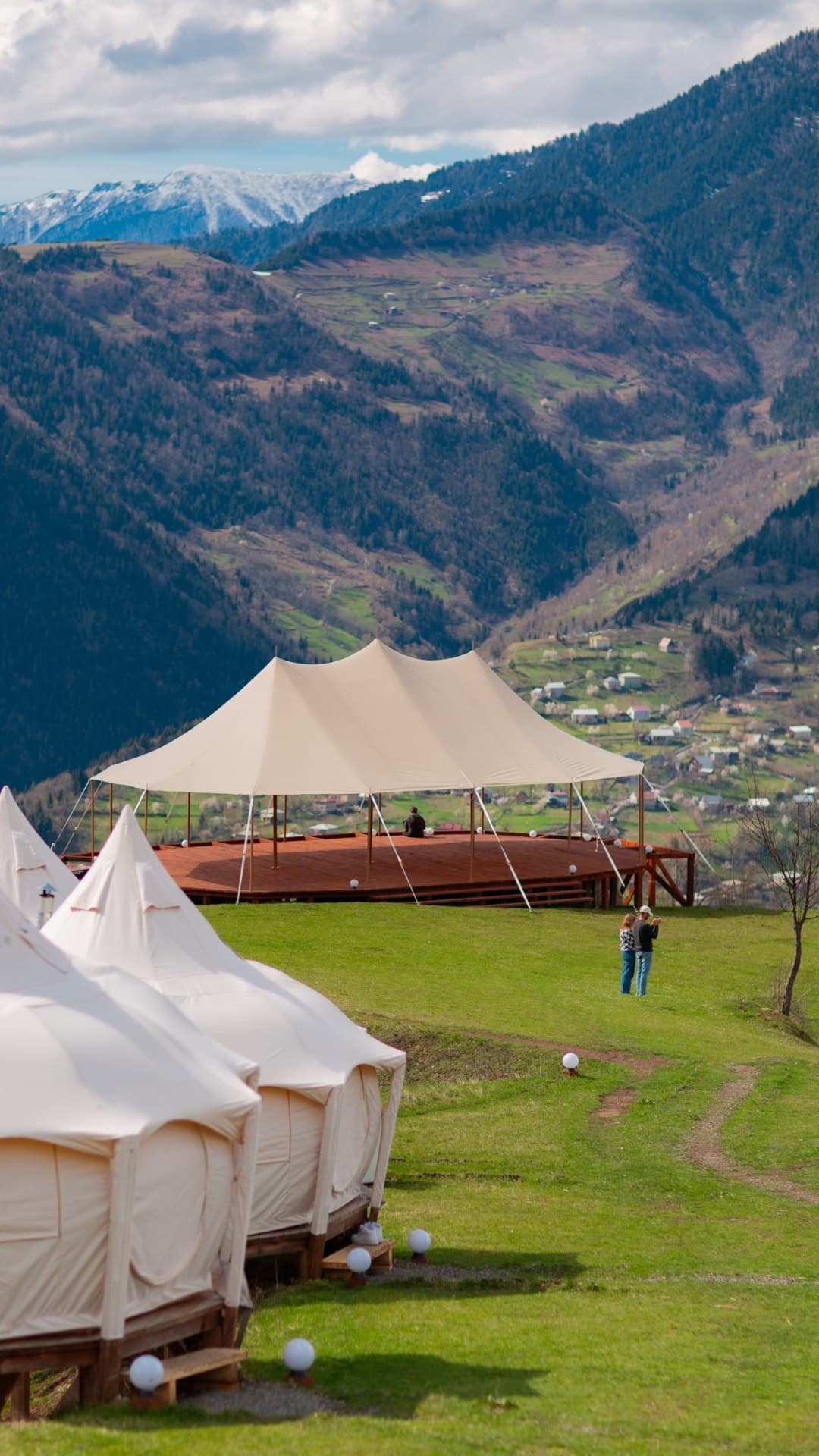
A residential 200-hour course needs a place your cohort has to itself, where everyone sleeps and eats on site and practice moves indoors when it rains. Glamping Tago in the Adjara mountains is built for that: it is made for weddings of about 30 guests and retreats of up to 30 people, the whole place belongs to one group and everyone sleeps on site; a Tbilisi studio suits a city course where trainees live in their own flats.
| Venue | Whole venue just for your cohort | Trainees sleep on site | Practice outdoors in nature | Private for the three weeks | Drive from the nearest airport | Cohort |
|---|---|---|---|---|---|---|
| Glamping Tago (ours), Adjara | Yes, whole-property buyout | Yes, 33 beds | Yes, a 138 m2 platform plus a 38 m2 indoor shala | Yes, on a buyout | Batumi, 87.1 km, about 2h30 | 12-33 trainees |
| Eco House Merisi, Adjara | Ask: a hotel with 15 cottages | Up to 54 in 12 cottages and 3 villas | No practice hall | Only if every cottage is booked | Batumi, 48.9 km, 65 min | By enquiry |
| Chateau Milisi, Adjara | No, a hotel | Hotel rooms | Conference space indoors | No | Batumi, 32.5 km, 48 min | By enquiry |
| Kiketi Farm, near Tbilisi | Ask: 27 rooms | Up to 65 | Yoga House for 15-50 | No, a farm park open to day visitors | Tbilisi centre, 28.7 km, 37 min | 40 and more |
| Tbilisi studios (Yoga Loft, Yoga Villa) | Rooms hired by the hour | No | No | No | In the city | 15-50 per room |
Where can you actually do a 200-hour yoga teacher training in Georgia (the country)?
Two schools run a full 200-hour course inside Georgia, and both are in Tbilisi. Everything else in the country is a weekend module, a studio intensive or a week-long retreat, which means a school bringing its own trainers has the residential market almost to itself.
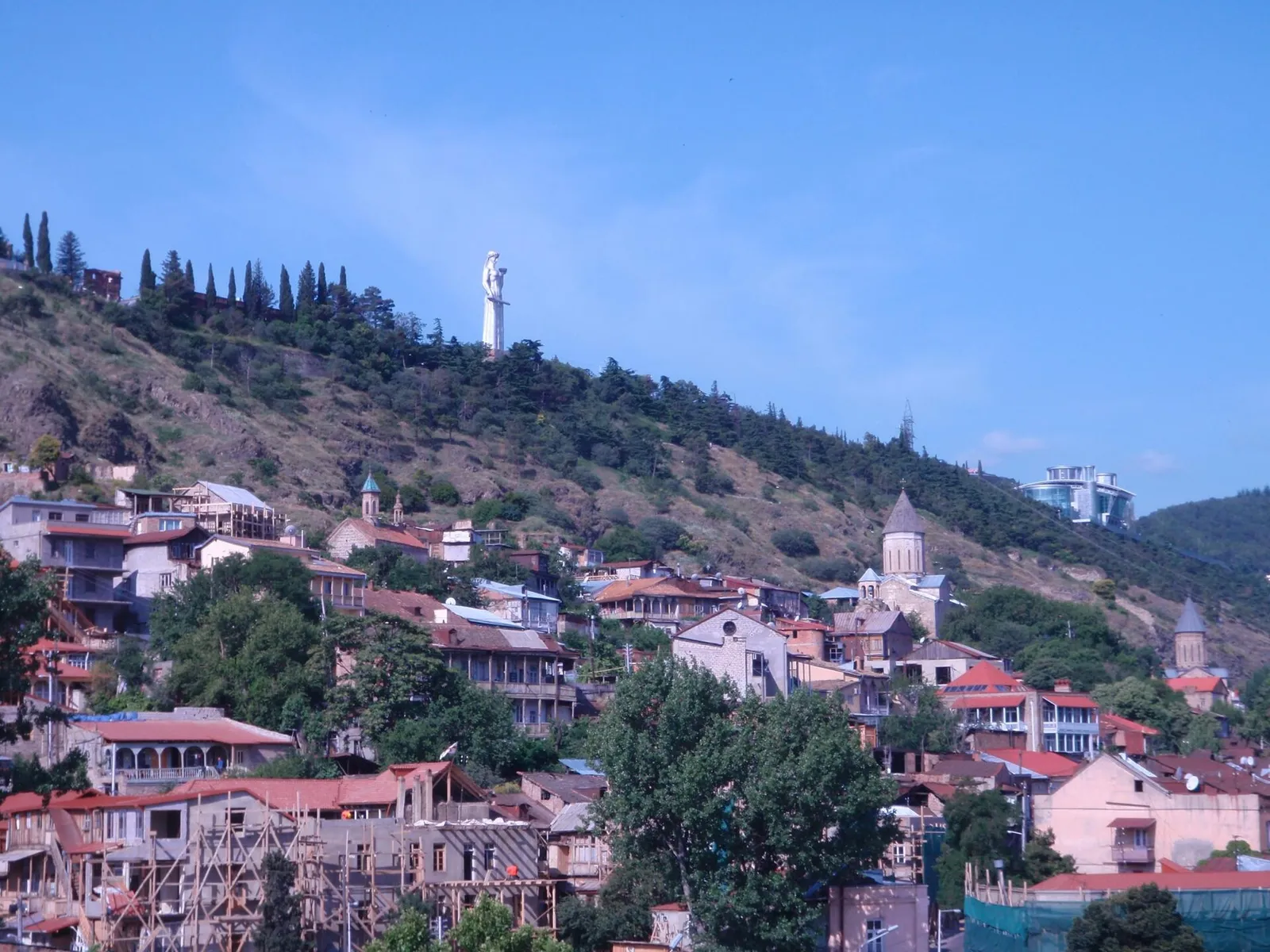
The Georgian Yoga Federation (yoga.ge) runs the long format: six months, four of theory and practice and two of practice only, with Saturday and Sunday sessions from 13:00 to 18:00 and optional practice two or three times a week on other days. A new module starts the first Saturday of every month. Tuition is 3,500 GEL in the studio and 5,200 GEL online, and the Yoga Alliance RYT 200 registration package is a further 780 GEL. The federation was founded in 2009, is a Yoga Alliance Registered Yoga School at RYS 200 level with Giorgi Berdzenishvili, E-RYT 500, as lead trainer, and has trained more than 270 instructors, and more than 100 of whom now teach in fitness centres and yoga studios.
Yoga Loft Academy, the training arm of the Tbilisi Yoga Community, runs the short format: a three-week hybrid course, whose 2026 cohort ran from 5 to 23 October, with module one online and pre-recorded and modules two and three taught in person at Tbilisi Yoga Villa. Study days are Monday to Friday. The full course is USD 1,400 (3,780 GEL), or USD 1,290 on the early-bird rate, and single modules go for USD 355, 655 and 455, with the cohort capped at eight people. A USD 300 deposit holds a place, is non-refundable and counts towards the fee. The academy splits the balance into monthly or weekly payments if you ask, with everything settled seven days before the course starts.
That is the whole list. BookRetreats, the biggest teacher-training marketplace, lists no teacher training inside Georgia, and none in Armenia or Turkey either, so the whole South Caucasus is empty on the platform most trainees look at first. Retreat Guru lists 526 teacher trainings across Europe and none of them in Georgia.
The studios below are where a visiting school hires a room, borrows props or runs a taster day.
Yoga Cave is the first yoga studio in Georgia, now in its fourteenth year, teaching the Yoga in Daily Life system with internationally certified teachers who work in Georgian, English and Russian.
Lumos Yoga Studio in Godziashvili Park publishes its full timetable, with morning classes from 08:00 and evening classes until 21:45, and sells class passes with discounts for three and six-month commitments. That makes it a straightforward price anchor when you are costing a city module.
On the coast, Mesto Sily at 2A David Agmashenebeli Street in Batumi runs seminars, trainings and master classes alongside a timetable that covers hatha, Iyengar, aerial and prenatal yoga, pilates, acroyoga, TRX and stretching on one pass. Mira Space on Shalva Inasaridze Street is a small room to hire for a coast day before or after a mountain block, and Sangeeta Space runs sound ceremonies and sound healing with gongs, which is worth knowing because our own camp has no gong.
Why run a teacher training in Georgia (the country)?
Because the paperwork is light, the flights are cheap, the food suits a yoga kitchen, and nobody else is here yet. Georgia is the country in the Caucasus between the Black Sea and Russia, not the US state, and it has spent the last decade making itself easy to enter.
Citizens of 94 countries and territories on the government list, last amended on 24 February 2026, enter and stay a full year with no visa, no registration and no fee, which covers most of the markets a school recruits from. The list runs from the whole EU and EFTA, the UK, the US, Canada, Australia and New Zealand to Japan, South Korea, Israel, the Gulf states, Turkey, Ukraine, Russia, Belarus, Brazil and Malaysia, and EU citizens may enter on a national identity card. Trainees whose passport is not on it but who hold a valid EU, Schengen, UK, US, Canadian, Australian, Japanese, Korean, Israeli or Gulf visa or residence permit get 90 days in any 180 without a Georgian visa. Everyone else applies at evisa.gov.ge for USD 20 plus a 2% service charge, with a decision in five working days. Send trainees to the official checker on geoconsul.gov.ge rather than a third-party page.
Getting here is cheap. Wizz Air flies into Kutaisi International Airport from 24 European cities with one-way fares from about 65 to 210 GEL, which is the cheapest door into the country. Turkish Airlines flies Istanbul to Tbilisi five or six times a day in 2 hours 25 minutes, and there are direct flights to Tbilisi from London, Amsterdam, Paris, Munich, Vienna, Warsaw, Copenhagen and Athens. Batumi airport, the closest to the Adjara mountains, has Istanbul with Turkish Airlines and Pegasus plus Israeli, Armenian, Azerbaijani and Iranian carriers.
Food is the quiet advantage. Georgian cooking has a deep vegetarian and vegan tradition of its own, so a fully vegetarian training kitchen is normal here rather than a special order.
Planning this yourself? See how Glamping Tago can host it
City course or three-week immersion: which model should your school run?
A city course is cheaper to start and harder to sell. An immersion costs the trainee more up front and delivers the thing they came for. The numbers below are the real difference.
| City course, Tbilisi | Residential immersion, mountains | |
|---|---|---|
| Hall | Hired by the hour, from 25 to 70 GEL | Included in the venue booking |
| Where trainees sleep | Their own hotel or flat, booked separately | On site, in the price |
| Food | On their own, scattered across the city | Three vegetarian meals a day, together |
| Typical length | Three weeks to six months | Three to four weeks |
| Evening and dawn sessions | End at the studio door | Part of the day |
| Weather risk | None | Real, so an indoor backup matters |
| What the school controls | The teaching hours only | The whole day, including sleep and food |
Tbilisi Yoga publishes the city side of that table in full: the 150 m2 main room at the Loft in Vake, for 30 to 50 people, is 70 GEL an hour; the 50 m2 Samsara room at the Villa in Saburtalo, for 15 to 25 people, is 50 GEL; the small Sun and Moon rooms are 30 and 25 GEL. Wi-Fi, air conditioning, water, a Bluetooth speaker, 15 bricks, belts and blankets come with the room, and mats are 5 GEL each per hour on top. Half the fee is due to confirm, a booking cancelled more than seven days ahead is refunded in full, one cancelled inside 72 hours is not, and you may reschedule once with three days' notice. The same studio rents props out for retreats elsewhere: cork mats at 15 GEL each per day, blocks and bolsters at 15 GEL each per day, which is worth knowing if your venue is short of bolsters.
Run the arithmetic for a 200-hour course taught over 18 days at six hall hours a day, and the main room alone comes to 7,560 GEL before anyone sleeps or eats. That is the honest comparison point for a venue quote: the city hall is not free, it just gets billed in smaller pieces.
What does a venue need for a 200-hour course, and what breaks first?
It needs an indoor hall big enough for the whole cohort on the worst weather day of the course, a second space so two things can run at once, a kitchen that can feed the same people three times a day for three weeks, and beds within walking distance of both.
Start with floor area, because that is what fails first. The published studio planning standard is 2 m2 per person for gentle styles, 2.5 to 3 m2 for vinyasa and ashtanga and 3.5 to 4 m2 once props or equipment are out. A standard mat covers about 1 m2, and adding a 0.5 m buffer on all sides makes the real footprint 1.1 m by 2.23 m, or 2.45 m2 a head. The same guide prices the trade-off plainly: 1.8 m2 a head is crowded, 2.2 to 2.5 m2 is comfortable for vinyasa or hatha, and restorative work with bolsters and blankets wants 3 m2. Teacher space, walkways, prop storage and any pillar come off the usable area, so plan one mat fewer than the arithmetic allows.
| Room | At 2.5 m2 a head | At 3 m2 with props |
|---|---|---|
| 38 m2 indoor shala | about 15 mats | about 12 mats |
| 138 m2 outdoor platform | about 55 mats | about 46 mats |
| 150 m2 Tbilisi hall for hire | about 60 mats | about 50 mats |
Then the daily load. Yoga Alliance allows no more than 14 instructional hours a day in any registered programme, and a residential 200-hour course runs six days a week with eight to ten scheduled hours a day over 21 to 28 days. That is the number the kitchen, the hot water and the timetable have to survive, not the 200 total. The same guide puts a ceiling on the cohort as well: above roughly 25 to 30 trainees, individual feedback gets scarce.
Weather decides the second hall. At the camp, rain falls on about 11 to 16 days a month from April to October, fewest in August and most in May, so a three-week course meets wet sessions every week. Plan the 38 m2 indoor shala into the timetable from the start, and an autumn course more than a summer one, because the wetter season starts on 15 September.
Before you sign anything, run the same checklist a careful trainee runs on you: look the school up in the public Registered Yoga School directory rather than trusting a logo, name the trainers who actually deliver the daily curriculum, ask for the syllabus and the hour-by-hour schedule, check the cohort cap, and get the deposit and refund terms in writing.
The two practice spaces
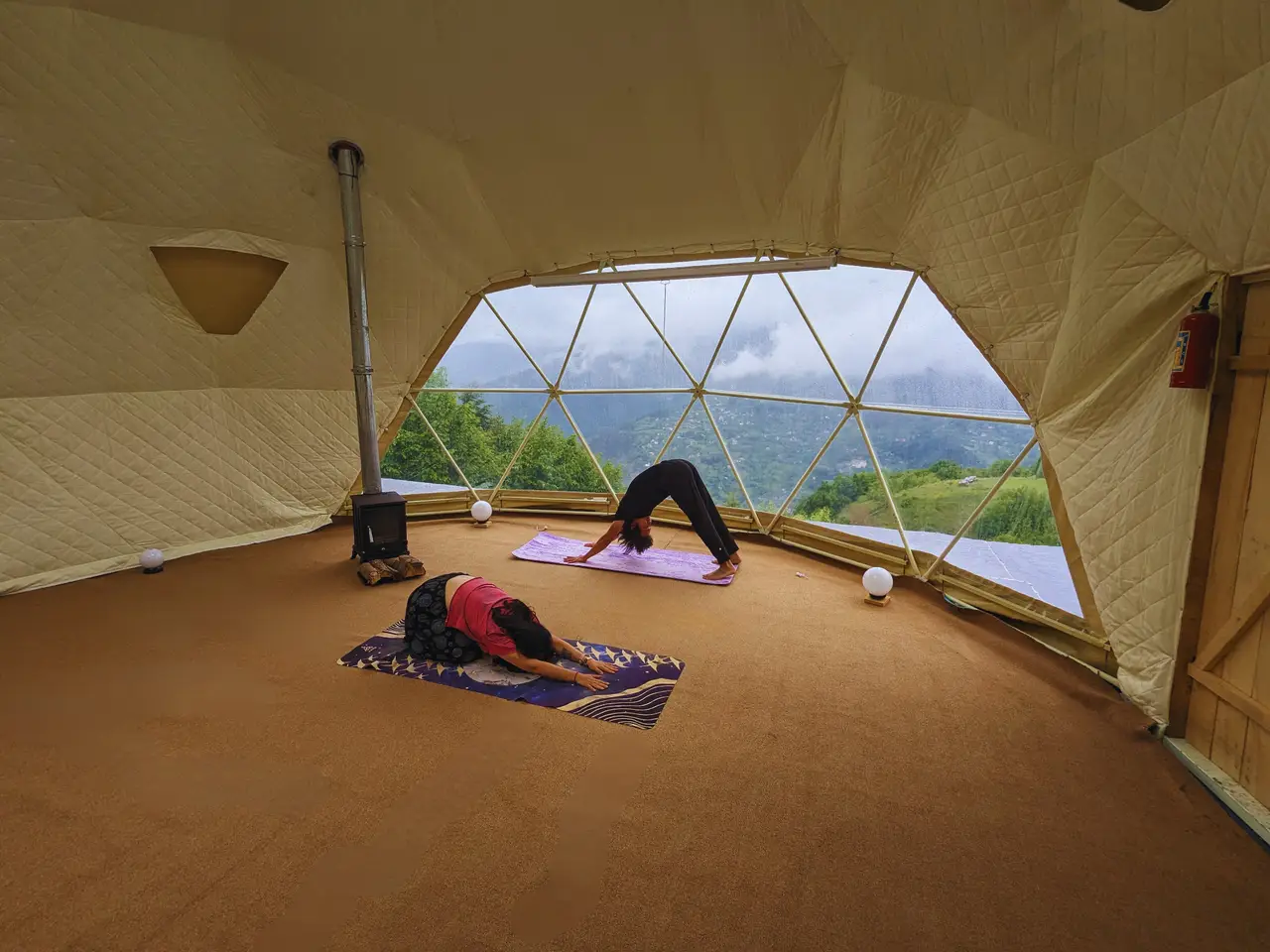
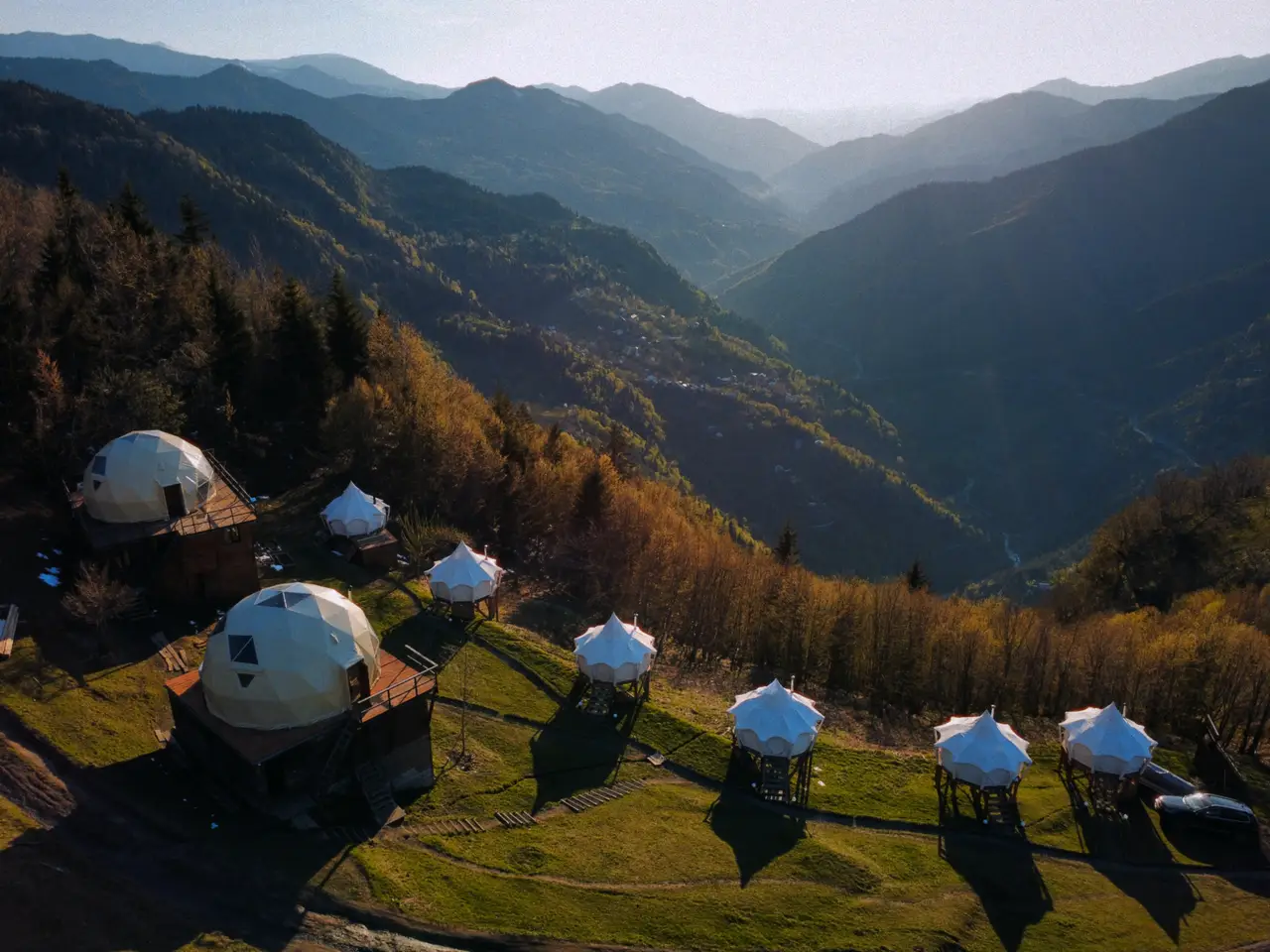
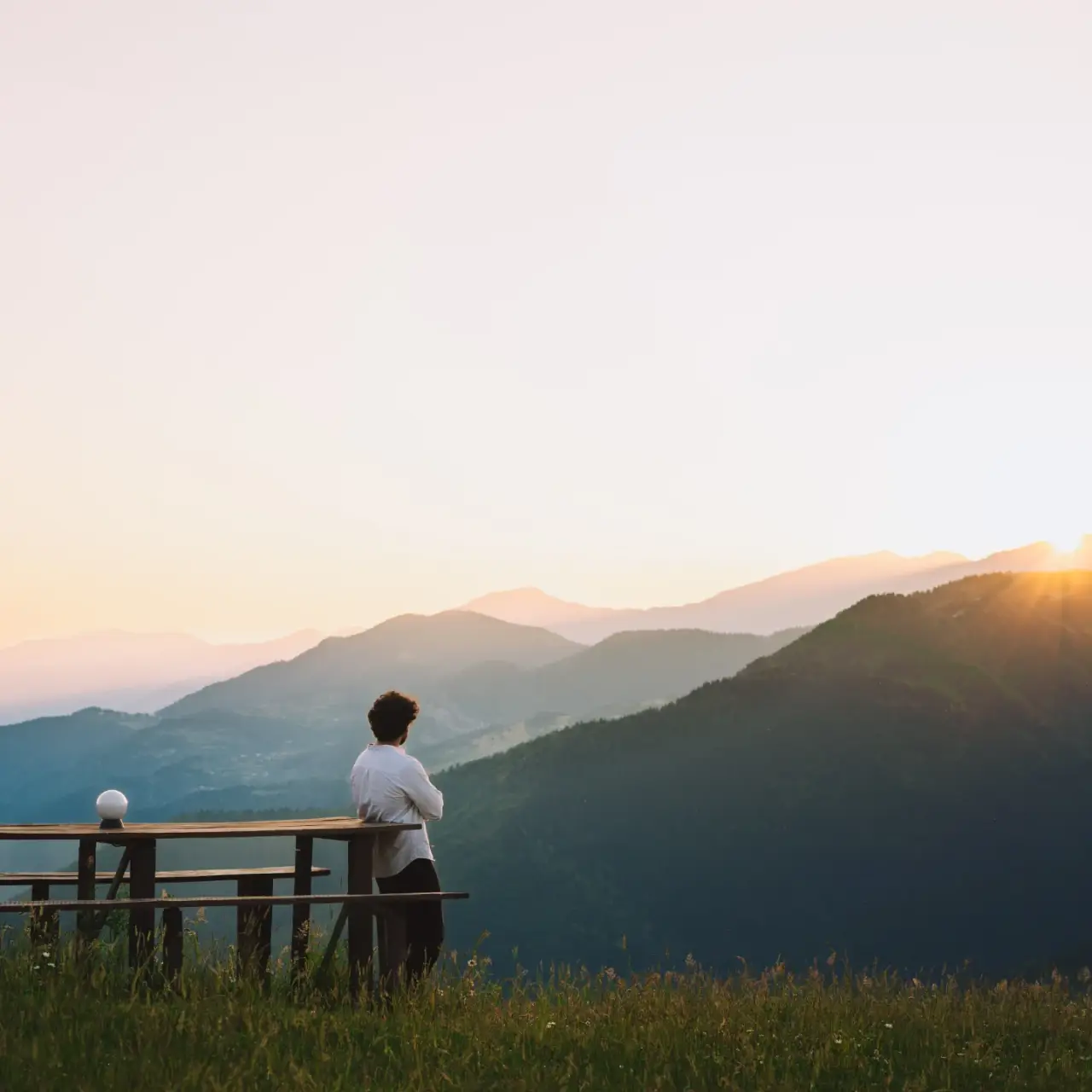
At Glamping Tago the two spaces are an outdoor platform of 138 m2 under a sailcloth tent, facing down the valley, and an indoor wooden shala of 38 m2 with a sprung floor and mountain views on three sides, which the site also calls the yoga dome. The platform takes morning practice, asana labs and evening sessions. The dome is the anatomy and philosophy room, the cold-dawn meditation room and the rain plan, and it holds a cohort of 12 to 16 on mats with room to move.
Props are mats, blocks, straps and bolsters for a group, so trainees do not fly with mats. For lectures there is a projector, a screen, a speaker and a microphone. There is no massage table and no gong, so a course that uses a harmonium or singing bowls brings its own. Internet is Starlink at about 300 Mbps, which is enough for a live online module or a guest lecturer on video.
What does a day on a 21-day course look like?
Six teaching days a week, eight to ten scheduled hours, and two practice slots with the lecture block in the middle. This is the pattern most residential schools run, with what a mountain venue changes about it in the right-hand column.
| Residential pattern | At Glamping Tago |
|---|---|
| 06:00-08:00 meditation, pranayama, morning asana | On the platform in clear weather, in the 38 m2 shala when it is cold or wet |
| 08:00-09:00 breakfast | The buffet runs 09:00 to 11:00 as standard, so an 08:00 breakfast is agreed with the kitchen in advance |
| 09:00-12:00 anatomy, alignment or teaching methodology | The shala, with projector, screen and microphone |
| 12:00-14:00 lunch and rest | Lunch is a la carte, 13:00 to 16:00 |
| 14:00-16:00 philosophy | The shala or the platform |
| 16:00-18:00 second practice or practice teaching | Both spaces can run at once |
| Evening self-study, occasional satsang | Dinner buffet 19:00 to 21:00, then the campfire |
Two things about that table matter more than the rest. Meal times are fixed and told to you at check-in, so a course with a 06:00 practice agrees breakfast when it books, not on arrival. And homework, reading, personal practice and public classes do not count as instructional hours under the Yoga Alliance standard, wherever they happen, which is what turns 200 hours into a 21-day timetable rather than a 14-day one.
Where can you hold a residential teacher training in Georgia? The venues compared
Four properties in Georgia can take a whole cohort and feed it for three weeks. RetreatHub, the venue-hire directory, lists exactly two of them for hire in the country.
| Venue | Whole venue for your cohort? | Beds on site | Practice space | Cohort | From the airport |
|---|---|---|---|---|---|
| Glamping Tago (ours) | Yes, a whole-property buyout | 33 | 138 m2 outdoor platform, 38 m2 indoor shala | 12-33 trainees | Batumi, 87 km, about 2 h 30 |
| Eco House Merisi | Ask: a hotel | 12 cottages and 3 villas, up to 54 | No hall; ceremony and dinner areas for up to 60 | By enquiry | Batumi, 65 min |
| Chateau Milisi | No, a hotel | Hotel rooms | Conference space | By enquiry | Batumi, 32.5 km |
| Kiketi Farm | Ask: 27 rooms for one group | Up to 65 | Yoga House for 15-50 | 40 and more | Tbilisi, 37 min from the centre |
Glamping Tago (our venue), Village Tago, Khulo (Adjara)
- Where: a ridge above Village Tago in Khulo municipality, mountainous Adjara
- Drive time: 87.1 km from Batumi airport, about 2h30 in practice
- Capacity: 33 beds on site, 12 to 33 trainees plus the teaching team, 64 more beds in the village
- Spaces: 138 m2 outdoor platform, 38 m2 indoor shala
- Season: 1 April to the end of October
- Good for: a full buyout, a vegetarian kitchen, a cohort that wants no distractions
- Watch out for: the last 8.6 km is a mountain road, shared shower and toilet blocks rather than private bathrooms, and no air conditioning
Yoga groups are the house speciality rather than a sideline. The 2026 stories on our retreats page include a 13-person yoga long weekend from 30 April to 3 May, a seven-woman yoga retreat in May and a teacher from Kazakhstan who brought 16 women for four days in August, with a silence day in the middle.
Eco House Merisi, Silibauri, Keda (Adjara)
- Where: the Merisi valley above Keda
- Drive time: 48.9 km and 65 minutes from Batumi airport
- Spaces: 12 cottages and 3 villas for up to 54 overnight guests, a panorama restaurant, and ceremony and dinner areas for up to 60; no practice hall, so a course brings its own room plan
- Season: all year
- Good for: a lower-altitude Adjara base with the strongest review record in the region
- Watch out for: it sits up a side valley, so it is a separate trip from the Tago road, not a stop on the way, there is no shop within walking distance, and every booking is paid 100% up front and non-refundable
Eco House Merisi has the deepest review record in this comparison by a wide margin, 4.9 from nearly 1,600 Google reviews, and with 151,000 Instagram followers it is the best known property in the Adjara mountains. Its rooms page lists the cottages one by one, which is where to start on what a whole-property booking would mean for a cohort.
Chateau Milisi, Milisi, Keda (Adjara)
- Where: Village Milisi above Keda
- Drive time: 32.5 km and 48 minutes from Batumi airport
- Spaces: a conference space, a wine cellar, a rooftop pool and a Finnish sauna
- Rooms from: USD 30 a night for a family room, USD 49 for a deluxe double, USD 80 for a five-person apartment
- Season: all year
- Good for: the closest mountain option to Batumi airport, and a weekend rather than a month
- Watch out for: the property is still being built, so daytime construction noise is normal, and recent guests are hard on the kitchen
Chateau Milisi is the honest borderline case in this guide. It is a four-star hotel with the facilities a group notices, and yoga retreats have run there, but the two things a three-week training depends on most are the two things its recent guests criticise: quiet days and food.
A yoga retreat run there from 15 to 20 June 2026 is still the most useful local market price on record: USD 1,180 for a shared double and USD 980 on the early bird, an extended package at USD 1,380 or 1,280, a single room for USD 300 more, and a USD 200 deposit, covering Batumi transfers, accommodation and breakfasts only.
Kiketi Farm, near Tbilisi
- Where: Kiketi, over the Tskneti road from Tbilisi
- Drive time: 28.7 km and 37 minutes from Freedom Square
- Capacity: up to 65 beds in 27 rooms
- Spaces: a Yoga House for 15 to 50, a gallery for 70 to 110, a waterfall area for 50 to 70, two bridge spaces for 40 to 60 and 35 to 130, a meadow for 150 to 200 and pavilions for 25 and 30
- Season: all year
- Good for: a large cohort that wants the capital half an hour away
- Watch out for: it is a farm park open to day visitors every day, with horse rides, workshops and a cafe, so the cohort shares the grounds
Kiketi Farm is the other venue RetreatHub lists for hire in Georgia, and the only one that can seat a cohort of 40 or more indoors. Ask in writing which spaces stay closed to day visitors during your course before you commit three weeks to it. Two October 2026 reviews complain about slow, disorganised service, so agree in writing who on their team looks after your group.
Where do trainees sleep and eat on a residential training?
On the ridge at Glamping Tago that means twelve Lotus Belle tents for two (a double or two singles, wood stove and gas heater, power sockets, towels, bedding and earplugs) and a nine-bed Half Dome dormitory with lockers and pods on three levels: 33 places in total. A third mattress in a tent is 50 GEL a night for an adult. The practical cohort is 12 to 33 trainees plus the teaching team. Bigger courses spill into the village, where seven families keep 27 rooms for 64 more guests and there are about 60 camping spots, three to ten minutes on foot from the gate, which puts 97 beds inside a ten-minute walk.
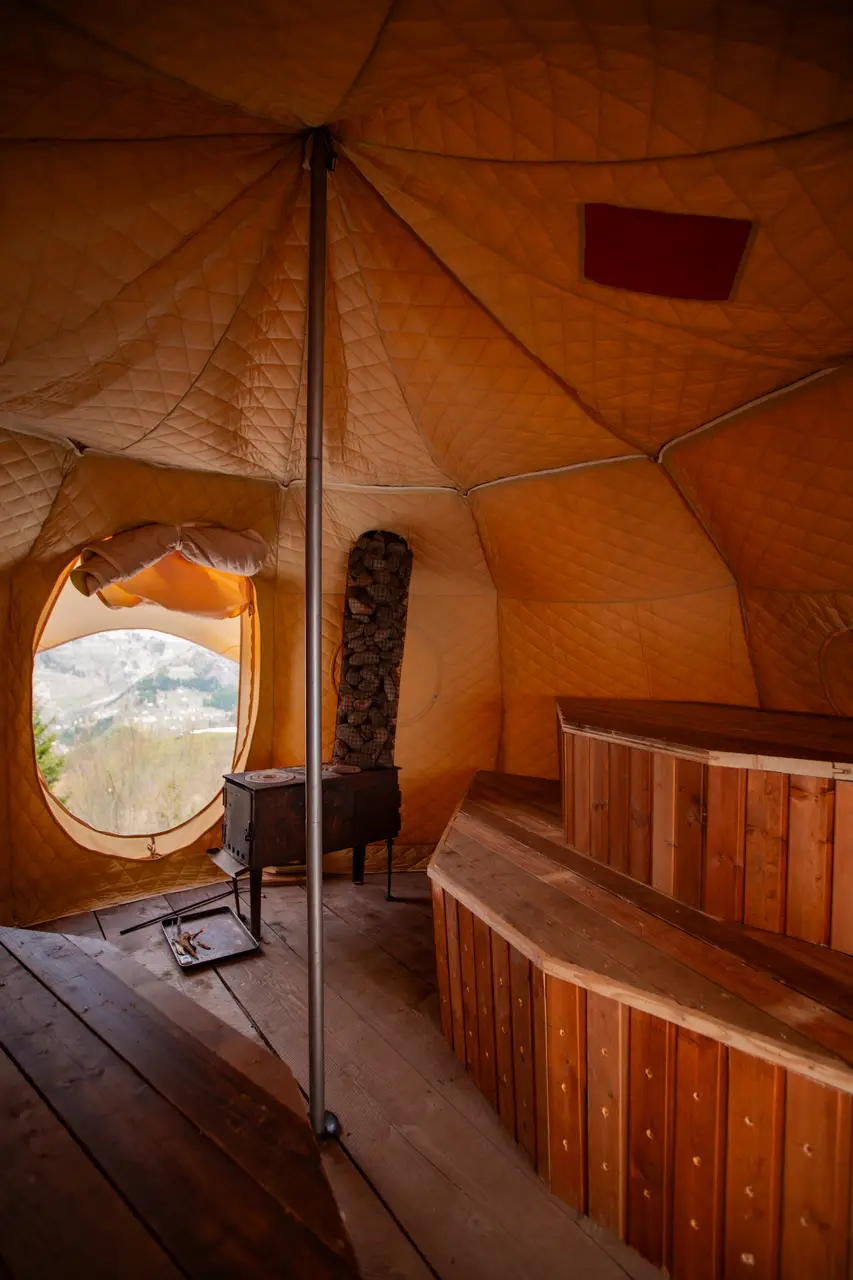
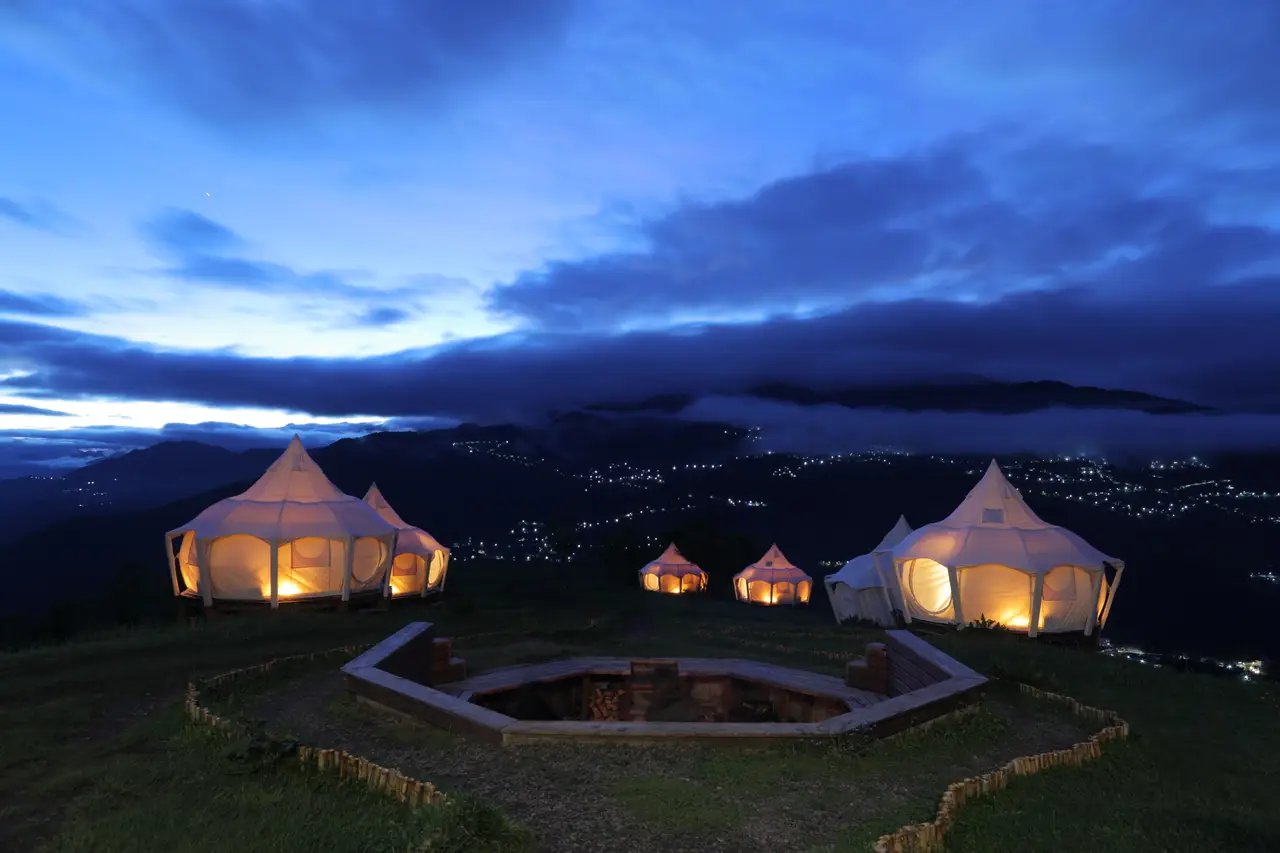
Showers and toilets are in shared blocks rather than inside the tents, with hot water, heating, bathrobes and a hair dryer. Laundry is 15 GEL. There is no air conditioning, and nights on the ridge are cold even in August, so the joining instructions need a warm layer and a rain shell on the list. Bottled water is 3 GEL for half a litre, and the tap water comes off the mountain, so tell trainees to bring a bottle or a thermos instead.
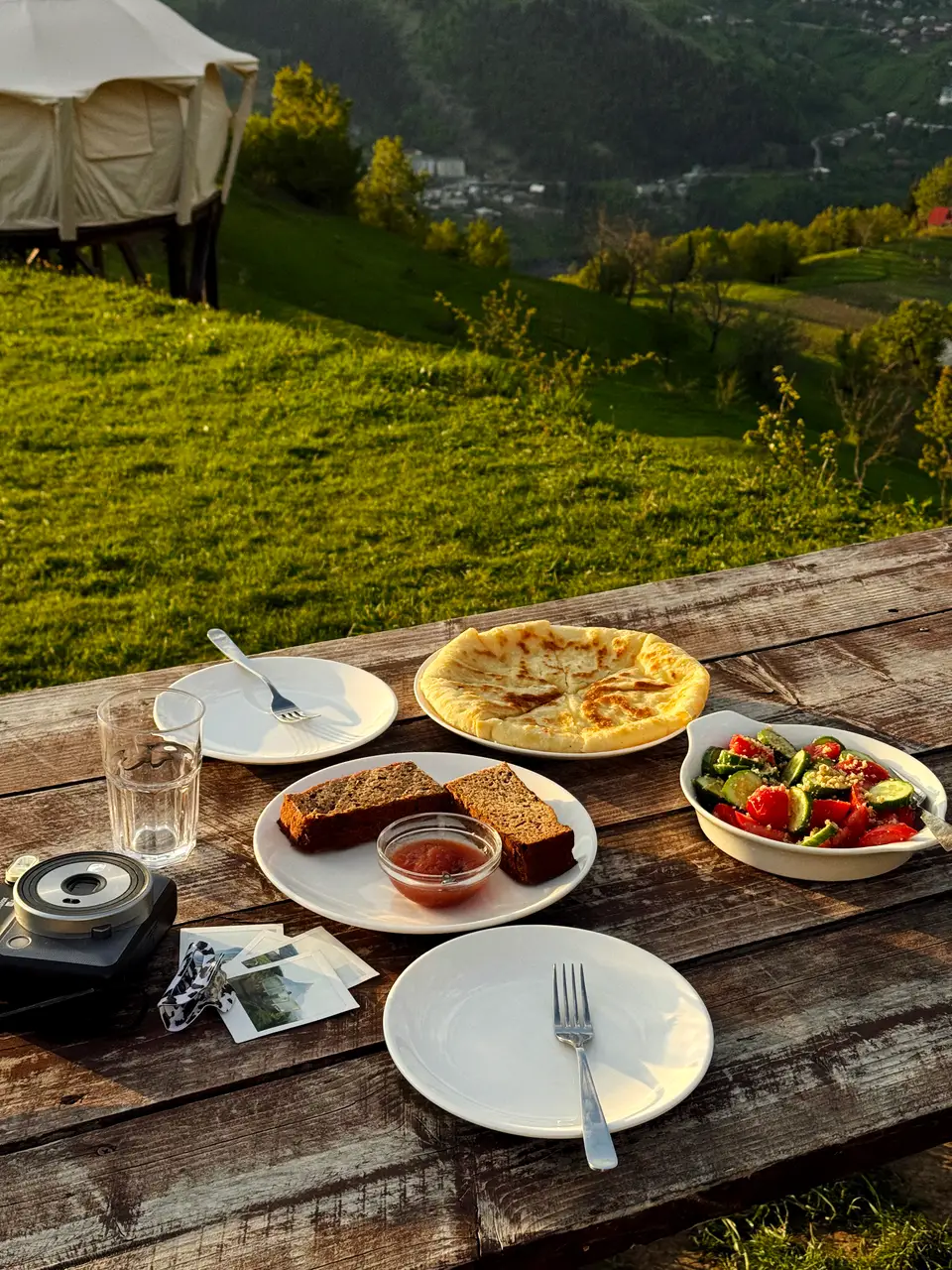
The kitchen is the part that decides a yoga training. Yurtalicious, our vegetarian yurt restaurant, seats 24 at the long table and up to 32 with extra tables, and it is fully vegetarian and vegan-leaning as standard rather than on request. Breakfast is a buffet from 09:00 to 11:00 at 32 GEL, lunch is a la carte from 13:00 to 16:00, and dinner is a buffet from 19:00 to 21:00 at 37 GEL, cooked fresh each day by women from the village. Full board is 100 GEL per person per day. Vegan and gluten-free are covered with notice, and a silence day or a fasting morning is a scheduling note rather than a problem. A group booking always includes breakfast and dinner, no outside food comes into the kitchen, and corkage on your own wine is 15 GEL a bottle.
For the closing dinner, a Georgian supra is 85 GEL per person and a Euro-Georgian buffet 125 GEL, both vegetarian. A supra needs the whole property: on a partial booking, with other guests in the restaurant, it is one of the few things we cannot run.
The rest of the rhythm: sauna, campfire and the programme extras
The evening sauna and the campfire come with the stay, and so does a morning yoga class with one of our own teachers, which matters on a training: it gives the trainees a class they are not teaching and the trainers a morning off. The wood-fired sauna has a cold plunge right next to it, a guided sauna ritual is possible on request, and a private sauna session outside the evening hours is 150 GEL.
For the programme itself, the organiser rates are a private yoga session 100 GEL, sound healing 100 GEL and a breathwork session 350 GEL for the group. A Georgian cooking workshop, where the group makes Adjarian khachapuri with our kitchen team, is from 50 GEL per person and takes one to two hours. A jara honey session on site is 75 GEL per person. A jeep day is 400 GEL per car for one destination and 600 GEL for two, and the Uchkho canyon day with certified guides and all the gear runs 415 to 1,125 GEL depending on group size.
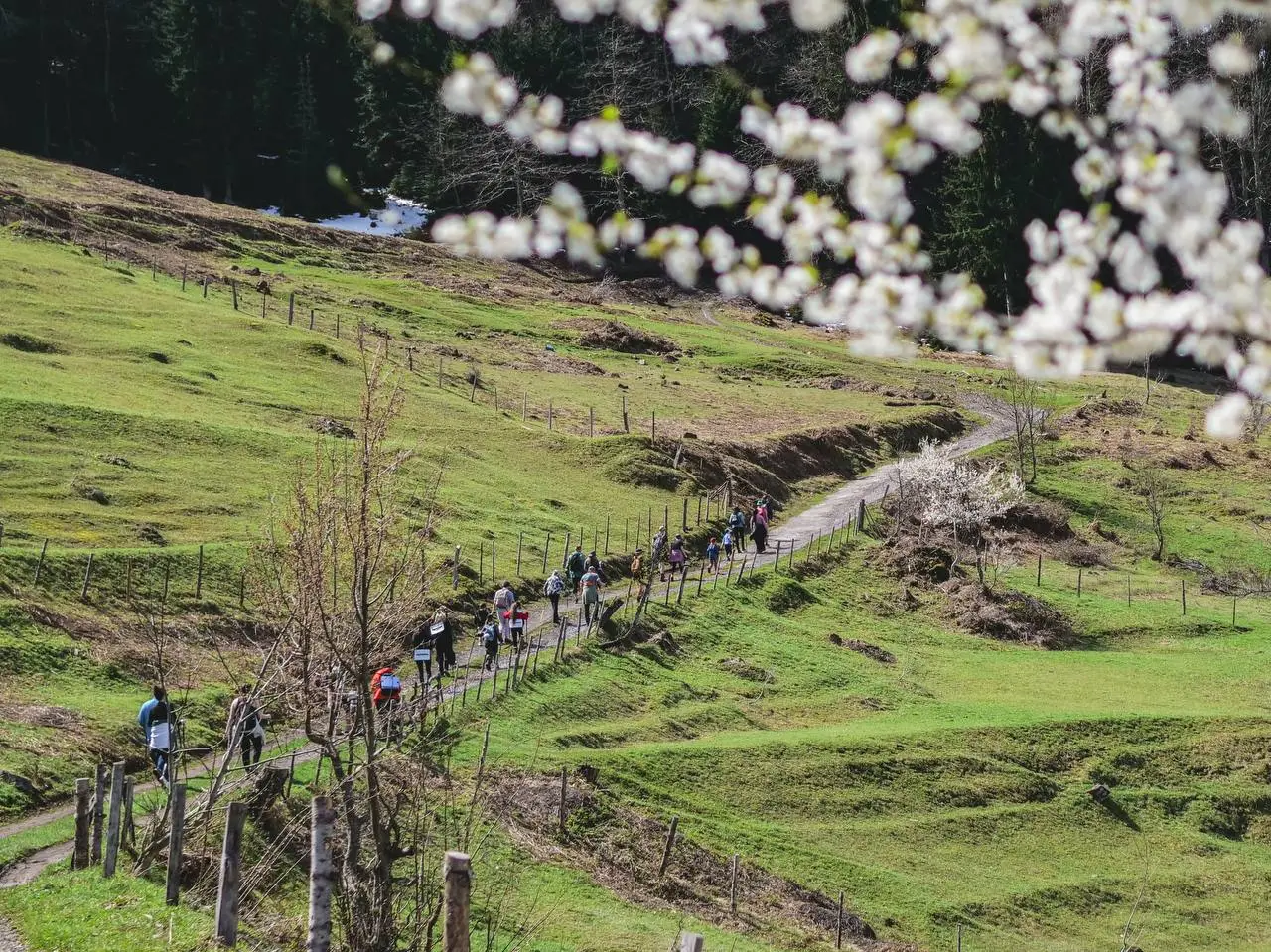
Five marked walking routes start at the gate, from a two-hour village loop or the Lonely Tree to the four to six-hour climbs to Otsinari lake and Skhalta monastery, all mapped on our tours page; they are free to walk, and a guide is 75 GEL for a half day or 100 GEL for a full day at the organiser rate. If the course wants a day out of the valley, Green Lake is the standard half-day jeep trip from here, and the Shuamta lakes at 2,150 m are the other one.
What does a 200-hour YTT cost per trainee in Georgia in 2026?
For sixteen trainees and two teachers over 21 nights, budget roughly 86,000 to 89,000 GEL for beds, three vegetarian meals a day and both practice spaces, which is about 2,100 USD a head before teacher fees, certification and flights. The figures below convert at the National Bank of Georgia rate of 2.61 GEL to the dollar.
There are two ways to book. A whole-property buyout gives the school the camp to itself, including both yoga spaces, sauna access, the campfire, tea and coffee and the sound equipment. A partial booking takes only the tents the course needs at the per-tent rate, with other guests staying alongside and practice slots scheduled in writing. Closing the restaurant to outside visitors as well is the privatisation option, and the privatisation fee for an event is 2,000 GEL.
2026 prices
| Month | Whole-property buyout, per night | Per Lotus tent, per night | Whole 9-bed dorm, per night |
|---|---|---|---|
| April | 1,962 GEL | 147 GEL | 294 GEL |
| May | 2,520 GEL | 200 GEL | 400 GEL |
| June | 3,584 GEL | 268 GEL | 536 GEL |
| July | 4,488 GEL | 336 GEL | 672 GEL |
| August | 4,488 GEL | 336 GEL | 672 GEL |
| September | 3,584 GEL | 268 GEL | 536 GEL |
| October | 2,316 GEL | 173 GEL | 346 GEL |
Full board is 100 GEL per person per day on top, and the organiser eats free for the whole stay.
| Course | Calculation | Total GEL | Per trainee |
|---|---|---|---|
| 16 trainees + 2 teachers, 21 nights in May, whole-property buyout | 21 x 2,520 + 17 x 21 x 100 food | 88,620 | about 5,540 GEL, roughly 2,120 USD |
| 16 trainees + 2 teachers, 21 nights in June, partial booking of 9 tents | 9 x 268 x 21 + 17 x 21 x 100 | 86,352 | about 5,400 GEL, roughly 2,070 USD |
| 12 trainees + 1 teacher, 21 nights in October, partial booking of 7 tents | 7 x 173 x 21 + 12 x 21 x 100 | 50,631 | about 4,220 GEL, roughly 1,620 USD |
That covers bed, board and both halls for three weeks. What a school still pays on top:
- Trainers. The single biggest line, and entirely yours.
- Yoga Alliance RYS registration, if you are not already registered: USD 400 once plus USD 240 a year per credential, so USD 640 in the first year, with up to six weeks for the review.
- RYT 200 registration for each graduate who wants it: USD 50 once plus USD 65 a year, so USD 115 in their first year. Most schools let the trainee pay this themselves.
- Teaching liability insurance. beYogi sells yoga teacher cover at USD 179 a year with general liability and malpractice up to USD 3 million a year and personal injury up to USD 2 million; the market runs USD 120 to 400.
- Marketplace commission, if you fill the cohort through a platform: 14% to 30% of the booking.
- Flights and ground transport for the teaching team.
How does Georgia compare with Bali, India and a training at home?
Georgia lands between Southeast Asia and Europe on price, and it beats both on how far a trainee has to fly from Europe or the Middle East.
| Where | What a trainee pays | What that includes |
|---|---|---|
| Georgia, mountain venue (this guide) | about 2,100 USD in room and board for 21 nights, before tuition | bed, three vegetarian meals a day, both halls |
| Bali, Bali Yoga Experience | USD 1,499 shared, USD 1,999 private | 23 days, 22 nights, three meals, pickup, materials, one massage, excursions, certificate, cohort capped at 15 |
| Bali, via Retreat Guru | USD 1,274 shared to USD 2,024 private | 20 days, 19 nights, all in |
| Guatemala, The Kula Collective | USD 4,290 | 22 days, 21 nights, three vegetarian meals a day |
| Europe, Danube kundalini course | from EUR 2,100 | 27 days, package included |
| Tbilisi, Yoga Loft Academy | USD 1,400 | tuition only, no beds, no food |
| United States | USD 2,500 to 5,000, USD 6,000 to 7,000 in New York, Los Angeles and San Francisco | tuition only |
Yoga Alliance puts the global range of school-set tuition at USD 1,500 to 5,000 and above. The same US source puts daily rates in context: US programmes run USD 130 to 240 a day, India and Nepal USD 40 to 55, Southeast Asia and Central America USD 1,500 to 3,000 for a full course, and online courses USD 500 to 2,500. On BookRetreats a Rishikesh 200-hour filters from USD 99 to USD 3,179 and Portugal from USD 336 to USD 5,013, so "200-hour in Asia is cheap" hides a 30-fold spread.
Do you need Yoga Alliance, and can you run an RYS 200 abroad?
You do not need it to teach, and most trainees want it anyway. Yoga Alliance recognises in-person, online and hybrid RYS 200 programmes and does not restrict where an in-person course is held, so a registered school can run its course at a retreat venue in another country. The school stays responsible for the curriculum, the trainers, the records and the certificates.
Registration costs the school USD 400 once plus USD 240 a year per credential, and the review takes up to six weeks, so apply at least two months before you open bookings. A graduate who registers as an RYT 200 pays USD 50 once plus USD 65 a year, then keeps the credential with 30 hours of continuing education and 45 hours of teaching every three years.
What the standard actually requires, under the elevated RYS 200 standards in force since 27 February 2020:
| Educational category | Minimum hours |
|---|---|
| Techniques, training and practice | 75 |
| Anatomy and physiology | 30 |
| Yoga humanities | 30 |
| Professional essentials, including the practicum | 50 |
| Elective hours, distributed across the four categories above | 15 |
On top of the hours:
- An assessment of every trainee, not just attendance, and a published syllabus tied to the categories.
- A lead trainer with E-RYT 500 who personally teaches at least 150 of the 200 hours. A programme may register up to five lead trainers.
- All 200 hours as classroom hours, of which up to 40 may be online: up to 20 in anatomy and physiology and up to 20 in yoga humanities.
- No more than 14 instructional hours in a day.
- In an online or hybrid course, at least 30 of the 200 hours live with a trainer rather than pre-recorded.
Homework, reading, personal practice, volunteer work and public classes do not count as instructional hours, wherever they happen.
What does Georgia need on paper: visas, insurance and the right to labour activity
Three things: entry for the trainees, insurance for everyone, and a registration for any trainer who is paid to work here.
Entry. Visa-free for one full year for citizens of the 94 countries and territories on the government list, with no registration and no fee. Others use the e-visa at USD 20 plus 2%, decided in five working days. Overstaying has been expensive since 1 October 2025: the Code of Administrative Offences fines an overstay of up to three months 1,000 GEL, up to a year 2,000 GEL and beyond that 3,000 GEL, each with an entry ban, and whoever invites or uses the services of a foreigner in breach of the rules is fined 2,000 GEL as well.
Insurance. Mandatory for every tourist since 1 January 2026, minimum sum insured 30,000 GEL, covering the whole stay.
Working here. Since 1 March 2026 a foreigner employed or self-employed in Georgia needs the right to labour activity, introduced by Resolution No 70 of 20 February 2026. It is issued for one employer and one position for a year, costs 200 GEL for a decision in up to 30 calendar days or 400 GEL for up to 10 working days against a statutory cap of 500 GEL, and working without it costs 2,000 GEL for a first offence and double on repetition.
The exemption is the part that matters to a visiting school. Resolution No 321, effective 9 July 2026, dropped the labour market test and put short-term professional activity outside the requirement: professional work or services tied to a specific short-term project, event or service rather than long-term employment in the local labour market, capped at four months in total per calendar year. The exemption is written into Article 1(4)(h) of the Law on Labour Migration itself. The quota professions are excluded from it, and that list includes tour, mountain, alpine and ski guides, so a foreign hiking guide is not covered even if a foreign yoga trainer is.
Even under the exemption there is a step. Before the activity starts, the local employer or service organiser registers the foreign worker in the ministry's electronic system at labourmigration.moh.gov.ge, giving the employer's details, the worker's personal data, the profession or position and the planned start and end dates. Registration is free of state charges, and if it is not done or not confirmed, the work stops being short-term professional activity and both parties face liability.
An employer also needs an annual quota once it engages more than five foreign nationals in a calendar year or they exceed 5% of staff, applying at least 10 working days ahead and showing turnover of 50,000 GEL per foreign worker, or 35,000 GEL for an educational institution.
If your school ends up selling places from a Georgian entity rather than a foreign one, the local set-ups are an individual entrepreneur with small business status at 1% of turnover up to 500,000 GEL and 3% above it, micro business status at 0% up to 30,000 GEL, or an LLC at 0% on reinvested and 15% on distributed profit. VAT at 18% is mandatory above 100,000 GEL of Georgian-source turnover, and small business status does not replace the right to labour activity. Where the school is foreign and the trainees pay abroad, that is a question for a Georgian accountant before you take deposits.
When should you run it, and how does a three-week course fit the calendar?
June and September. The camp is open from 1 April to the end of October, the warm season in Khulo runs 5 June to 21 September with daily highs above 19C, and June and September give warm days and mid-season prices without August's crowds and August's rates.
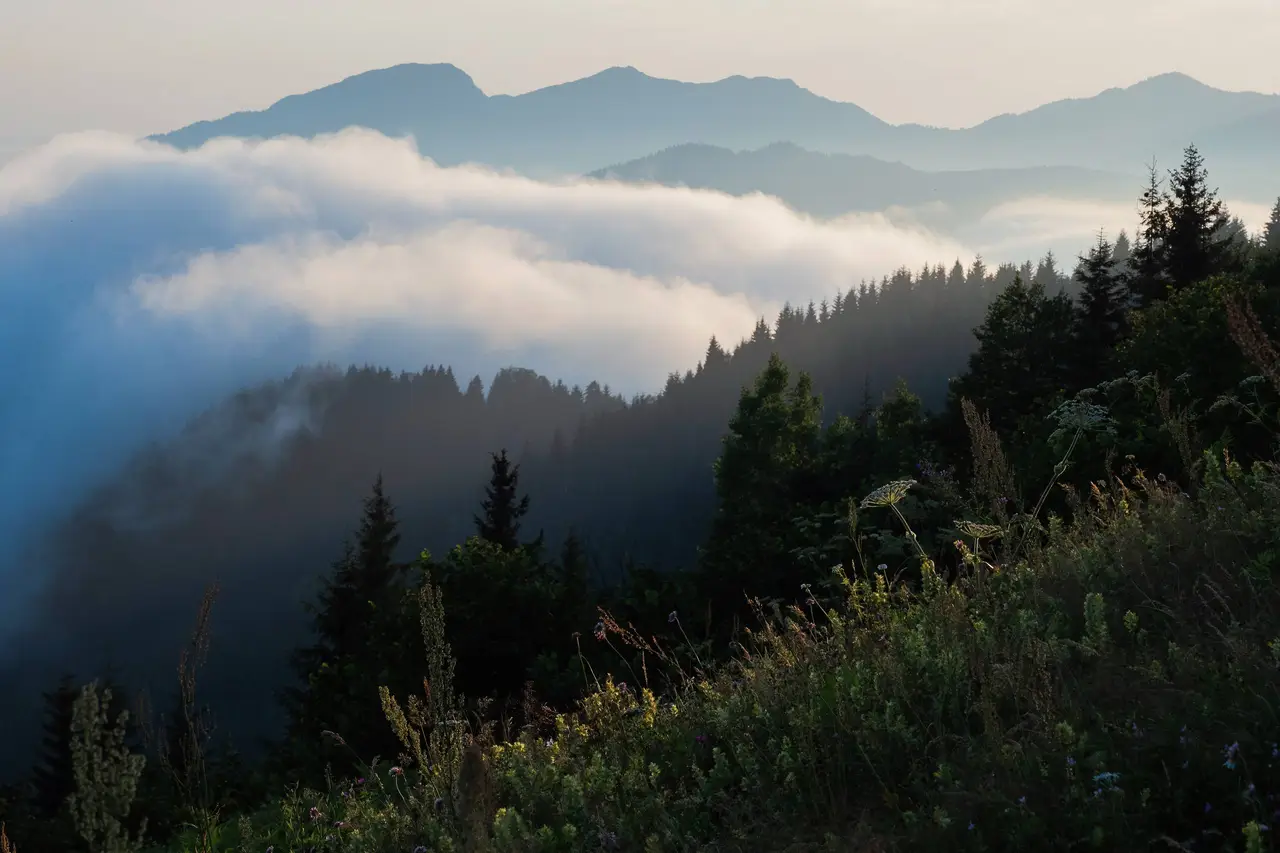
August is the hottest and clearest month, with an average high of 23C, a low of 13C and clear or partly cloudy skies 91% of the time. It is also the most expensive month and the busiest. November is the wettest month at 112 mm and April the driest at 46 mm, and April and May are green, cool and cheapest.
A three-week course fits the season four ways:
- Mid-April to early May: cheapest beds, cold mornings, a real risk of rain days, so the 38 m2 indoor hall carries more of the timetable.
- June: the best balance of weather and price, and the month most schools should aim at first.
- July and August: warmest and busiest, top of the price list, and the hardest dates to get.
- September into mid-October: clear, quiet, cooling fast at night, and the wetter half of the year starts on 15 September, so the indoor hall matters again.
High-season dates are usually booked six to twelve months ahead, and a school that wants the same three weeks every year should say so in the first email. Dates can be held without a deposit for up to one week.
Getting a cohort here: how do trainees reach the venue?
Fly to Batumi, drive 87.1 km, then cover the last 8.6 km up the mountain road. Allow about 2h30 in total from Batumi airport, because the mountain section runs slower than a map suggests.
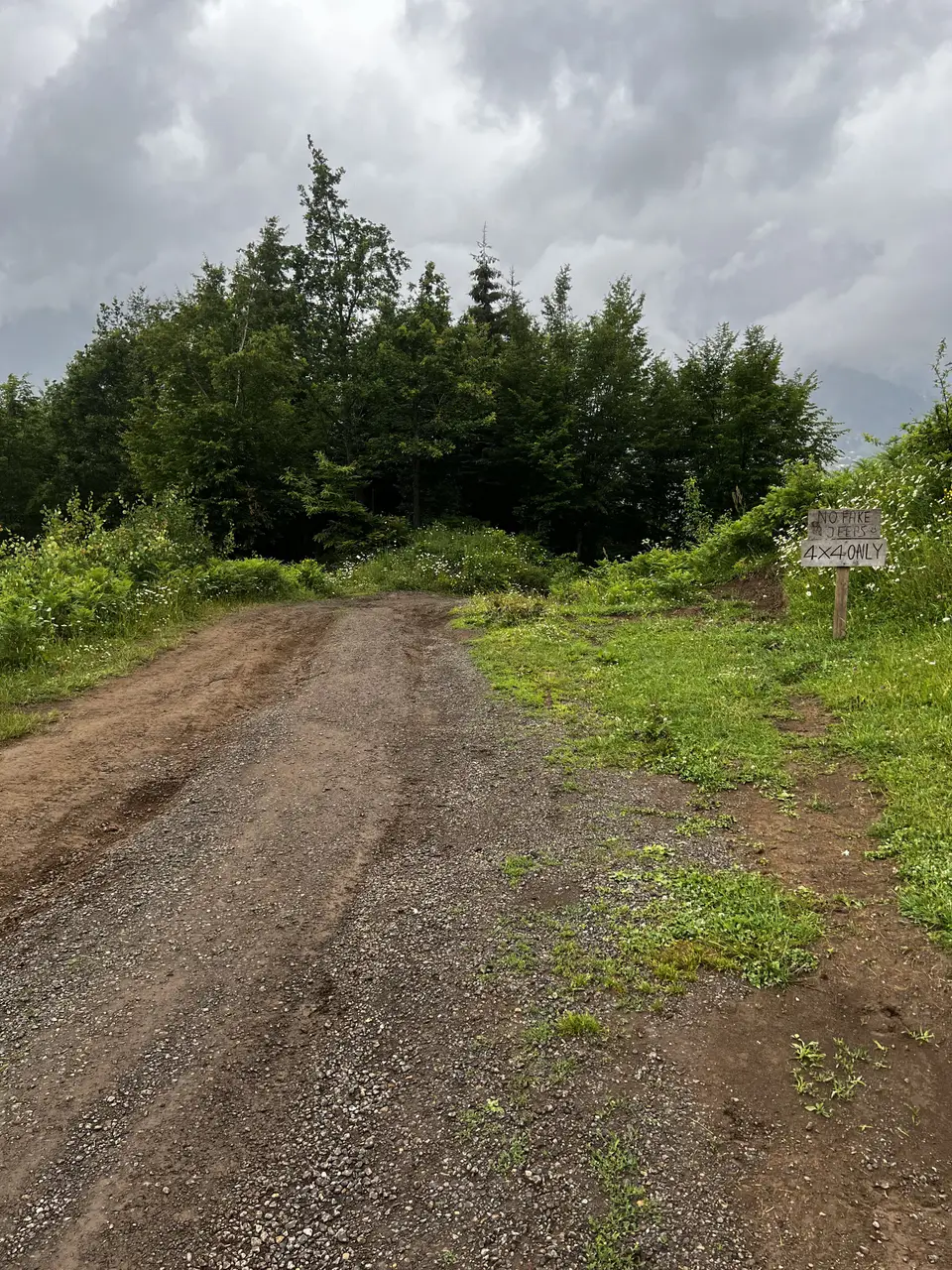
- Batumi airport to Village Tago: 87.1 km over the Batumi to Akhaltsikhe road. A private 4x4 for up to four people is 265 GEL each way and takes about 2h30.
- On a budget: a marshrutka leaves Batumi bus station for Khulo every 30 minutes from 08:00 to 20:00, takes about 2h30 and costs about 10 GEL. The sign in the window reads ბათუმი - ხულო. A ride-hailing app such as Bolt covers Batumi to Khulo in about two hours for up to 175 GEL, and drivers often ask more than the app price because they have no return passenger.
- The last stretch: a 4x4 taxi waits at the Khulo cable car station and takes 30 to 35 minutes for 75 GEL per car, up to four people. A minibus for the same leg is 135 GEL. Book either at least 24 hours ahead; the taxi has no fixed hours, so tell us when the group reaches Khulo.
- Kutaisi airport to Village Tago: 139.2 km, priced at 465 GEL per 4x4 and about 5h30 on our own transfer page. On a budget, a bus from the airport reaches Batumi four times a day in about two hours for 25 GEL, and the train from the airport's own station runs four times a day, also in two hours, for 31 GEL.
- Tbilisi to Village Tago: 296.5 km by road, or 925 GEL for a private 4x4 in about 8h30. Most trainees arriving in the capital take the double-decker train to Batumi first: four departures a day in summer and two in autumn, at 08:05 and 17:10, four hours and one minute, 36 GEL in second class and 76 in first, booked on tkt.ge up to 20 days ahead because summer trains sell out. A marshrutka from Didube takes seven hours for 35 GEL, and the Ortachala bus six and a half for 40 GEL. For a minibus transfer from Tbilisi we collect the group at whatever address in the city the organiser gives us.
- From Akhaltsikhe and eastern Georgia: 360 GEL per 4x4 and about 4h30 over the Goderdzi pass. The pass is asphalt almost the whole way, a few kilometres near Bodzauri are still unfinished, and it closes in snow, so call the road department before you send anyone that way (the number is on our transfer page).
Khulo is a genuine stop on the drive up: routing through the cable car station adds 3.4 km and three minutes, and the town, about 6 km before the camp, has the shops, a Bank of Georgia ATM, a pharmacy and a fuel station, so a three-week cohort stocks up there on the way in. The Merisi valley and Milisi are not on the way. Adding Eco House Merisi to the same drive turns 87.1 km into 110.4 km and adds 38 minutes, and Chateau Milisi turns it into 100 km and adds 26 minutes, so both are separate trips.
For a cohort of fifteen or more, pool arrivals into a small convoy of 4x4s from one flight rather than booking cars one by one, tell us the flight numbers, and send the trainees who land early to Batumi for the day instead of parking them at the airport. A picnic stop at the waterfall on the way up is 50 GEL on top of the transfer.
The Khulo to Tago cableway is closed for repair with no reopening date. It is the picture everyone has seen of this village, and it is not a way to arrive. Walking up from Khulo takes two to three hours on the path from the stairs in the town centre.
How do you fill a cohort, and what do the booking platforms take?
Directly, if you can, because the platforms take 14% to 30%. Both big marketplaces are free to list on and charge on the booking.
- BookRetreats: free to list, commission on the full booking amount at the visibility rate you pick in the listing, plus a 3% payment processing fee on payments taken through the platform. 15% is the base rate, and 20%, 25% or 30% buys a ranking boost rather than a fixed position. The commission also applies to extras booked after the first payment.
- Retreat Guru: free to list on the marketplace and 14% commission on the total price of a marketplace booking. It collects the deposit and you collect the balance yourself. Its management software starts at USD 110 a month.
Cancellation terms are set by the platform, so decide the tier before the listing goes up. Retreat Guru offers two: flexible refunds the deposit in full at 30 days or more, half at 15 to 29 days and nothing inside 14; moderate, which is the default on a new account, moves those steps to 60 days, 30 to 59 days and nothing inside 29. If you cancel an event yourself, you have 14 days to repay the participants. BookRetreats gives every booking a 72-hour free cancellation window first, then applies your tier: flexible refunds the deposit up to the day before, moderate uses 30 days and 15 to 29 days, and strict uses 60 days and 30 to 59 days with the balance due 30 days out.
Work-study and karma-yoga places cut tuition by 20% to 50% and are used as a recruitment tool, which is worth two of the places in a cohort of sixteen if the course needs bodies more than it needs margin. It also helps to know who you are selling to: only about 40% of trainees enrol planning to teach professionally, and another 30% want the option later, so a programme written only for future professionals is speaking to less than half the room.
The gap here is the opportunity. Neither marketplace carries a single 200-hour course inside Georgia, so the first well-listed residential training here has the page to itself.
How does a school book the venue: the order, the deposits and the deadlines?
In this order: hold the dates, pay 30%, lock the numbers, then send the timetable.
- Send dates, cohort size and the daily schedule. Write to Anastasia, who coordinates retreats here, on +995 599 29 97 57 or at anastasia@glampingtago.ge, or through retreat.glampingtago.ge. You get availability, a draft plan for the two spaces and a quote with your own numbers back within 24 hours, plus the presentation, the accommodation map and the availability calendar if you ask. A 15 to 30 minute video walkthrough of the spaces is quicker than a site visit.
- Hold the dates. Dates can be held without a deposit for up to one week.
- Confirm with 30%. A 30% prepayment of the total confirms the booking. It is non-refundable and it is your minimum, so you never pay less than that whatever happens to the numbers. Inside 60 days for a June to August date, the split is at least 50% up front and the rest within a week.
- Adjust tents. More than 60 days out, tent numbers move freely, never below the 30%. From 60 to 30 days you can drop two tents free, and one more between 30 and 14 days. Free means the tent leaves the bill; the 30% is never returned.
- Lock the count 14 days out, in writing. The accommodation balance is invoiced then and paid before arrival.
- Send the programme 30 days out, the tent allocation list 7 days out, and the list of organisers with their roles and phone numbers.
- Pay. Accommodation by bank transfer in GEL or through a 24-hour payment link, with a company invoice in GEL or EUR if you need one. Food and extras are settled at the end of the stay. Russian cards do not work anywhere in Georgia, so trainees coming from Russia or Kazakhstan should plan on KoronaPay, cash or a transfer to a Georgian account.
The organiser eats free for the whole stay, and the standard agent or organiser commission is 10%, paid against an invoice by bank transfer. Check-in is from 15:00 and check-out by 11:00; early check-in or late check-out at 13:00 costs 200 GEL for the group when we can offer it, with a minimum of eight rooms.
What goes wrong most often on a three-week training abroad?
The same six things, and five of them are settled at the booking stage.
- The hall gets double-booked. Put your practice hours in the booking confirmation, not in a conversation. This is the single most common problem groups raise with us, and it is always the same shape: a group was told it had the hall all week, and something else was already in the diary for one afternoon. Ask for the slots in writing, especially if another group is on site.
- There is no plan B for rain. Even in August, the driest month up here, rain falls on about 11 days. Confirm which space the course uses when it rains, and check it fits the whole cohort on mats.
- The timetable overruns. Ten-hour days become twelve, trainees stop sleeping and the second week falls apart. The 14-hour ceiling is a legal limit, not a target.
- Lecture blocks are taught on the floor. Three hours of anatomy sitting cross-legged on wood is a miserable way to learn. Ask what the lecture seating actually is, and where the projector and microphone come from.
- The food repeats. Twenty-one days is long enough for a short menu cycle to become the thing people talk about, and it is the most common piece of feedback we get from long groups. Agree the menu range, not just the diet, and put the silence day and any fasting morning in the programme you send 30 days ahead.
- Nobody plans the rooming. Some trainees want a single room and the rest are happy sharing. Settle who is where before the tent list is due, not on arrival day.
Glamping Tago for this
Glamping Tago as the venue for your 200-hour training
We are Jonas and Lisa, a Belgian couple who fell in love with Georgia and opened Glamping Tago in 2021. The camp stands on the ridge above Village Tago in Khulo municipality, mountainous Adjara, 87.1 km and about 2h30 from Batumi airport. It is made for weddings of about 30 guests and retreats of up to 30 people: the whole place belongs to one group and everyone sleeps on site. A training here takes the whole property or the tents it needs, and the practice slots go into the booking in writing.
Two spaces run in parallel: a 138 m2 platform under a sailcloth tent for asana, and a 38 m2 indoor shala with a sprung floor for anatomy, philosophy, cold dawns and rain days. Mats, blocks, straps and bolsters are here for the group, along with a projector, screen, speaker and microphone.
Trainees sleep in twelve Lotus Belle tents for two and a nine-bed dome, 33 beds in all. Yurtalicious, our fully vegetarian yurt restaurant, does all three meals, and a morning yoga class with one of our teachers comes with the stay.
Send your three weeks, your cohort size and the shape of the day to Anastasia on +995 599 29 97 57 or anastasia@glampingtago.ge and you get availability, a plan for the two spaces and a quote with your numbers within 24 hours.
- Cohort
- 12 to 33 trainees plus the teaching team; 33 beds on site
- Practice spaces
- 138 m2 outdoor platform and a 38 m2 indoor shala, scheduled in writing
- Food
- Fully vegetarian, full board 100 GEL per person per day; the organiser eats free
- Whole-property buyout
- 2026, per night: 2,520 GEL in May, 3,584 in June and September, 4,488 in July and August
- Per Lotus tent
- 2026, per night: 200 GEL in May, 268 in June and September, 173 in October
- Season
- 1 April to the end of October; June and September are the best weeks
- Transfer
- Private 4x4 for up to 4 people: 265 GEL from Batumi, 75 GEL from Khulo, one way; a minibus from Khulo is 135 GEL
- Booking
- 30% non-refundable prepayment confirms the dates; high season goes 6 to 12 months ahead
Questions people ask
Where can I do a 200-hour yoga teacher training in Georgia (the country)?
Two schools run one, both in Tbilisi. The Georgian Yoga Federation teaches a six-month weekend course at 3,500 GEL in studio or 5,200 GEL online, and Yoga Loft Academy runs a three-week hybrid at USD 1,400 with a cohort capped at eight. For a residential course, a school brings its own trainers to a venue such as Glamping Tago in the Adjara mountains.
Can a foreign school run a Yoga Alliance RYS 200 training in Georgia?
Yes. Yoga Alliance recognises in-person, online and hybrid RYS 200 programmes and does not restrict where an in-person course is held. Your registered school keeps responsibility for the curriculum, the trainers, the records and the certificates, and the Georgian venue provides the halls, the beds and the food.
How much does a 200-hour yoga teacher training venue in Georgia cost?
For 16 trainees and 2 teachers over 21 nights at Glamping Tago, 88,620 GEL on a May whole-property buyout or 86,352 GEL on a June partial booking of nine tents, including three vegetarian meals a day and both practice spaces. At 2.61 GEL to the dollar that is about 2,100 USD per trainee before tuition, certification and flights.
What does a venue need for a three-week teacher training?
Two practice spaces so the timetable survives rain and parallel sessions, at least 2.5 m2 of floor per person, a kitchen that can do three meals a day for three weeks, seating for lecture blocks, and beds within walking distance. The published studio standard is 2 m2 per person for gentle styles and up to 4 m2 with props, and teacher space and walkways come off the usable area.
How many trainees can a mountain venue in Georgia host?
Glamping Tago sleeps 33 on the ridge in twelve two-person tents and a nine-bed dome, which makes a practical cohort of 12 to 33 trainees plus teachers. Seven families in Village Tago keep 27 rooms for 64 more guests, three to ten minutes on foot. Kiketi Farm near Tbilisi takes up to 65, and above roughly 25 to 30 trainees individual feedback gets scarce anyway.
Do visiting yoga teachers need a work permit in Georgia?
Since 1 March 2026 a foreigner working in Georgia needs the right to labour activity, at 200 GEL for a 30-day decision or 400 GEL for 10 working days. Short-term professional activity tied to a specific project or event sits outside that requirement, capped at four months per calendar year, but the organiser must register the trainer in the ministry's electronic system before the activity starts. That registration is free.
When is the best time to run a teacher training in the Georgian mountains?
June and September. Glamping Tago is open from 1 April to the end of October, the warm season in Khulo runs from 5 June to 21 September, and August is hottest, busiest and dearest. Nights are cold on the ridge even in summer, the wetter half of the year starts on 15 September, and high-season dates go six to twelve months ahead.
Is the food at a yoga retreat venue in Georgia vegetarian?
At Glamping Tago the kitchen is fully vegetarian and vegan-leaning as standard, not on request. Full board is 100 GEL per person per day: a breakfast buffet at 32 GEL from 09:00 to 11:00, lunch a la carte from 13:00 to 16:00 and a dinner buffet at 37 GEL from 19:00 to 21:00. Vegan and gluten-free are covered on notice, a group booking always includes breakfast and dinner, and the organiser eats free.
How do trainees get to a retreat venue in Adjara?
Fly to Batumi and allow about 2h30 for the 87.1 km up, or to Kutaisi for 139.2 km and about 5h30. A private 4x4 for four costs 265 GEL from Batumi and 465 GEL from Kutaisi. On a budget, a marshrutka leaves Batumi bus station for Khulo every 30 minutes from 08:00 to 20:00 for about 10 GEL, then the last 8.6 km is 75 GEL per 4x4 or 135 GEL for a minibus. A group arriving together can also come up the easier Skhalta valley road, which suits a minibus.
Glamping Tago
Planning something in the mountains?
Tell us the dates and the number of people. We answer within a day, with a real price, not a brochure.